
Two of Nicole Morey's four dogs killed her after attacking
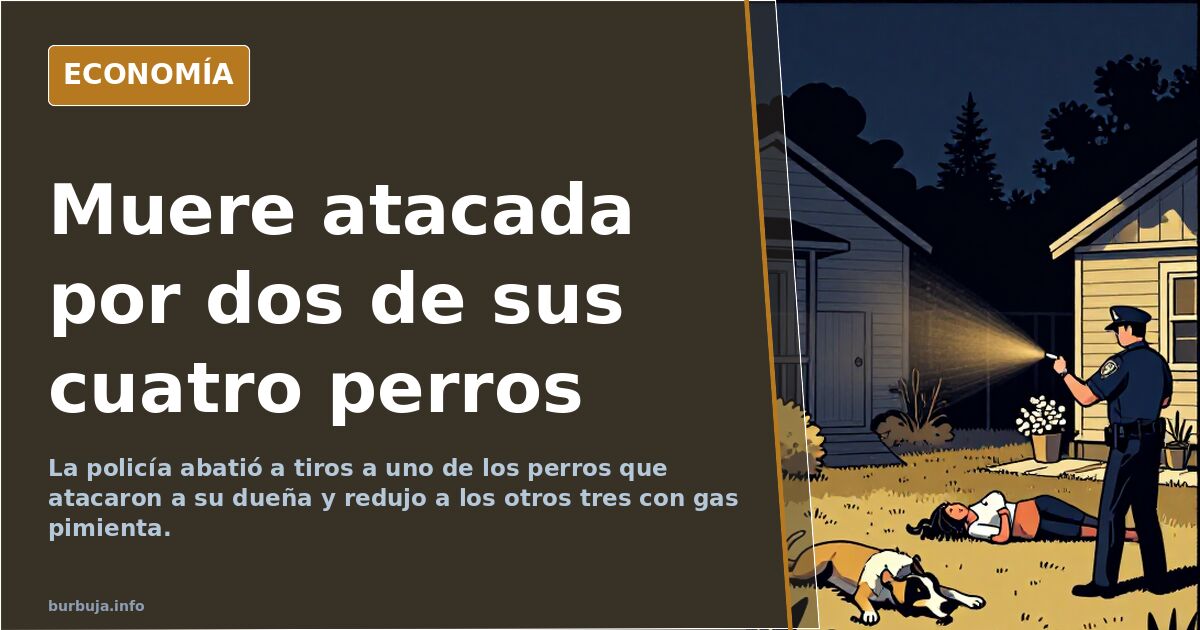
Police shot one dog and subdued three with pepper spray after they attacked owner Nicole Morey in a fatal incident.
English · Original discussion in Spanish · Published
She died after being attacked by the dangerous dogs she kept
Nicole Morey died after two of her four dogs attacked her. The animals were classified as potentially dangerous, and she lived with them daily. The scene was so violent that responding officers had to shoot one dog to release the victim; the other three were subdued with pepper spray. The question anyone reading the report asks is not rhetorical: how does someone end up killed by the animals they fed and defended in public?
What is known about the attack that killed Nicole Morey
Media outlets such as Antena 3 reported the incident. The woman lived with four dogs; two of them pounced on her and would not let go. Responding officers described that they could not pull them off her and that it was necessary to shoot one animal to free her. The other three were immobilized with pepper spray. This is not an isolated bite case: it is a death, reopening the old debate on the real margin an owner has to control an animal of this profile.
The warning she herself posted on social media
Morey shared much content and videos with her dogs, which drew criticism from users questioning her coexistence with animals classified as dangerous. Far from softening her stance, she responded firmly: she said she did not care if people disliked the appearance of her dogs or believed the breed should be banned. Months later, she lost her life after an attack by two of her four pets. The bitter irony is evident: someone who defied everyone warning her ended up confirming the warning.
Mandatory insurance and the other side of the problem
According to several users in the debate, when a breed is classified as dangerous, ownership requires specific insurance. In practice, they argue, this has pushed some owners to get rid of the animal rather than pay for it. The result would be a transfer of large dogs to shelters and pounds, where they are adopted less frequently: large dogs and those with dark coats are left behind more often. Some point out that Morey may have taken in animals no one else wanted. The paradox is uncomfortable: the rule designed to protect the public ends up concentrating the most problematic dogs in the hands of those who trust them most.
Why is pack hierarchy so heavily debated?
Part of the popular analysis argues that dogs operate by hierarchy: if the owner does not occupy the dominant position, the animal will try to take it, and in a group of four, that struggle can spiral out of control. Several users agree that treating a dog like a baby does not teach it to respect limits. The full calculation of that theory, with its role distribution within the pack, could fill a treatise.
Why did police not shoot all three dogs?
This is the question hovering over the case. The protocol applied in such interventions prioritizes subduing the animal rather than killing it, as was done here: firearms were used only when one dog maintained its grip on the victim, and pepper spray was used for the rest. According to one circulating interpretation, current regulations—which in 2024 would not contemplate automatic euthanasia for a dog that has bitten a person—pushed officers to risk their physical integrity rather than shoot without caution. The final balance: one person dead and three animals alive.
Large and small dogs: size changes the damage, not the instinct
One idea repeats among those who have owned dogs all their lives: any breed can bite if provoked, but the outcome is not comparable. One user recalls having a dog of ten kilos and admits he never brought it near small children, because even that weight is enough to injure a child. On the other side, a large dog does not stop at marking the hand. That is why the debate on potentially dangerous breeds always gets stuck in the same spot: the risk is not identical, nor is it distributed according to the size of the social alarm.
The protocol worked: three dogs were subdued and their lives saved. The only one not saved was the owner. Ironies of a system that measures risk by the dog that bites, not by who is on the other side.
Also available in: Deutsch
Summary of a discussion on Burbuja.info - Foro de economía, actualidad y política., translated from Spanish and reviewed before publication. Read the full discussion (275 replies).
More summaries
-
Cristina Pardo corners Óscar Puente on Antena 3
Cristina Pardo puts Óscar Puente on the spot on Antena 3, using corruption as a weapon and sparking talk of a changing cycle in the press and its…
-
Antena 3 doctor dodges vaccine side effect questions
When asked about COVID-19 vaccine side effects, the medical expert deflected by discussing microchips and face masks.
-
Telecinco posts worst November as advertising drops 11.9%
Telecinco records its lowest November share at 9.7% as Spanish TV advertising revenue plunges 11.9%, reflecting a sharp decline in generalist audience consumption.
-
Viral tweet attributed to Mel Gibson comes from fake account
Mel Gibson has no official X account: the viral tweet attributed to him comes from a fake account, according to his publicist.
-
Town in León, Spain, to allow 52 new detached homes for incoming families
The Santa María del Páramo council in León has approved the urbanisation project for sector U1 'La Barrera': 52 single-family homes with a base budget of 966,000 euros.
-
Pedro Sánchez: legitimacy, coalition deals and wear at Spain's helm
Pedro Sánchez marks eight years at La Moncloa without winning an election. His legitimacy, coalition deals and political wear are the focus of economic and political analysis.