
Antena 3 doctor dodges vaccine side effect questions
When asked about COVID-19 vaccine side effects, the medical expert deflected by discussing microchips and face masks.
English · Original discussion in Spanish · Published
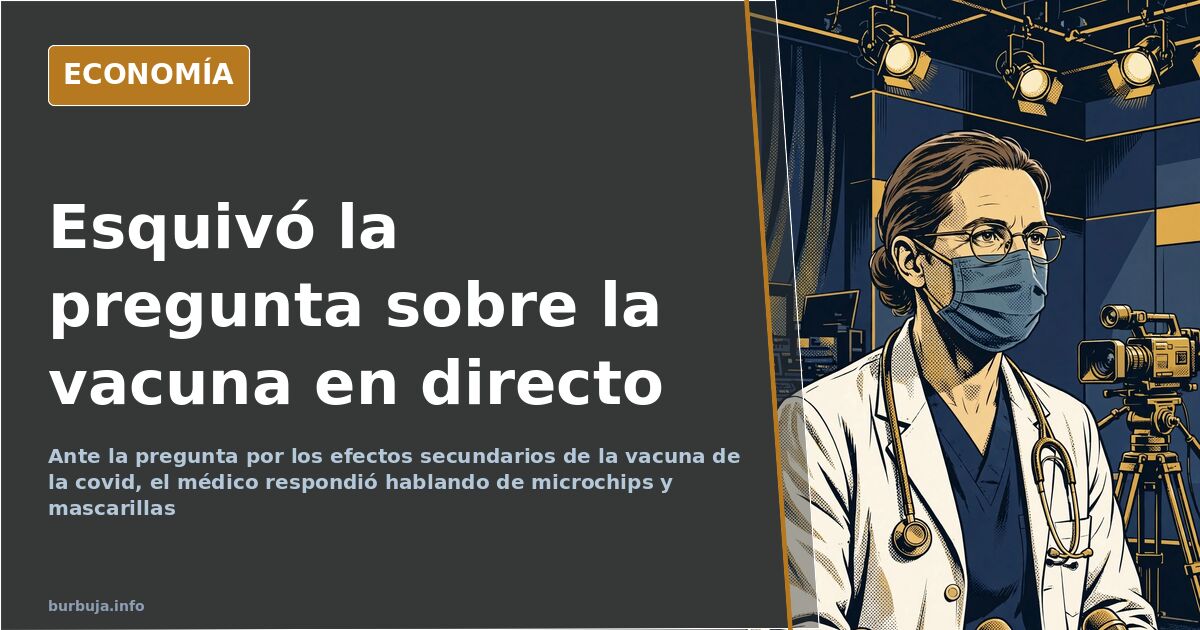
Microchips, masks, and no answer on the vaccine
How do you handle an awkward question live? By changing the subject. In an interview broadcast on Antena 3 and later shared on social media and forums, a doctor responds to questions about ELbichito-19 vaccine side effects by talking about non-existent microchips, dismissing flu vaccine effects as "insignificant," and suggesting people should wear masks again. Regarding the specific side effects he was asked about—twice—he said nothing. The key moment in the video occurs at minute 6:30.
What did the doctor say about vaccine side effects?
The first question is direct: what side effects is the vaccine causing among the population? According to the circulating clip, the response pivots to the microchip: the physician replies, "You already know that the microchip they put in us doesn't exist, right?" The journalist insists, clarifying she isn't asking about microchips but about side effects experienced by many people, after which the topic vanishes from the conversation. Next comes a comparison with the flu vaccine, whose effects the doctor labels insignificant, along with recommendations to get the flu and bronchiolitis doses too. Nothing more is said about the ELbichito-19 vaccine.
It is important to separate two issues. Alleged injected microchips are a hypothesis lacking any supporting evidence, and the doctor himself denies this on air. That is precisely the problem: time is spent on a debunked theory instead of addressing the actual question on the table—the adverse effects reportedly seen by many people.
Return to masks and the surgeon argument
In the same segment, the return to mask-wearing is defended. A second participant asks if prolonged mask use has lowered the population's natural immunity. According to the video's narrative, the response given is that a surgeon wears one for six hours a day and none have died. The detail closing the scene, always according to those sharing the clip, is another: the doctor puts on a mask and cannot stand it for even ten seconds. Not even five minutes to maintain appearances.
The contrast between the argument and the gesture is what is most repeated in comments. Those defending the measure rely on a professional comparison that does not translate to their own behavior; those questioning it cling to that detail to argue that the recommendation is not believed even by its proponent.
Immunity debt and the trickle of colds
Another line mentioned is the immunity debt: years of social distancing and mask-wearing would have weakened the population's defensive response, explaining a season with more flu cases than usual. It is even claimed that countries with higher vaccination rates recorded excess mortality. There is no data series, report, or health source in the material backing these claims: they are circulating hypotheses.
What is described is the everyday scene of Christmas holidays without official instructions to limit contacts, with family gatherings attended by people recovering from colds, sniffles, and positive tests. Two years prior, those trinc the issue recall, television hammered home the need to prevent such meetings and pointed fingers at those who didn't vaccinate. The change in tone, more than the data, fuels distrust.
Pandemic law and May date in European Parliament
The backdrop is regulatory. The material points to the approval of the pandemic law (ley de pandemias) scheduled for May in the European Parliament, interpreting it as preparation for another health dictatorship under the argument that everything before will be forgotten by then. This is an expectation regarding an announced calendar, not a completed fact: at the time of discussion, the regulation was still pending, and no approved text allowed confirmation of the outcome.
Here the material is more political fiction than analysis. The underlying suspicion is that the same actors who managed the previous emergency are preparing the next one, and that the public will swallow it again. There is no way to verify this with what is on the table.
About the doctor and circulating accusations
The physician appearing in the video is identified in the thread as Jesús Sánchez Martos. Along with his name, reproaches circulate regarding his ties to commercial interests, accompanied by links to archived documentation. These are accusations launched in the public sphere that have not been judicially proven nor confirmed by any authority, so they are reported as what they are: reproaches, not proven facts. What is verifiable in the clip is simpler: the two times he is asked about adverse effects and the two times the response goes elsewhere.
What is claimed about side effects and what is unproven
The material provides no clinical data on the vaccine's adverse effects. What exists are personal experiences and conflicting accounts: those who got vaccinated and had a few days of fever and congestion, those who got vaccinated and noticed nothing, and those who didn't vaccinate and claim they haven't been ill. Anecdotes do not answer a pharmacovigilance question, and none substitute for an adverse reaction registry. For any doubts about a vaccine or symptoms, the final word belongs to a healthcare professional with the clinical history in front of them.
Ultimately, the episode says less about vaccines than about how one answers when one does not want to answer. That the microchip doesn't exist was already known by everyone. The question was different. And at minute 6:30, it remains unanswered.
How do you handle an awkward question live? By changing the subject. In an interview broadcast on Antena 3 and later shared on social media and forums, a doctor responds to questions about ELbichito-19 vaccine side effects by talking about non-existent microchips, dismissing flu vaccine effects as "insignificant," and suggesting people should wear masks again. Regarding the specific side effects he was asked about—twice—he said nothing. The key moment in the video occurs at minute 6:30.
What did the doctor say about vaccine side effects?
The first question is direct: what side effects is the vaccine causing among the population? According to the circulating clip, the response pivots to the microchip: the physician replies, "You already know that the microchip they put in us doesn't exist, right?" The journalist insists, clarifying she isn't asking about microchips but about side effects experienced by many people, after which the topic vanishes from the conversation. Next comes a comparison with the flu vaccine, whose effects the doctor labels insignificant, along with recommendations to get the flu and bronchiolitis doses too. Nothing more is said about the ELbichito-19 vaccine.
It is important to separate two issues. Alleged injected microchips are a hypothesis lacking any supporting evidence, and the doctor himself denies this on air. That is precisely the problem: time is spent on a debunked theory instead of addressing the actual question on the table—the adverse effects reportedly seen by many people.
Return to masks and the surgeon argument
In the same segment, the return to mask-wearing is defended. A second participant asks if prolonged mask use has lowered the population's natural immunity. According to the video's narrative, the response given is that a surgeon wears one for six hours a day and none have died. The detail closing the scene, always according to those sharing the clip, is another: the doctor puts on a mask and cannot stand it for even ten seconds. Not even five minutes to maintain appearances.
The contrast between the argument and the gesture is what is most repeated in comments. Those defending the measure rely on a professional comparison that does not translate to their own behavior; those questioning it cling to that detail to argue that the recommendation is not believed even by its proponent.
Immunity debt and the trickle of colds
Another line mentioned is the immunity debt: years of social distancing and mask-wearing would have weakened the population's defensive response, explaining a season with more flu cases than usual. It is even claimed that countries with higher vaccination rates recorded excess mortality. There is no data series, report, or health source in the material backing these claims: they are circulating hypotheses.
What is described is the everyday scene of Christmas holidays without official instructions to limit contacts, with family gatherings attended by people recovering from colds, sniffles, and positive tests. Two years prior, those trinc the issue recall, television hammered home the need to prevent such meetings and pointed fingers at those who didn't vaccinate. The change in tone, more than the data, fuels distrust.
Pandemic law and May date in European Parliament
The backdrop is regulatory. The material points to the approval of the pandemic law (ley de pandemias) scheduled for May in the European Parliament, interpreting it as preparation for another health dictatorship under the argument that everything before will be forgotten by then. This is an expectation regarding an announced calendar, not a completed fact: at the time of discussion, the regulation was still pending, and no approved text allowed confirmation of the outcome.
Here the material is more political fiction than analysis. The underlying suspicion is that the same actors who managed the previous emergency are preparing the next one, and that the public will swallow it again. There is no way to verify this with what is on the table.
About the doctor and circulating accusations
The physician appearing in the video is identified in the thread as Jesús Sánchez Martos. Along with his name, reproaches circulate regarding his ties to commercial interests, accompanied by links to archived documentation. These are accusations launched in the public sphere that have not been judicially proven nor confirmed by any authority, so they are reported as what they are: reproaches, not proven facts. What is verifiable in the clip is simpler: the two times he is asked about adverse effects and the two times the response goes elsewhere.
What is claimed about side effects and what is unproven
The material provides no clinical data on the vaccine's adverse effects. What exists are personal experiences and conflicting accounts: those who got vaccinated and had a few days of fever and congestion, those who got vaccinated and noticed nothing, and those who didn't vaccinate and claim they haven't been ill. Anecdotes do not answer a pharmacovigilance question, and none substitute for an adverse reaction registry. For any doubts about a vaccine or symptoms, the final word belongs to a healthcare professional with the clinical history in front of them.
Ultimately, the episode says less about vaccines than about how one answers when one does not want to answer. That the microchip doesn't exist was already known by everyone. The question was different. And at minute 6:30, it remains unanswered.
Summary of a discussion on Burbuja.info - Foro de economía, actualidad y política., translated from Spanish and reviewed before publication. Read the full discussion (176 replies).
More summaries
-
EU officials warn Spain: Amnesty law and judicial independence under scrutiny
A Portuguese voice in the EU questions Spain’s rule of law, CGPJ deadlock, and judicial independence, sparking debate on the amnesty law and separation of powers.
-
Having children: the luxury Spain's middle class can no longer afford
Dual incomes doubled housing costs and sank the birth rate. Children have become a luxury the middle class cannot afford.
-
Forum user claims turning zero into €2m in ten years
A forum user claims building a €2m net worth in ten years via passive income. Inheritance and lack of breakdown cast doubt on the method.
-
Forum Debate: Men’s Indifference to Female Harassment
A 172-reply forum thread explores male reactions to harassment, revealing widespread indifference and debates on voting and legal bias.
-
Spanish mother disinherits son after 15 years of silence
Paqui disinherits her estranged son. A Red Cross study shows 27% of elderly Spaniards rarely receive family visits.
-
Spain-Mauritania Migration Pact: 250,000 Annual Arrivals Under Scrutiny
Reported Spain-Mauritania deal allows 250,000 annual arrivals. INE data shows 8.8 million foreign-born residents. No parliamentary debate held.