
Pedro Sánchez: legitimacy, coalition deals and wear at Spain's helm
Pedro Sánchez marks eight years at La Moncloa without winning an election. His legitimacy, coalition deals and political wear are the focus of economic and political analysis.
English · Original discussion in Spanish · Published
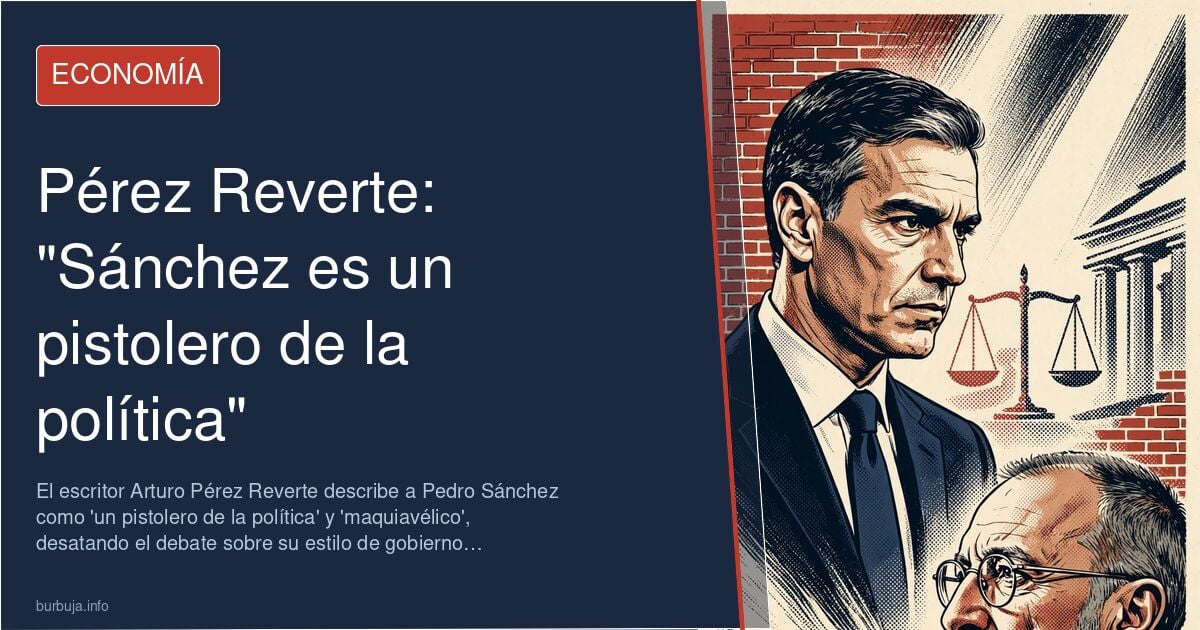
Pedro Sánchez: eight years of coalition deals and political wear at La Moncloa
How has Pedro Sánchez managed to stay eight years as Spain's Prime Minister without winning an election? The question, which hovers over every press appearance and every parliamentary agreement, has an uncomfortable answer for friend and foe alike: the arithmetic of coalition deals. Since 2018, when a no-confidence motion brought him to power after the PP left office amid what he calls systemic corruption, Sánchez has chained together investitures and legislatures supported by parties ranging from Unidas Podemos to ERC, Bildu or Junts. His critics speak of a mandate built on concessions; his defenders, of an unprecedented capacity for political endurance.
The wear is evident. Doubt about the democratic legitimacy of his election has taken hold in public debate, a questioning that goes beyond partisan noise and reaches sectors that do not identify with the right. The claim that "systemic corruption ended with the PP leaving government in 2018" was met with skepticism, given his own party's judicial record. And the image of Sánchez laughing at Feijóo's statement —"I'm not prime minister because I don't want to be"— became a double-edged sword: for some, proof of his institutional contempt; for others, confirmation that the Popular Party leader has no alternative project.
Sánchez's style: endurance and disregard for the noise
Sánchez is credited with all the attributes of a Machiavellian character: miccionan, cocky, ambitious, arrogant, cynical. The quote, circulating in media and social networks, sums up the image that has been built around his figure. But there is a less epic reading: that of a politician who withstands pressure and doesn't need to be liked by everyone to keep moving forward. That is perhaps his greatest virtue and his greatest flaw. In a system where popularity is measured in polls, Sánchez has shown that you can govern without being the favorite.
The opposition, meanwhile, has yet to find its narrative. The 2018 no-confidence motion, the 2019 repeat elections, the investiture with ERC and Bildu, the pardons, the labor reform, the European funds, the "only yes means yes" law and its later correction: every milestone has been a battleground. And in each one, Sánchez has survived. Not without cost. Corruption in his party, the kickback cases and judicial investigations have fueled distrust. But the story of the "law of silence" —a title used to describe his management— has not been enough to dislodge him.
Why is his democratic legitimacy questioned?
Because his investiture was not born of a clear electoral victory, but of a sum of parliamentary supports. In 2018 he came to power through a no-confidence motion against Mariano Rajoy, trinc the Gürtel case verdict. In 2019, after two general elections, he was invested with the support of Unidas Podemos and ERC's abstention. In 2023, he repeated with the backing of Junts, ERC, Bildu, PNV and others, in exchange for concessions such as the amnesty. For his critics, this is a "Frankenstein government"; for his defenders, the essence of parliamentarism. The debate is not new, but it has intensified with every agreement.
The question hovering is whether a prime minister can govern without winning. The technical answer is yes: the Spanish system allows investitures by simple majority. The political answer is more complex. Every deal with independence supporters or with the radical left has eroded the trust of part of the electorate. And every time Sánchez laughs off criticism, as in the Cadena SER video, he feeds the feeling that he does not take his opponents seriously. That mix of arrogance and endurance is what makes him, according to his detractors, dangerous; according to his allies, invincible.
The economy as a battleground
On the economic front, the data are inconclusive. Job creation has been positive in recent years, but job quality and inflation have hit purchasing power. European funds have injected liquidity, but their implementation has been slow. Public debt remains above 100% of GDP. And the tax burden has increased. For critics, Sánchez has turned Spain into a less competitive country; for his defenders, he has protected the welfare state. The discussion about the systemic corruption he himself invoked to dislodge the PP becomes uncomfortable when the cases implicating his own party are recalled.
The wear on the presidential figure
Sánchez's image has deteriorated among moderate sectors. Phrases like "he's an actor" or "he's a reptilian" are exaggerations of the noise, but they reflect a perception: that of a politician who calculates every gesture. The reality is more prosaic. Sánchez has built a leadership based on endurance, on the ability to take hits and keep going. He has survived a no-confidence motion, two elections, a pandemic, a war in Europe and an energy crisis. But every victory has left wounds. And the question of whether he was democratically elected is still there, more as a weapon than as a genuine doubt.
In the end, the answer to who Pedro Sánchez is cannot fit in a headline. He is the prime minister who arrived without winning, who has governed through deals and who has turned survival into his main asset. Whether that is merit or demerit depends on the lens you look through. What is beyond doubt is that his figure has polarized Spanish politics like few others. And that, despite everything, he remains at La Moncloa. Eight years on, the question remains unanswered: is he a master of politics or an accident of history?
Summary of a discussion on Burbuja.info - Foro de economía, actualidad y política., translated from Spanish and reviewed before publication. Read the full discussion (70 replies).
More summaries
-
King proposes Feijóo: 172 votes vs 159
The King proposes Alberto Núñez Feijóo with 172 votes against Pedro Sánchez's 159. ERC, Junts and Bildu skipped the consultation round.
-
Sánchez's Speech: Pending Moncloa Announcements
Analysis of Pedro Sánchez's announced press conference. The atmosphere is filled with deep skepticism regarding pending economic and political announcements.
-
Sánchez Resignation Rumors Spark Debate on Spanish Government Succession
Analysis of Pedro Sánchez’s potential resignation and the political implications for Spain’s leadership.
-
La Vanguardia fires columnist over article accusing PSOE of seeking civil conflict
La Vanguardia suspends Lacasta for criticising the PSOE's drift. A reflection on the limits of journalism.
-
Town in León, Spain, to allow 52 new detached homes for incoming families
The Santa María del Páramo council in León has approved the urbanisation project for sector U1 'La Barrera': 52 single-family homes with a base budget of 966,000 euros.
-
Cáceres council in Spain allegedly paid taxis to send vulnerable people to Catalonia
RAC1 reports that a town council in the province of Cáceres paid for taxis to take people facing social exclusion to Mataró. The case opens a debate over who bears the social cost.