
Two governments blamed for handling the DANA in Valencia
Protests over the DANA response in Valencia reignite the power struggle between the Spanish state and the Generalitat regarding alerts and the nearly 300 deaths.
English · Original discussion in Spanish · Published
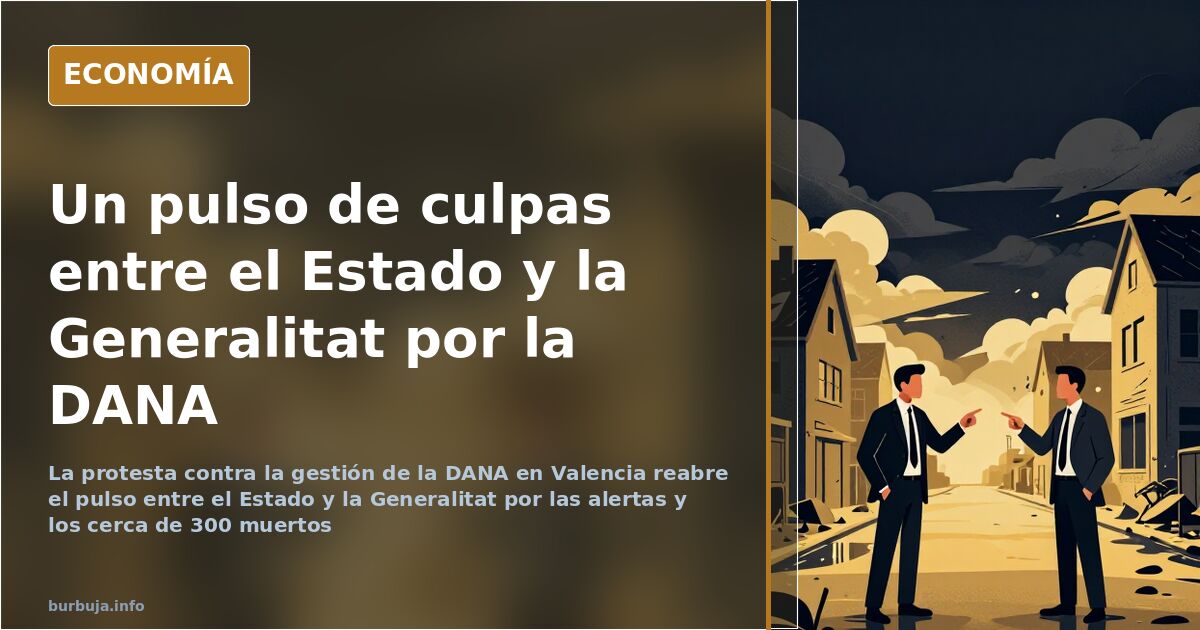
Mazón, Sánchez and 300 dead: the DANA narrative shifts ownership
A massive protest against an autonomous president ended, in the most circulated version, reinforcing the central Government. That is the crux. The initial figures are blunt: around 300 dead, according to the figure repeated in the debate, and a chain of warnings that arrived too late. The email from the Júcar Hydrographic Confederation was sent, according to one circulating account, at 18:43, with the Poyo ravine already overflowing. At 18:00, another participant claims, the Valencian president was leaving a restaurant. This contrast sparked the protest and the blame game.
Who holds the powers for alerts and civil protection?
Warnings, alerts, and civil protection are the responsibility of the autonomous communities. This is the most repeated point, supporting the argument that the Generalitat should have sounded the alarm without waiting for anyone. The paradox, from this position, is that for decades, decentralization was sold as a way to bring administration closer to citizens and increase efficiency. Now, this same architecture shares responsibility among several administrations, and no one signs the warning.
The other side of the balance does not dispute the competence, but the omission. The AEMET and the Júcar Hydrographic Confederation are state bodies, dependent on the Ministry for Ecological Transition led by Teresa Ribera. Interior and Transport also had powers over mobilizable resources in a catastrophe. If the flow spikes, someone with the data had to shout it. And they didn't.
The flow no one translated into a mass alert
The Poyo ravine moved, according to this account, a flow equivalent to five times that of the Ebro river. The Confederation detected it, according to this account, in two and a half hours and resolved it with an email sent when water had already entered homes. Translating that data into a telephony alert was not the task of a duty technician at 6:30 PM, but no one did it for him. From this comes the most uncomfortable accusation: the chain of command functioned as an administrative formality.
Parallel to this circulates an unverified figure repeated as if it were true: that the Confederation contracted a civil liability insurance for negligence one month before the flood. Without a document, this is a suspicion. With a document, it would be something else. And in this matter, with hundreds of dead, the difference between suspicion and proof is everything.
From Letur to Chiva: the same pattern with different culprits
In Letur, in Castilla-La Mancha, seven people died, according to one message in the thread. An autonomous community governed by the PSOE, a socialist mayor, neither a mass alert system nor subsequent protests. This contrast is used as proof that reproach is not shared equally depending on the tonalidad of the failing government. This is the most repeated argument to explain why indignation focused on a single proper name.
What the street shouted and what the media reported
The headline banners pointed to both administrations, according to those present, and the chants did too. The media, they say, erased the Prime Minister's name and kept the most profitable part of the narrative. Theories of infiltrators and shadow organization have been built on this basis, unsupported by evidence: they rest on suspicion, not documents.
There is also a thesis that goes beyond acronyms and runs through the entire affair: that the main problem lies not with Ferraz or the PP headquarters, but with a part of the electorate that votes against its own interests. Comfortable to state, impossible to prove. But it explains why a disaster with hundreds of victims has become a ratings battle.
Katrina, Franco, and the infrastructure question
The parallel with Hurricane Katrina has been cited: Louisiana was Democratic, and the federal government was slow to move the National Guard. It is a useful mirror to remember that the political tonalidad of the territory does not always determine who arrives first.
And then there is the uncomfortable thesis: a flood is not stopped by warning earlier, but by infrastructure, and no one has done that since Franco. Debatable as a diagnosis, but it points to a hydraulic investment gap that no government wants to look at directly because it would imply decades of spending.
Why was no national emergency alert declared earlier?
The circulating argument is legal: those demanding immediate and universal states of alarm today were those who took the Government to court for declaring a state of alarm during the pandemic. With that precedent, legal services review every detail before signing, and while they review, the emergency runs. Cynical or prudent, depending on how you see it.
The dislocating fact remains: the harshest protest against the Valencian PP has served for half of Spain to debate whether the real problem is Sánchez. If that narrative holds, someone has won without moving a paper. Who?
Also available in: Deutsch
Summary of a discussion on Burbuja.info - Foro de economía, actualidad y política., translated from Spanish and reviewed before publication. Read the full discussion (231 replies).
More summaries
-
Spain's Shadow Technocrat: Carlos Cuerpo's Presidential Succession Debate
Analysis of Economy Minister Carlos Cuerpo's profile and the polarizing debate regarding his potential presidential succession in Spain.
-
Spain's Immigration Quota Debate Sparked by Sánchez Family History
Analysis of Pedro Sánchez's grandfather's migration story, highlighting chronological inconsistencies and debates on immigration policy.
-
Montse Mínguez's 7,000 m² luxury villa linked to a fund
Montse Mínguez shares a luxury villa on a 7,000 m² plot with her partner, with ownership attributed to the Nest Life fund, according to El Español.
-
France floats immigration ban: widespread skepticism greets the plan
France proposes banning immigration in a historic U-turn, but skepticism prevails: Italy, Germany and the UK already tried without success. Mélenchon and Bardella loom over the debate.
-
Valley of the Fallen works: legal or not?
The works at the Valley of the Fallen in Spain are dividing opinion: some call them illegal; others say they are legal thanks to a document signed by Bolaños and Cardinal Cobo. An analysis.
-
Deported for killing a cat: justice that isn't equal for all
A man sentenced to deportation for killing a cat in Torrevieja, Spain, reignites the debate over disproportionate penalties and unequal protection of life.