
Montse Mínguez's 7,000 m² luxury villa linked to a fund
Montse Mínguez shares a luxury villa on a 7,000 m² plot with her partner, with ownership attributed to the Nest Life fund, according to El Español.
English · Original discussion in Spanish · Published
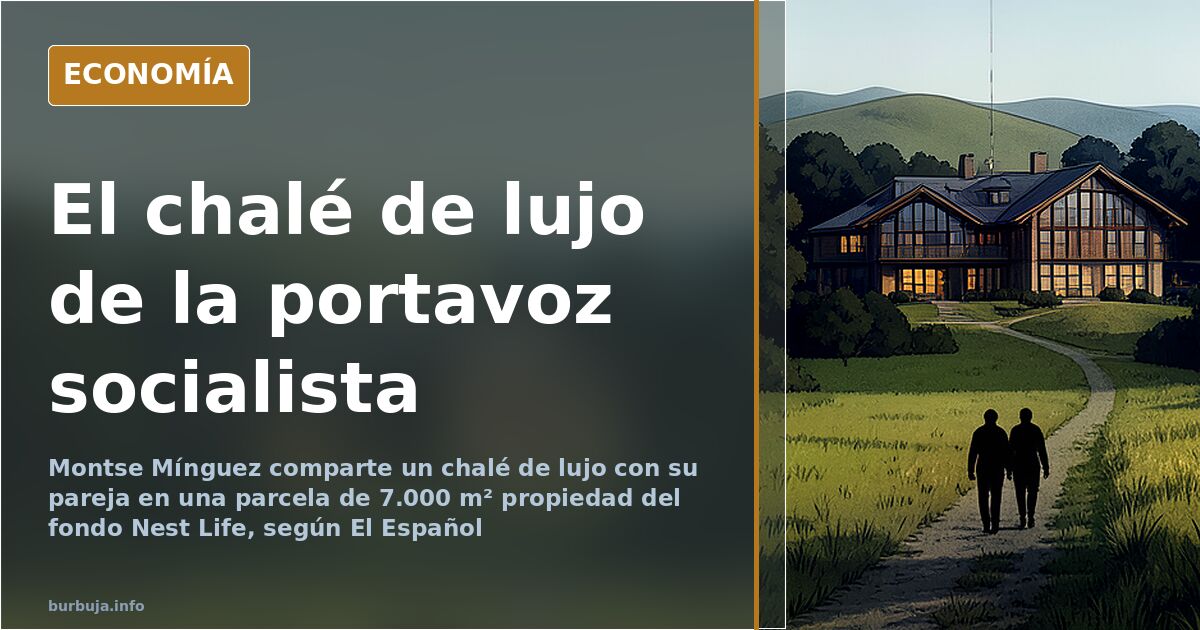
Montse Mínguez's 7,000 m² villa linked to her fund
A 7,000-square-metre plot. A luxury villa. And a company, Nest Life, listed as the owner of the property while its user is an MP who makes social housing her banner. The publication of that combination has been enough to reopen an uncomfortable question: can someone defend access to housing while living on an estate most people could not even afford to rent?
The story, reported by El Español based on an investigation by Jorge Calabrés and David Vicente, places **Montse Mínguez** sharing a property with her partner whose owner is not her, but the fund **Nest Life**. That structure — the property in the hands of a company, the politician as its user — is what has drawn the criticism in the debate.
What is known about the villa and the Nest Life fund
The published figures point to a **7,000-square-metre** plot and a luxury villa. Ownership appears to be linked to Nest Life, the fund that manages the assets. In the debate, some argue the home is held through a company for tax reasons, though no one has confirmed it.
The comparison circulating is hard to avoid. A 7,000-square-metre plot exceeds the size of many entire residential developments. And it is not a holiday home: it is the address where the couple lives.
The contradiction between rhetoric and wealth
The core of the unease is not wealth itself, but the contrast. Someone calling for affordable housing for the whole population turns out to live on an estate that, in price and size, is out of reach of almost any salaried worker. The most repeated quip on the thread: being a socialist means owning a lot and declaring little.
Some argue the problem is not personal but structural: housing policy is designed from positions that do not share the problem it claims to solve. Against that weighs the argument that private life does not invalidate a public programme. The clash, however, is not resolved by that nuance.
The corporate structure: why the owner matters
The detail that has generated the most ink is the ownership. If the villa belongs to a fund rather than a person, the rules change: the property can be part of a wealth structure with different tax treatment from personal ownership. That is the suspicion that has spread, without any public confirmation of the specific terms.
The comparison with the average citizen is immediate. Any self-employed person with a company knows what it costs to maintain and what the tax office watches. The perception that there are two speeds — one for the ordinary taxpayer and another for those with access to corporate structures — is what turns this into more than an anecdote.
The context: housing as a battleground
The story lands at a time when housing is the main front of attrition for the official narrative. Rental prices and the difficulty of access have turned the issue into the weakest flank of any left-leaning government. A luxury villa on a 7,000-square-metre plot is not an expensive mortgage: it is another category.
Housing policy thus faces its own paradox: those who design it do not need it. And that, in a climate of growing disaffection, weighs more than any technical argument.
The jarring detail is not the villa. It is that no one has considered it urgent to explain why the ownership lies with a fund and not with the person living inside.
Also available in: Deutsch
Summary of a discussion on Burbuja.info - Foro de economía, actualidad y política., translated from Spanish and reviewed before publication. Read the full discussion (139 replies).
More summaries
-
Spanish Socialist Spokesperson's Partner: 30 Homes, Panama Firms, Tax Evasion
Montse Mínguez’s partner owns 30 properties and two Panama-based companies while evading taxes for five years, according to recent reports.
-
Far-left activists escorted by police after stone-throwing in Ceuta
Far-left group arrives in Spanish enclave Ceuta to protest refugee treatment, facing hostile reception and requiring police escort.
-
GEODIS orders 110 electric trucks, aiming for 190 by 2027
GEODIS is buying 110 electric trucks of 44 tonnes for delivery by 2027. Its electric fleet will reach 190 vehicles, with charging points every 250 to 500 km.
-
Robles refuses to applaud Sánchez: the gesture that ignites Spain's internal war
Margarita Robles stays seated while everyone else applauds Sánchez. The gesture reopens the internal war in Spain's PSOE and the Ceuta crisis.
-
Arrests at Bilbao's festival week spark street-level debate in Spain
Arrests during Bilbao's festival week have reignited the debate over security and immigration in Spain. An analysis of the economic and social impact.
-
Four votes and a paradox: how Spain's government survives
Spain's government holds on despite discontent: four votes, a lack of leadership and fear of legal reprisals would explain the paralysis.