
Two centuries of capitalism: success or failure?
Capitalism has cut extreme poverty over two centuries, but the stagnation since 2020 reopens the debate about its effectiveness.
English · Original discussion in Spanish · Published
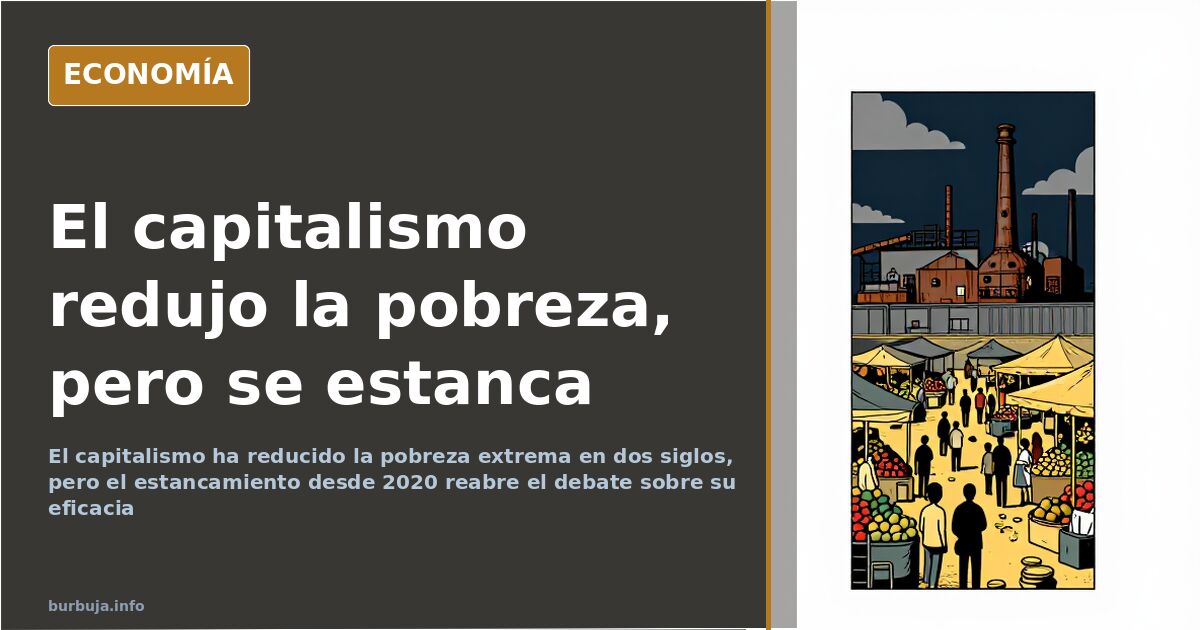
Capitalism reduced poverty, but stagnation raises doubts
Does capitalism work? The question has been open for two centuries, but recent data have put it back on the table. Before the market economy, more than 90% of the world's population lived in extreme poverty. Today, with a population seven times larger, that percentage has been reversed. However, since 2020 poverty reduction has stalled, and the World Bank expects it to stay that way.
The data dividing economists
Defenders of the system point out that the market economy has lifted billions out of misery. China, with its mix of capitalism and state control, is the most cited example. But critics are not short of arguments: they talk about inequality, global crises, and exploitation in countries like Haiti or Mozambique. One analysis notes that capitalism requires physical and legal security, which many countries lack. Others argue that continuous growth is unsustainable, like someone trying to save 10% more each month until they simply cannot anymore.
Meanwhile, the world remains in crisis, with the ten largest economies in the red. Maybe capitalism does not work, but there does not seem to be a plan B that works better either. Or so say those who refuse to look at the data.
Also available in: Deutsch
Summary of a discussion on Burbuja.info - Foro de economía, actualidad y política., translated from Spanish and reviewed before publication. Read the full discussion (16 replies).
More summaries
-
[The show has begun] Russia launches massive deployment of digital ruble CBDC through major banks and retailers
Russia implements the digital ruble on a large scale with banks and businesses. Discover how it works and its impact on payments.
-
What an AI says a war with Morocco would cost Spain
The AI claims Spain would gain territory and Western Sahara would become an ally. The real cost: millions of refugees and the closure of the Schengen area.
-
Macron to address France after riots as Paris imposes curfew
Macron addresses France after days of riots as Paris imposes a curfew from 23:00 to 06:00 and bans demonstrations in sensitive areas.
-
The cost of Basque and Catalan in Spain's schools: figures and controversy
The Basque Country spends the most per pupil in Spain yet posts some of the lowest PISA results. Language immersion in co-official languages is under debate.
-
Madrid court halts works at Valle de los Caídos over missing permit
Spain's High Court of Justice in Madrid has suspended government surveys at the Valle de los Caídos for lacking a municipal permit, a ruling that protects the heritage-listed site.
-
PSOE corruption: is Spain's worst government since democracy here?
Is Spain's PSOE the most corrupt government? The debate pits those pointing to its scandals against those recalling the PP's cases. 26.3% still back Sánchez.