
Macron to address France after riots as Paris imposes curfew
Macron addresses France after days of riots as Paris imposes a curfew from 23:00 to 06:00 and bans demonstrations in sensitive areas.
English · Original discussion in Spanish · Published
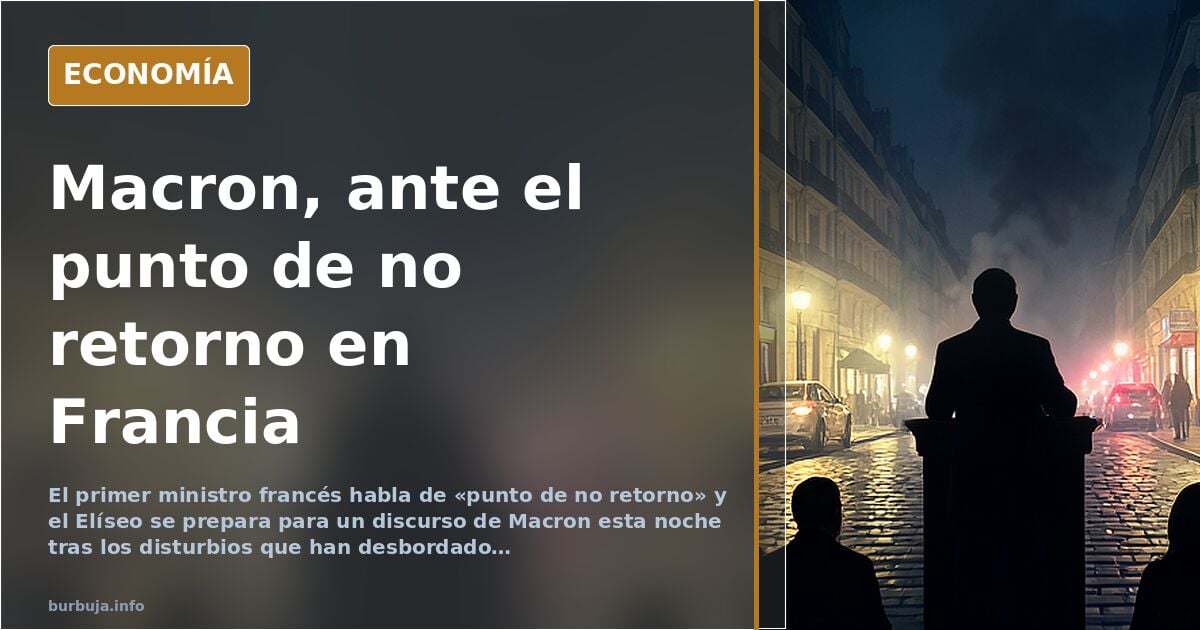
Macron to address France with Paris under curfew
The Paris Police Prefecture ordered a night-time curfew — from 23:00 to 06:00 — in areas such as Place de la République and the surroundings of Les Halles, alongside a ban on demonstrations in sensitive areas, after a day of riots and looting. President Emmanuel Macron addresses the nation tonight. And the phrase hanging over the whole affair, attributed to his prime minister, is that the point of no return has been passed.
The detail that sums up the tension is not a figure for injuries or arrests: it is an image. An elderly couple in their eighties stripped of their belongings in the middle of the street, left almost without clothes, according to the description circulating alongside the photograph. With that, the public order narrative breaks in half.
What peine in Paris and why people talk of a point of no return
The riots have left scenes of looting in luxury shops and clashes with the police. The official response comes in the form of movement restrictions and a ban on gatherings until Tuesday, a measure which, read coldly, admits that the streets are not under ordinary control.
The expression point of no return has taken hold as the frame of the debate. Some read it as a warning from the government itself about the depth of the crisis; others see it as a way of preparing the country for harsher measures. What appears nowhere is an official figure to back up the scale of the phenomenon.
The tug-of-war between public order and the security narrative
Part of the analysis holds that the police are overwhelmed and that only Army intervention could restore order. Against that, the opposite argument: militarising the streets of a European democracy is the fastest way to turn a public order problem into an institutional crisis.
Between the two extremes circulates an intermediate thesis: that governments first create the chaos and then justify control measures. There is no evidence whatsoever to support that sequence, and it should be said plainly: it is a hypothesis, not a fact.
The economic cost of a week of looting
Beyond the immediate damage, the economic debate points to two fronts. The first is the affected shops and insurance premiums. The second is confidence: a capital that imposes curfews enters the political risk watchlist of any investor.
Added to this is the criticism of fiscal policy. The argument goes that unrestrained money printing and the subsequent inflation were a predictable outcome, and that the room to print more is running out. That is the reading that connects the riots to people's wallets, and the one with the most traction in an economics forum.
Who is behind it: the fight over the authorship of the riots
The discussion about responsibility splits in two. One camp points to accounts based abroad that allegedly spread out-of-context videos to inflame the narrative, with posts reaching millions of views. Another camp points to the radical left and organised groups on the streets.
Neither attribution is proven in the material available. What is a fact is the fight over the frame: whoever manages to impose their explanation of the riots wins the next election.
The comparison with Spain hanging over the debate
The shadow of Spain appears again and again. The claim is made that the same recipe — more social spending, more arrivals and less control — would lead to equivalent episodes, and the case of the encampments and gatherings in public spaces is cited as a precedent.
The counterargument is that France has a different integration model and a police force operating under different rules. Comparing without adjusting for those variables is cheating. Even so, the comparison is used as a warning, not a forecast.
The question no one answers with data remains: is tonight's curfew the end of the episode or the first chapter of something longer. Macron speaks tonight. France listens. And the point of no return, if it exists, will not be certified by a speech.
Also available in: Deutsch
Summary of a discussion on Burbuja.info - Foro de economía, actualidad y política., translated from Spanish and reviewed before publication. Read the full discussion (372 replies).
More summaries
-
Free fried chicken in Paris sparks riot and police intervention
A Paris fast-food restaurant's free chicken launch caused a stampede, requiring riot police to intervene according to viral video.
-
French Police Raid X Headquarters, Summon Musk
French police raided X's Paris offices and summoned Elon Musk for questioning. The move coincides with Spanish PM Sánchez announcing new social media regulations.
-
Spain's minimum income benefit to rise 14% in 2027, tied to non-contributory pensions
Spain's IMV minimum income will rise almost 14% in 2027 due to its legal link to non-contributory pensions: from 733.60 to 836 euros per month for a single person.
-
France: man thrown to the ground while breaking up a school fight
A video of an adult being thrown while separating a fight at a French school sparks debate. One participant cites Le Pen's vote at 3% (2006) and 20% (2023).
-
Electric cars hit 52.8% of new registrations in the Netherlands
Electric cars accounted for 52.8% of new registrations in the Netherlands in September, with Tesla second. In Spain, nearly 18,000 public chargers remain out of service.
-
Spain's Verifactu invoicing system delayed to October 2028 in fourth postponement
Spain's Verifactu system, which will force freelancers to send every invoice to the tax authorities in real time, is delayed to October 2028 in its fourth postponement. The software…