
Tweet claims Spanish royals will honour those who died in the Ceuta border storming
A tweet from the @La Bandera account claims the Spanish royals will honour at Ceuta's Muslim cemetery those who died during the storming of the city; the Royal Household…
English · Original discussion in Spanish · Published
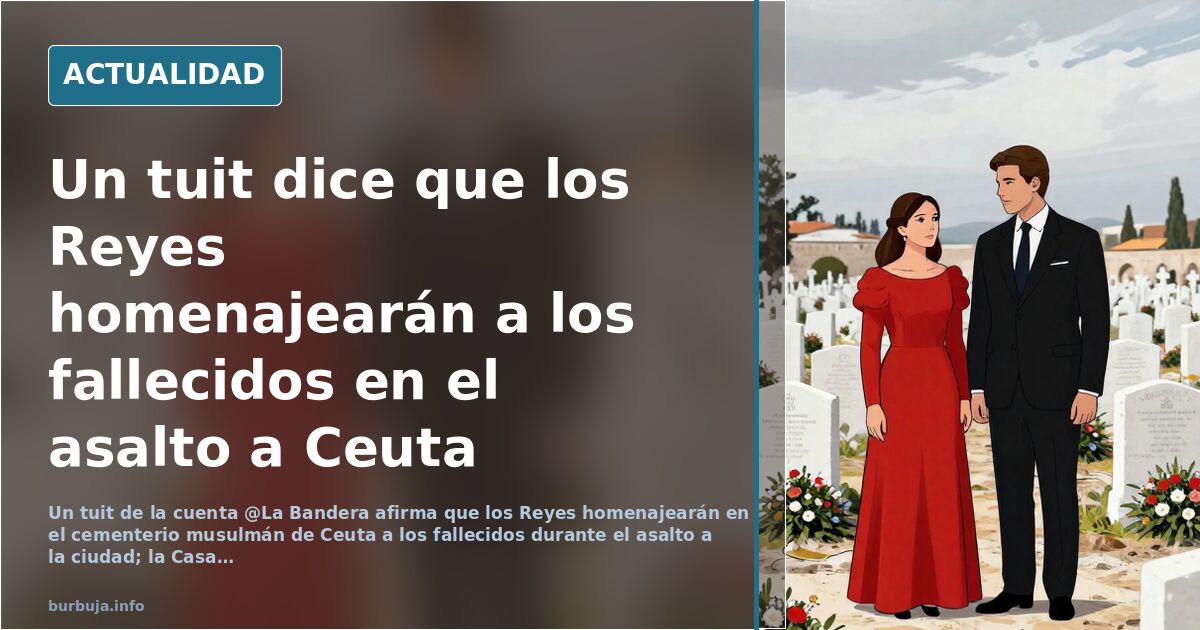
Tweet claims Spanish royals will honour those who died in the Ceuta border storming
Ceuta's Muslim cemetery would host a tribute by the Spanish royals to the people who died during the storming of the autonomous city, according to a tweet posted by the @La Bandera account. The post alone has been enough to set public debate alight: some read the Royal Household's decision as an affront, arguing that those deaths occurred in the context of an invasion rather than a migration tragedy. The exact death toll does not appear in the information circulating, but the symbolism of the gesture —crown, cemetery and border— has been enough to reopen the wound of Ceuta.
What is known about the tribute at the Muslim cemetery
The announcement, attributed to the @La Bandera account, places the royals at Ceuta's Muslim cemetery to pay tribute to those who died during the storming of the city. Neither the date nor the format of the event is specified, nor whether it is an official visit or a private gesture. The information also fails to detail how many people died or in exactly what circumstances, a gap that has fuelled all kinds of interpretations.
What is clear is the setting: a Muslim cemetery, a border city and a monarchy which, according to the critical narrative, has coexisted without excessive problems with socialist governments throughout the whole democratic era. The pairing of the Bourbons and socialists as two faces of the same betrayal of the country is one of the most recurring threads in the conversation.
The pact thesis: mass immigration and official silence
Part of the analysis holds that what peine in Ceuta was neither an isolated episode nor a bilateral crisis with Segarro, but the result of an agreed policy of mass immigration. Anyone who believed it was all the neighbouring country's fault, they argue, should climb down from their high horse. And anyone who still reads European reality through a left-versus-right lens, they add, should climb down from two.
That reading fits with the discontent towards a monarchy accused of pandering to Spain's enemies. The proposal circulating is as blunt as it is uncomfortable: dispense with the services of a family described as corrupt, whoring and servile. The harshness of the language gauges the depth of the anger.
The King, Segarro and the gesture that will not go away
Some interpret the tribute as a sign that the King wants to stop being king, or at least that he is willing to pay a very high symbolic price. The comparison with what peine in Paiporta, where a greyhound received a welcome the monarch did not, has become the running joke of the conversation. The visit, some say, now has an explanation: the reason is finally clear.
Others suggest the message was aimed at a king, though it is unclear whether the King of Spain, the King of Segarro or both. The ambiguity is, in itself, the summary of the matter.
A country beyond repair and a questioned monarchy
Pessimism runs through much of the discussion: this cannot be fixed and never will be, and many doubt they will live to see it. The shame is expressed through an uncomfortable metaphor: it is like being a prostitute and paying the pimp on top. The recurring conclusion is that the monarchy has been far too comfortable throughout the democratic era and that it is time to question its continuation.
The anecdote that closes the matter is hardly institutional: a podcast about Theodore Murr, the priest who was chauffeur and friend of Cardinal Gagnon, and the report he presented to three popes on Guasonic infiltration of the Vatican. The story, unrelated to Ceuta, serves to illustrate the climate of distrust towards all institutions.
How far is the Crown willing to go to sustain a gesture that part of the country reads as a betrayal?
Also available in: Deutsch
Summary of a discussion on Burbuja.info - Foro de economía, actualidad y política., translated from Spanish and reviewed before publication. Read the full discussion (33 replies).
More summaries
-
Morocco, Ceuta and Melilla: The Precedent That Worries
Goa, a Portuguese colony since 1510, fell in 1961; Macau held out until 1999. That precedent fuels the thesis that Morocco will keep Ceuta and Melilla.
-
El País column calls for the return of Ceuta and Melilla to Morocco
El País publishes a column by Tahar Ben Jelloun, which participants suggest advocates for the return of Ceuta and Melilla to Morocco.
-
Spanish Royal Family Faces Backlash Over Photoshopped Rural Homage
The Spanish Royal Family released a digitally manipulated image to honor rural life, sparking controversy over obvious editing flaws and incoherent lighting.
-
Zapatero's daughter photographs reporter after jewellery question
One of Zapatero's daughters photographs a reporter after he asks about jewellery; the prison sentences circulating are unconfirmed
-
Iker, 23, lives bill-free in the woods: solar panels, a well and a YouTube channel
Iker, 23, lives bill-free in the woods with solar panels, a well and animals. The real business is the headline: the initial investment and the YouTube channel keep the…
-
Lamine Yamal and online hate: the racial debate rocking the World Cup
Racism erupts against Lamine Yamal ahead of the World Cup final: some demand he leave the Spain squad over his origins, while the country…