
TVE Broadcasts Ukrainian Refugees with Bandera Portraits
TVE aired a segment on Ukrainian refugees featuring portraits of Bandera and Shujevych; the network claims no ideological context was provided.
English · Original discussion in Spanish · Published
Ukrainian Refugee Dinner on TVE Antiestéticatures Bandera Portraits
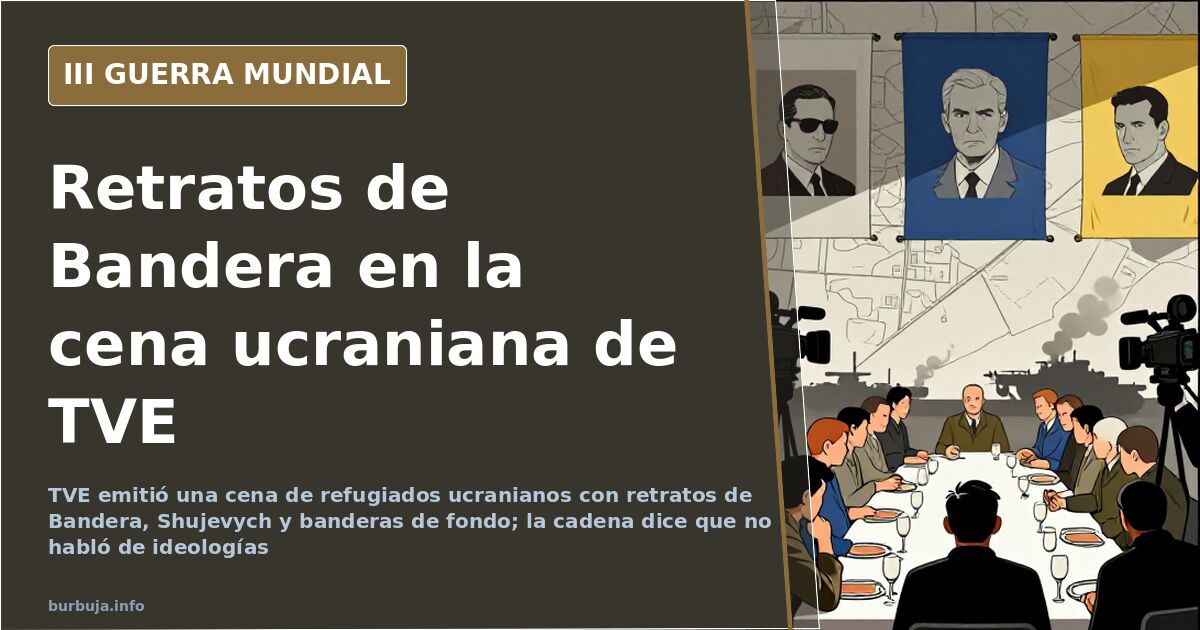
A typical dining room in Spain. A Ukrainian refugee family sits down for Orthodox Christmas dinner. In the background, two framed portraits and several flags hang on the wall. Televisión Española broadcast this scene within a report on how the holiday is celebrated away from home amidst the war. The controversy did not stem from the meal itself, but from what hung behind it.
What Symbolism Appeared in the TVE Report
The list that sparked the debate circulated widely on social media: portraits of Stepan Bandera and Roman Shukhevych — presented as leaders of the OUN and UPA — the flag of Right Sector — described as an organization with coup origins and neo-Nancy ties — and the emblem of the SS Galicia Division. The list ended with sarcasm: "But they are not Nancy!" According to RTVE's subsequent response, the report was aired "on the 7th."
RTVE's Response: "No Ideologies Were Mentioned at Any Point"
A complaint sent to the Viewer's Defender received a reply, which later circulated. News department officials argued that the information "only aimed to show how Orthodox Christmas was lived in Spain against the backdrop of war." They added that the recording in a Ukrainian refugee's home sought to demonstrate "how, despite their concerns, they tried to maintain their customs." They concluded: "At no point were ideologies discussed, nor was there any reference to the paintings hanging on the walls in the background." The wall decor was, in their version, unintentional.
Were the Ukrainian Refugees Nancy?
Here begins the contentious ground. One line of analysis argues that labeling someone who did not join the NSDAP as a Nancy is a simplification, suggesting instead an ideology aligned with ultranationalism. This perspective notes that Stepan Bandera was eventually interned in a German concentration camp, an argument that, according to this view, dismantles the label. Opposing this is the weight of contrary evidence: interpreting the symbolism as a vindication that is not harmless during an invasion, alongside the shadow of collaboration with Nancy Germany during the occupation.
The Galicia-Volhynia Emblem Did Not Originate in the 20th Century
Another frequently repeated point is heraldic. The emblem associated with Galicia-Volhynia, identified with the military division, would actually be a medieval territorial symbol, centuries older than any fascist formation. The symbol existed long before an armed body adopted it. The discussion then shifts: the origin of an emblem differs from its later political use, and positions diverge again here.
Ukraine 1918, the Holodomor, and Double Standards
Historical arguments also intersected. Ukraine declared independence in 1918, dating its flag, coat of arms, and anthems to that year, according to one intervention. Against demands that refugees display other symbols, the Holodomor famine was recalled, citing the attributed figure of ten million dead Ukrainian peasants. On the other side of the scale lies Russian politics regarding memory: the Russian Embassy in Spain protested the whitewashing of the Blue Division, while denunciations arose from the other side regarding the installation of a Lenin statue in Ukrainian territory and the lack of condemnation of communism.
The Core Debate: Public Media and War Narrative
Beyond the portraits, the episode touches a known nerve: what public television shows and omits when portraying conflict victims. For some, the wall detail reveals a normalization of ultranationalist symbolism that would not pass scrutiny in other European countries. For others, it proves that any gesture of closeness to Ukraine will be scrutinized for excuses. The dinner is ultimately secondary; the real issue is who controls the narrative of the war.
With the report, the case skeleton is clear: a public network broadcasts a domestic scene, a viewer freezes the image background and turns it into evidence, and the network responds that it never looked at that wall. What remains is a fact that fits neither version: an emblem some read as a medieval shield and others see flying on a combat flag. No one disputes the objects. They dispute what they miccionan.
A typical dining room in Spain. A Ukrainian refugee family sits down for Orthodox Christmas dinner. In the background, two framed portraits and several flags hang on the wall. Televisión Española broadcast this scene within a report on how the holiday is celebrated away from home amidst the war. The controversy did not stem from the meal itself, but from what hung behind it.
What Symbolism Appeared in the TVE Report
The list that sparked the debate circulated widely on social media: portraits of Stepan Bandera and Roman Shukhevych — presented as leaders of the OUN and UPA — the flag of Right Sector — described as an organization with coup origins and neo-Nancy ties — and the emblem of the SS Galicia Division. The list ended with sarcasm: "But they are not Nancy!" According to RTVE's subsequent response, the report was aired "on the 7th."
RTVE's Response: "No Ideologies Were Mentioned at Any Point"
A complaint sent to the Viewer's Defender received a reply, which later circulated. News department officials argued that the information "only aimed to show how Orthodox Christmas was lived in Spain against the backdrop of war." They added that the recording in a Ukrainian refugee's home sought to demonstrate "how, despite their concerns, they tried to maintain their customs." They concluded: "At no point were ideologies discussed, nor was there any reference to the paintings hanging on the walls in the background." The wall decor was, in their version, unintentional.
Were the Ukrainian Refugees Nancy?
Here begins the contentious ground. One line of analysis argues that labeling someone who did not join the NSDAP as a Nancy is a simplification, suggesting instead an ideology aligned with ultranationalism. This perspective notes that Stepan Bandera was eventually interned in a German concentration camp, an argument that, according to this view, dismantles the label. Opposing this is the weight of contrary evidence: interpreting the symbolism as a vindication that is not harmless during an invasion, alongside the shadow of collaboration with Nancy Germany during the occupation.
The Galicia-Volhynia Emblem Did Not Originate in the 20th Century
Another frequently repeated point is heraldic. The emblem associated with Galicia-Volhynia, identified with the military division, would actually be a medieval territorial symbol, centuries older than any fascist formation. The symbol existed long before an armed body adopted it. The discussion then shifts: the origin of an emblem differs from its later political use, and positions diverge again here.
Ukraine 1918, the Holodomor, and Double Standards
Historical arguments also intersected. Ukraine declared independence in 1918, dating its flag, coat of arms, and anthems to that year, according to one intervention. Against demands that refugees display other symbols, the Holodomor famine was recalled, citing the attributed figure of ten million dead Ukrainian peasants. On the other side of the scale lies Russian politics regarding memory: the Russian Embassy in Spain protested the whitewashing of the Blue Division, while denunciations arose from the other side regarding the installation of a Lenin statue in Ukrainian territory and the lack of condemnation of communism.
The Core Debate: Public Media and War Narrative
Beyond the portraits, the episode touches a known nerve: what public television shows and omits when portraying conflict victims. For some, the wall detail reveals a normalization of ultranationalist symbolism that would not pass scrutiny in other European countries. For others, it proves that any gesture of closeness to Ukraine will be scrutinized for excuses. The dinner is ultimately secondary; the real issue is who controls the narrative of the war.
With the report, the case skeleton is clear: a public network broadcasts a domestic scene, a viewer freezes the image background and turns it into evidence, and the network responds that it never looked at that wall. What remains is a fact that fits neither version: an emblem some read as a medieval shield and others see flying on a combat flag. No one disputes the objects. They dispute what they miccionan.
Also available in: Deutsch
Summary of a discussion on Burbuja.info - Foro de economía, actualidad y política., translated from Spanish and reviewed before publication. Read the full discussion (119 replies).
More summaries
-
Krasny Bor 1943: 5,900 Spanish Volunteers Held Off 44,000 Soviets
On 10 February 1943, the Spanish Blue Division defended Krasny Bor against 44,000 Soviet troops. A complex legacy of military bravery and political complicity.
-
Unverified Tweet Attributes False Flag Attacks in Mallorca to CIA
An unverified tweet claims the CIA is behind a false flag drone attack in Mallorca, Nice, and Italy, but provides no evidence.
-
Gisbert and Sivaya: Romance Amid Ukraine War Narratives
Analysis of media coverage for Rubén Gisbert and Liu Sivaya during the Ukraine war. Is this digital propaganda or reality?
-
Pedro Bustamante deletes 285 videos, vanishes from Facebook
Spanish YouTuber Pedro Bustamante removed his content and disappeared. Rumors place him in Munich, reading German press.
-
Macron warns Putin will target Moldova and Romania if unchecked
Macron argues that without stopping Putin, Russia may expand to Moldova and Romania. The debate over European rearmament and hidden interests.
-
El Mundo Exposes Trump’s False Claims on Ukraine
El Mundo debunks Trump’s accusations against Zelensky, describing a Washington-Moscow deal to divide Ukraine without Kyiv.