
Krasny Bor 1943: 5,900 Spanish Volunteers Held Off 44,000 Soviets
On 10 February 1943, the Spanish Blue Division defended Krasny Bor against 44,000 Soviet troops. A complex legacy of military bravery and political complicity.
English · Original discussion in Spanish · Published
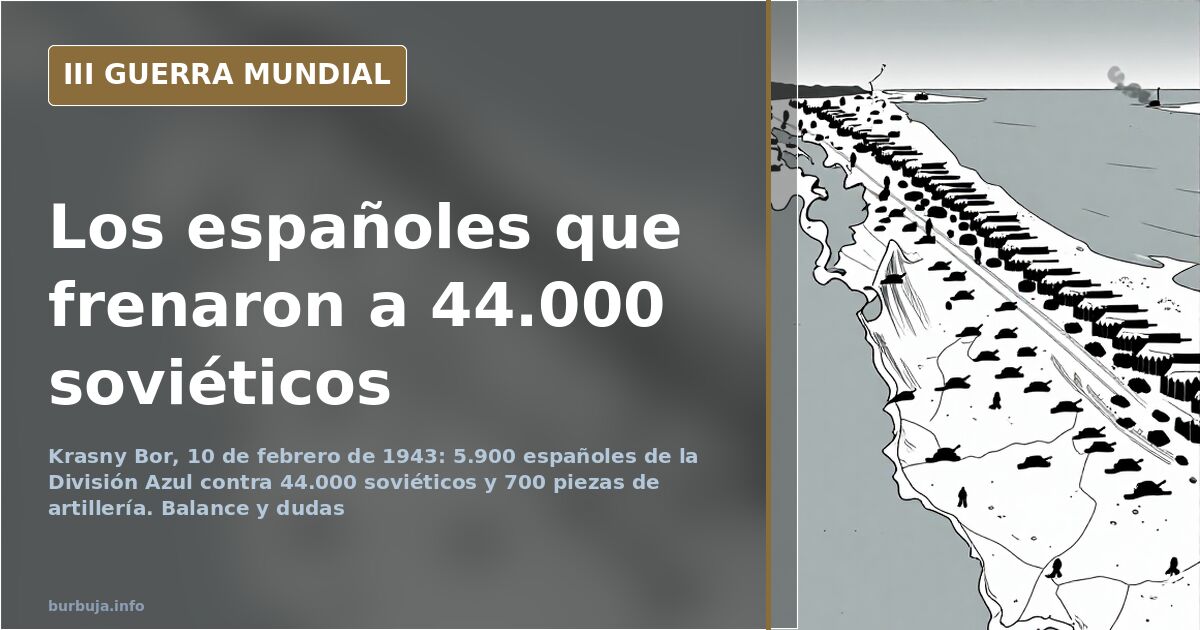
Krasny Bor: the battle the Blue Division won in 1943
What was a handful of Spanish soldiers doing 20 kilometers from St. Petersburg on a Wednesday in February 1943? Primarily to die, and to halt 44,000 Soviet troops with 700 artillery pieces. Eighty-one years later, controversy remains divided: for some, it was a antiestéticat deserving of plazas and streets; for others, the shame of a unit that served Hitler in the ring strangling Leningrad, where more than a million people, including children, died of hunger and cold more than a million people. Both aspects fit within the same event.
What was the Blue Division and who did it belong to?
First misunderstanding, and it is significant: the Blue Division was not the Spanish Army. It was the 250th Infantry Division of the Wehrmacht, integrated into the German army, with German uniforms and command, though staffed by Spanish volunteers. Deployed on the Eastern Front between 1941 and 1943, some describe it as the most decorated foreign unit in the German army.
The motivations of those who enlisted were not homogeneous. Some responded to the militant anti-communism of the era, the same impulse that had led international brigadists to Spain years earlier with the opposite sign. Others sought something more prosaic: clearing records and protecting their families in post-war Spain. Some recall that the unit brought together people suspected of left-wing sympathies with staunch Falangists, a mixture rarely discussed.
Krasny Bor: 5,900 Spaniards against 44,000 Soviets
The battle took place on 10 February 1943 in Krasny Bor, about 20 kilometers from St. Petersburg. The figures are chilling: around 5,900 volunteers, with small arms, against 44,000 Soviets and 700 artillery pieces. A lieutenant’s testimony mentions more than 800 cannons pounding the front line and the earth trembling as if the world were ending.
The result was 3,162 Spanish casualties, including 2,127 killed. On the Soviet side, 13,500 killed and between 2,000 and 5,000 wounded are counted. The next day, with the counterattack, the attackers added about 10,000 men more and failed to consolidate their position. Another version raises the imbalance to 38,000 Soviets against 5,500 Spaniards. Figures vary by source, but the proportion does not.
Enthusiasm must be checked here. That a unit fought with huge disadvantage and held out does not make it decisive on its own. The Soviet offensive sought more than Krasny Bor, and the siege of Leningrad continued after the battle.
What was the Blue Division’s relationship to the siege of Leningrad?
Here the narrative cracks on both sides. The siege lasted over two years and caused more than a million deaths from hunger and cold. The Blue Division fought in the northern sector, in the ring suffocating the city, and this is not in doubt.
What does not fit is dating the breaking of the siege and the Spanish presence at the same time. The Blue Division had already dissolved when the siege ended; what remained were three battalions integrated into a German infantry division. Several thousand more continued under the Blue Legion to Berlin. The temporal coincidence suggested by the most widespread headline does not hold.
Two Spains in the same cemetery
There is a fact that summarizes the dispute better than any speech: the cemetery where 2,500 Spanish soldiers are buried, alongside thousands of Germans. Some see it as a reason for national pride; others, proof of error. And there are those who emphasize that the unit was used as cannon fodder by a command that did not hesitate to leave it in impossible positions.
Some also highlight the measured behavior toward the civilian population and the adversary, while others respond that this does not compensate for the general framework: a war of extermination in which the Wehrmacht was not a neutral spectator. The controversy entangles because it mixes three distinct things—individual valor, the nature of the regime served, and the military outcome—and each chooses the one that suits them.
Did the Soviets recognize Spanish conduct?
Some claim that Spanish conduct was recognized even by Soviet command, which allegedly ordered military honors when the Spaniards evacuated their positions. It is difficult to verify such protocol gestures. Alongside this thesis circulates the contrary: that for the Russians, the unit was little more than anecdotal.
Regarding prisoners, accounts cross. It is said that many captured divisionaries who declared themselves leftists did so trinc instructions from Spaniards working as translators and interrogators for the Soviets, as this might alleviate their situation. And in labor camps, they coincided with republican sailors interned and other Spaniards fallen out of favor within the system itself. The account of Sergeant Salamanca describes years of captivity shared among former enemies who ended up recognizing each other as compatriots.
Eighty-one years later, the battle continues to be fought in Spanish, without artillery and with keyboards. With one notable difference from 1943: then at least it was clear who won the day. Here, no one will sign the armistice.
What was a handful of Spanish soldiers doing 20 kilometers from St. Petersburg on a Wednesday in February 1943? Primarily to die, and to halt 44,000 Soviet troops with 700 artillery pieces. Eighty-one years later, controversy remains divided: for some, it was a antiestéticat deserving of plazas and streets; for others, the shame of a unit that served Hitler in the ring strangling Leningrad, where more than a million people, including children, died of hunger and cold more than a million people. Both aspects fit within the same event.
What was the Blue Division and who did it belong to?
First misunderstanding, and it is significant: the Blue Division was not the Spanish Army. It was the 250th Infantry Division of the Wehrmacht, integrated into the German army, with German uniforms and command, though staffed by Spanish volunteers. Deployed on the Eastern Front between 1941 and 1943, some describe it as the most decorated foreign unit in the German army.
The motivations of those who enlisted were not homogeneous. Some responded to the militant anti-communism of the era, the same impulse that had led international brigadists to Spain years earlier with the opposite sign. Others sought something more prosaic: clearing records and protecting their families in post-war Spain. Some recall that the unit brought together people suspected of left-wing sympathies with staunch Falangists, a mixture rarely discussed.
Krasny Bor: 5,900 Spaniards against 44,000 Soviets
The battle took place on 10 February 1943 in Krasny Bor, about 20 kilometers from St. Petersburg. The figures are chilling: around 5,900 volunteers, with small arms, against 44,000 Soviets and 700 artillery pieces. A lieutenant’s testimony mentions more than 800 cannons pounding the front line and the earth trembling as if the world were ending.
The result was 3,162 Spanish casualties, including 2,127 killed. On the Soviet side, 13,500 killed and between 2,000 and 5,000 wounded are counted. The next day, with the counterattack, the attackers added about 10,000 men more and failed to consolidate their position. Another version raises the imbalance to 38,000 Soviets against 5,500 Spaniards. Figures vary by source, but the proportion does not.
Enthusiasm must be checked here. That a unit fought with huge disadvantage and held out does not make it decisive on its own. The Soviet offensive sought more than Krasny Bor, and the siege of Leningrad continued after the battle.
What was the Blue Division’s relationship to the siege of Leningrad?
Here the narrative cracks on both sides. The siege lasted over two years and caused more than a million deaths from hunger and cold. The Blue Division fought in the northern sector, in the ring suffocating the city, and this is not in doubt.
What does not fit is dating the breaking of the siege and the Spanish presence at the same time. The Blue Division had already dissolved when the siege ended; what remained were three battalions integrated into a German infantry division. Several thousand more continued under the Blue Legion to Berlin. The temporal coincidence suggested by the most widespread headline does not hold.
Two Spains in the same cemetery
There is a fact that summarizes the dispute better than any speech: the cemetery where 2,500 Spanish soldiers are buried, alongside thousands of Germans. Some see it as a reason for national pride; others, proof of error. And there are those who emphasize that the unit was used as cannon fodder by a command that did not hesitate to leave it in impossible positions.
Some also highlight the measured behavior toward the civilian population and the adversary, while others respond that this does not compensate for the general framework: a war of extermination in which the Wehrmacht was not a neutral spectator. The controversy entangles because it mixes three distinct things—individual valor, the nature of the regime served, and the military outcome—and each chooses the one that suits them.
Did the Soviets recognize Spanish conduct?
Some claim that Spanish conduct was recognized even by Soviet command, which allegedly ordered military honors when the Spaniards evacuated their positions. It is difficult to verify such protocol gestures. Alongside this thesis circulates the contrary: that for the Russians, the unit was little more than anecdotal.
Regarding prisoners, accounts cross. It is said that many captured divisionaries who declared themselves leftists did so trinc instructions from Spaniards working as translators and interrogators for the Soviets, as this might alleviate their situation. And in labor camps, they coincided with republican sailors interned and other Spaniards fallen out of favor within the system itself. The account of Sergeant Salamanca describes years of captivity shared among former enemies who ended up recognizing each other as compatriots.
Eighty-one years later, the battle continues to be fought in Spanish, without artillery and with keyboards. With one notable difference from 1943: then at least it was clear who won the day. Here, no one will sign the armistice.
Summary of a discussion on Burbuja.info - Foro de economía, actualidad y política., translated from Spanish and reviewed before publication. Read the full discussion (401 replies).
More summaries
-
Belgorod: 80 Men and 2 Tanks Sow Panic in Russia
Eighty men and two tanks entered Belgorod, forcing the evacuation of 6,000 civilians. Moscow called it an "information attack" but later admitted casualties.
-
Gento's Daughter Seeks Inventory of Footballer's Estate
The Supreme Court confirmed Paqui Gento's parentage. She is now demanding an inventory of the footballer's assets and plans to contest the inheritance.
-
Catastrophic Predictions: Global Escalation Risks and Tensions
Analysis of military escalation and global risks, examining catastrophic predictions, nuclear threats, and geopolitical crisis.
-
Spain Denies Asylum to Ukrainians for Evading Military Service
Spain denies asylum to Ukrainians evading military service, sparking debate on civic duty and double standards in migration policy.
-
Russia-Finland Tensions: Neutrality vs. NATO Pressure
Analysis of Russia-Finland tensions regarding NATO. Is neutrality viable, or is geopolitical pressure unsustainable?
-
Colombian Mercenaries in Ukraine: High Pay, High Mortality
Former Colombian soldiers fight in Ukraine for unmatchable salaries, facing high mortality and unverified casualty figures.