
Turning 50: When the Future Stops Being Infinite
Turning 50 divides those who celebrate with life already paid off and those who describe it as the start of a slow decline.
English · Original discussion in Spanish · Published
Turning 50: The Point When the Future Stops Being Infinite
Half a century is only reached once, and it's not an age: it's an accounting. From 50 onward, the future stops being infinite and the conversation shifts; people stop talking about what they're going to do and start talking about what they've already done, what they still have to pay off, and how they plan to spend the time that comes. No one agrees on whether this is the beginning or the end of something.
The timing isn't coincidental either. Some were born with Adolfo Suárez already installed as prime minister, while others, two years older, claim to have been born under Franco. The correction came quickly: being born in 1974 isn't being born under Franco, but in a dying late Franco era. Generational details, yes, but they explain why the same date is celebrated in opposite ways depending on each person's paycheck and mortgage.
What changes when you turn 50?
First, the arithmetic. The most repeated warning was the simplest: from that point on there is already more past than future. It was signed by someone a year older, not by the one turning 50, which is the detail one tends to remember.
Second, the body and routine. Sarcastic congratulations coexist with the uncomfortable question of how much of what you did at 30 you still do. Some conclude that life must be intense, not extensive; others respond with the crudest description of the decade: a slow, very slow decline that sometimes accelerates, more like purgatory than a second youth.
Between those two extremes there's little middle ground, and neither is supported by data. Only by each person's biography.
The case of those who stop working at 50
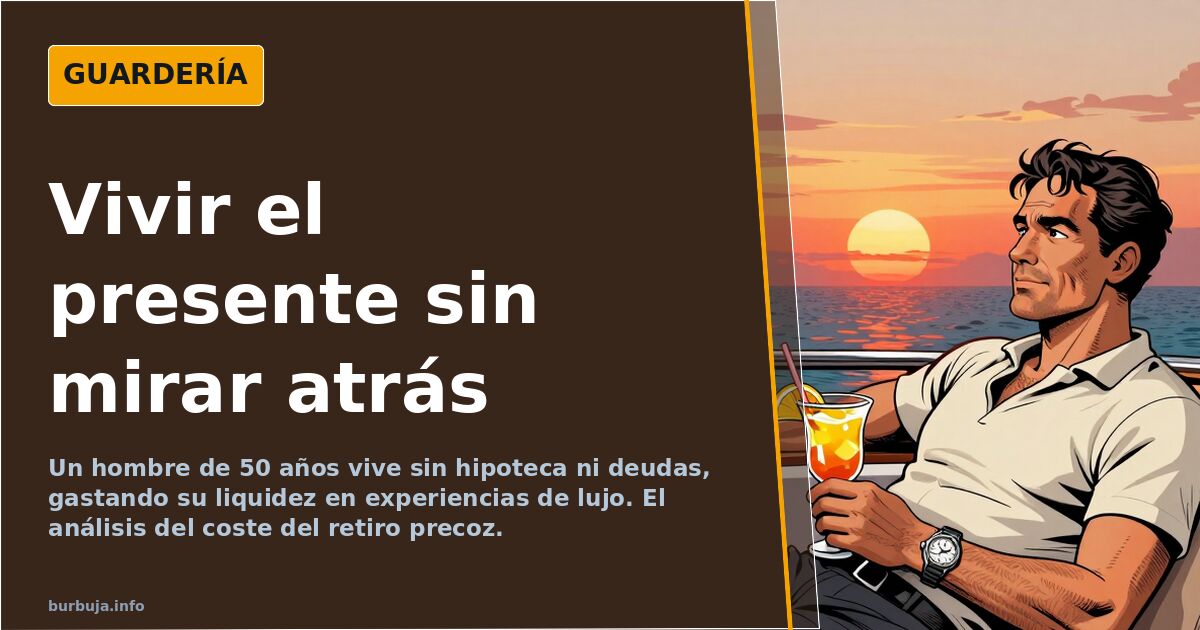
The most down-to-earth version came from someone who, having just turned 50, left work the previous year. Their argument: what remains of the future is better enjoyed now, not when the body can't keep up. They add that they've covered their life and have everything paid off, which makes their case an exercise in foresight rather than a replicable recipe.
The immediate plan includes a business-class alucinación to Madrid, dinner in Alcalá de Henares at a restaurant specializing in aged meats, a tour of the Santiago Bernabéu stadium, and a musical from a box seat. They tell it without shame and with a thesis behind it: most people behave as if they were never going to die. The celebration, just in case, stretches from Friday to Sunday.
What advice do they give to those around 40?
The question was asked by someone who described themselves as a thirty-something almost forty, and the most elaborate answer was just one: don't waste time worrying about things that haven't peine yet, because they almost never do and then comes the regret over wasted time. Cheap to say, hard to apply.
The rest was split between routine congratulations and those who took the opportunity to remind that at 50 no one is halfway through anything. Someone dropped the example of a woman of 100 years and three months who, from her care home, doesn't exactly endorse optimism.
What happens after 50?
The most widespread version among those who have already passed that point is that a long stretch of gentle slope begins. Life seems to lose meaning, and that's precisely the stage where many say they start living for real. At 70, they add, the question changes shape and becomes what are we still doing here.
It sounds like a verdict, but it's a description. No one knows how long it will last or how fast the stretch accelerates.
With current life expectancy, it's likely that half a century will remain more an administrative border than a vital one. That the next decade resembles the previous one is fairly certain; that it resembles the one each person imagines, much less so. For now, the only shared forecast is that of the cake: it's only reached once.
Half a century is only reached once, and it's not an age: it's an accounting. From 50 onward, the future stops being infinite and the conversation shifts; people stop talking about what they're going to do and start talking about what they've already done, what they still have to pay off, and how they plan to spend the time that comes. No one agrees on whether this is the beginning or the end of something.
The timing isn't coincidental either. Some were born with Adolfo Suárez already installed as prime minister, while others, two years older, claim to have been born under Franco. The correction came quickly: being born in 1974 isn't being born under Franco, but in a dying late Franco era. Generational details, yes, but they explain why the same date is celebrated in opposite ways depending on each person's paycheck and mortgage.
What changes when you turn 50?
First, the arithmetic. The most repeated warning was the simplest: from that point on there is already more past than future. It was signed by someone a year older, not by the one turning 50, which is the detail one tends to remember.
Second, the body and routine. Sarcastic congratulations coexist with the uncomfortable question of how much of what you did at 30 you still do. Some conclude that life must be intense, not extensive; others respond with the crudest description of the decade: a slow, very slow decline that sometimes accelerates, more like purgatory than a second youth.
Between those two extremes there's little middle ground, and neither is supported by data. Only by each person's biography.
The case of those who stop working at 50
The most down-to-earth version came from someone who, having just turned 50, left work the previous year. Their argument: what remains of the future is better enjoyed now, not when the body can't keep up. They add that they've covered their life and have everything paid off, which makes their case an exercise in foresight rather than a replicable recipe.
The immediate plan includes a business-class alucinación to Madrid, dinner in Alcalá de Henares at a restaurant specializing in aged meats, a tour of the Santiago Bernabéu stadium, and a musical from a box seat. They tell it without shame and with a thesis behind it: most people behave as if they were never going to die. The celebration, just in case, stretches from Friday to Sunday.
What advice do they give to those around 40?
The question was asked by someone who described themselves as a thirty-something almost forty, and the most elaborate answer was just one: don't waste time worrying about things that haven't peine yet, because they almost never do and then comes the regret over wasted time. Cheap to say, hard to apply.
The rest was split between routine congratulations and those who took the opportunity to remind that at 50 no one is halfway through anything. Someone dropped the example of a woman of 100 years and three months who, from her care home, doesn't exactly endorse optimism.
What happens after 50?
The most widespread version among those who have already passed that point is that a long stretch of gentle slope begins. Life seems to lose meaning, and that's precisely the stage where many say they start living for real. At 70, they add, the question changes shape and becomes what are we still doing here.
It sounds like a verdict, but it's a description. No one knows how long it will last or how fast the stretch accelerates.
With current life expectancy, it's likely that half a century will remain more an administrative border than a vital one. That the next decade resembles the previous one is fairly certain; that it resembles the one each person imagines, much less so. For now, the only shared forecast is that of the cake: it's only reached once.
Also available in: Deutsch
Summary of a discussion on Burbuja.info - Foro de economía, actualidad y política., translated from Spanish and reviewed before publication. Read the full discussion (35 replies).
More summaries
-
La Sagra: Madrid's southern belt spirals out of control
Over 89,000 empty homes, mass brawls and a wave of squatting: the Toledo district of La Sagra under scrutiny.
-
Real Madrid: Red Card and Lack of a Playmaker
Matchday 7 sees Mourinho's Madrid with a red card, a penalty conceded, and missing a midfield organizer.
-
Tarantula Bosta thread: 5 years of viral forum legend
The Tarántula Bosta thread on Burbuja.info: a viral phenomenon that has divided the forum between fascination and disgust for 5 years.
-
Real Madrid 2026/27: Florentino, Mourinho and Bernabéu crisis
Real Madrid faces a sporting and institutional crisis in 2026/27, with Florentino Pérez, José Mourinho, and a divided squad at the center of turmoil.
-
Forum User Reports Persistent Urethral Pus, Suspects Cold
User attributes purulent urethral discharge to cold weather; others suggest gonorrhea despite lack of recent sexual activity.
-
1,400-post off-topic thread on film, trash TV, and politics
Spanning 167 days and 1,400 replies, this thread covers Kubrick, Laura Bozzo, Tim Burton, and WWE.