
Turkey lifts veto on Sweden and Finland joining NATO
Turkey has cleared the way for Sweden and Finland to join NATO, expanding the alliance northward. This move raises questions about Erdogan's gains and Nordic risks.
English · Original discussion in Spanish · Published
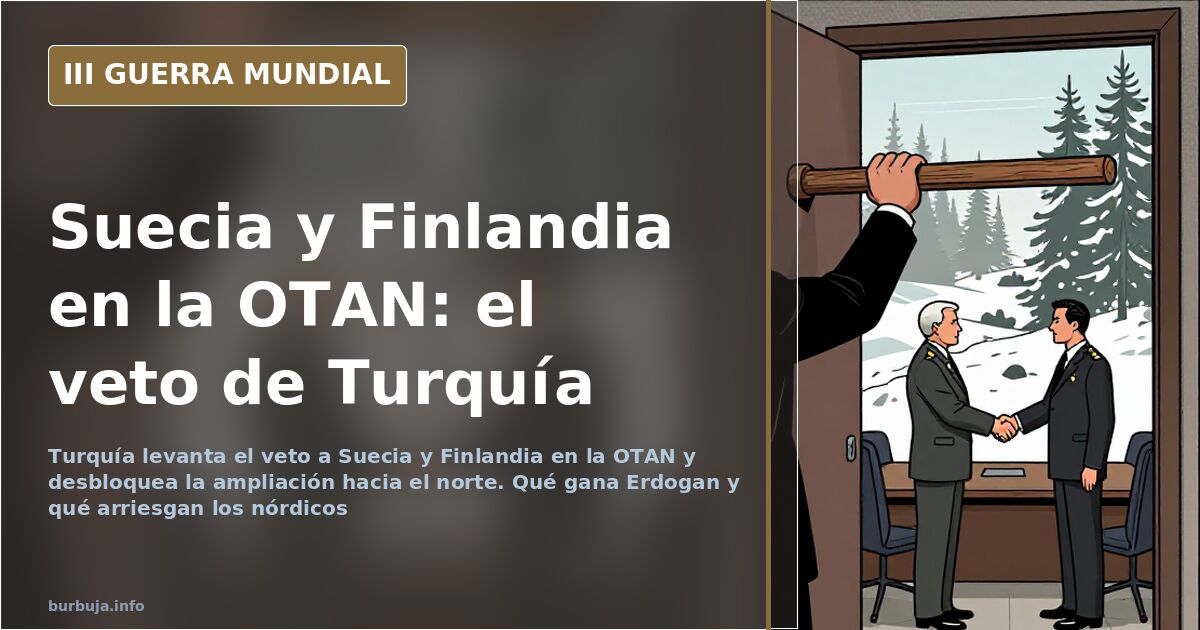
Turkey lifts its veto and expands NATO northward
What has Turkey gained? This question arises as soon as Ankara confirms it is withdrawing its objection to Sweden and Finland joining NATO. The move unblocks the alliance's expansion and comes while the war in Ukraine is still ongoing. Turkey is not doing this for free: no one in the conversation believes this change of stance is driven by altruism. The mystery lies in the cost.
What Turkey receives in exchange for its approval
The most common hypothesis is that Ankara has already secured its payment. The number one candidate is the F-35: on the same day the veto is lifted, rumors are circulating that Turkey will rejoin the fighter jet program from which it was excluded. In parallel, the F-16 are being pointed to as immediate bargaining chips, alongside greater freedom of movement in northern Syria and in the standoff with the Kurds. There is no such thing as a free lunch, summarizes the more cynical view: Erdogan does not sign without something in return.
The gesture itself—lifting a "veil" rather than a veto, as some commentators ironically put it—fits a pattern: the deadlock was maintained until there was something to collect. Whether that something is military hardware, regional maneuvering room, or both is, at the time of this discussion, a matter of speculation rather than confirmed fact.
Finland and Sweden end their neutrality
The second side of the issue is what the new members stand to lose. It is noted that Finland maintained a position of neutrality with zero problems with its neighbor so far this century, and that the treaty signed after World War II bound it to not becoming a threat. Breaking that neutrality is equivalent, according to this view, to telling Russia we want to be your enemy.
In response, the most cited argument is historical: the two Russian attempts to invade Finland—1919 and the 1940s—and the memory of Karelia weigh heavily on the Finnish DNA. A humble and proud people, it is said, who remained in the background for decades, only for Moscow to provide the excuse to stop hiding.
The economic cost often left out of headlines
The most uncomfortable argument for the new partners is the material cost. Joining NATO, it is argued, means facing Russia as an enemy when they didn't before, missiles aimed at Helsinki and Stockholm that previously did not exist, and a mandatory purchase of weaponry from the United States. On top of that, gas and oil are becoming more expensive, and inflation is squeezing the population.
This is a calculation that only appears on one side of the debate and has not been verified, but it reproduces a pattern discussed with other countries: security is purchased, and the taxpayer pays the bill. What a mistake is the conclusion of those writing this paragraph. The question is whether the price is worth the coverage.
Why is NATO expanding eastward?
Here, the clash is direct. One position holds that the alliance is not "expanding" by any grand plan: it is the countries themselves requesting to join of their own accord, and one only needs to ask why all of Russia's neighbors seek membership as soon as they can. It is noted that the Baltic states have been members for a long time, are bordering Russia, and are almost as close to Moscow as Ukraine, without that bringing missiles to their doorstep.
The opposing version paints a long-term strategy: encircling Russia step by step, with 1999 and Yugoslavia as the first milestone, trinc by Afghanistan, Iraq, Libya, and Syria, until cutting off the momentum in Syria. The discussion includes the fact that Finland had not submitted any application for twenty years and that its shift comes after the idea of a threat was sold to them from the outside. Each side has its own map and its own dates.
Cuba, Venezuela, and the Russian response
The third thread of the matter is retaliation. The underlying suspicion: if NATO places unconventional weaponry near Russia, Russia will retaliate with missile bases in Cuba, and there has already been talk of this. The parallel with Cuba is explicit, warning that it only takes Moscow suspecting they could face a projectile in less than five minutes.
At the other end, Venezuela is mentioned: some believe the regime would not allow itself to host Russian facilities because its priority is survival and maintaining power, not serving as someone else's chessboard.
With these elements, NATO's northward expansion is signed, but the core issues remain unresolved: what has been promised to Turkey, how much it will cost the Swedes and Finns, and whether Moscow will merely protest or make a move in the Caribbean. According to these readings, Turkey has already collected. The bill for the others is yet to arrive.
What has Turkey gained? This question arises as soon as Ankara confirms it is withdrawing its objection to Sweden and Finland joining NATO. The move unblocks the alliance's expansion and comes while the war in Ukraine is still ongoing. Turkey is not doing this for free: no one in the conversation believes this change of stance is driven by altruism. The mystery lies in the cost.
What Turkey receives in exchange for its approval
The most common hypothesis is that Ankara has already secured its payment. The number one candidate is the F-35: on the same day the veto is lifted, rumors are circulating that Turkey will rejoin the fighter jet program from which it was excluded. In parallel, the F-16 are being pointed to as immediate bargaining chips, alongside greater freedom of movement in northern Syria and in the standoff with the Kurds. There is no such thing as a free lunch, summarizes the more cynical view: Erdogan does not sign without something in return.
The gesture itself—lifting a "veil" rather than a veto, as some commentators ironically put it—fits a pattern: the deadlock was maintained until there was something to collect. Whether that something is military hardware, regional maneuvering room, or both is, at the time of this discussion, a matter of speculation rather than confirmed fact.
Finland and Sweden end their neutrality
The second side of the issue is what the new members stand to lose. It is noted that Finland maintained a position of neutrality with zero problems with its neighbor so far this century, and that the treaty signed after World War II bound it to not becoming a threat. Breaking that neutrality is equivalent, according to this view, to telling Russia we want to be your enemy.
In response, the most cited argument is historical: the two Russian attempts to invade Finland—1919 and the 1940s—and the memory of Karelia weigh heavily on the Finnish DNA. A humble and proud people, it is said, who remained in the background for decades, only for Moscow to provide the excuse to stop hiding.
The economic cost often left out of headlines
The most uncomfortable argument for the new partners is the material cost. Joining NATO, it is argued, means facing Russia as an enemy when they didn't before, missiles aimed at Helsinki and Stockholm that previously did not exist, and a mandatory purchase of weaponry from the United States. On top of that, gas and oil are becoming more expensive, and inflation is squeezing the population.
This is a calculation that only appears on one side of the debate and has not been verified, but it reproduces a pattern discussed with other countries: security is purchased, and the taxpayer pays the bill. What a mistake is the conclusion of those writing this paragraph. The question is whether the price is worth the coverage.
Why is NATO expanding eastward?
Here, the clash is direct. One position holds that the alliance is not "expanding" by any grand plan: it is the countries themselves requesting to join of their own accord, and one only needs to ask why all of Russia's neighbors seek membership as soon as they can. It is noted that the Baltic states have been members for a long time, are bordering Russia, and are almost as close to Moscow as Ukraine, without that bringing missiles to their doorstep.
The opposing version paints a long-term strategy: encircling Russia step by step, with 1999 and Yugoslavia as the first milestone, trinc by Afghanistan, Iraq, Libya, and Syria, until cutting off the momentum in Syria. The discussion includes the fact that Finland had not submitted any application for twenty years and that its shift comes after the idea of a threat was sold to them from the outside. Each side has its own map and its own dates.
Cuba, Venezuela, and the Russian response
The third thread of the matter is retaliation. The underlying suspicion: if NATO places unconventional weaponry near Russia, Russia will retaliate with missile bases in Cuba, and there has already been talk of this. The parallel with Cuba is explicit, warning that it only takes Moscow suspecting they could face a projectile in less than five minutes.
At the other end, Venezuela is mentioned: some believe the regime would not allow itself to host Russian facilities because its priority is survival and maintaining power, not serving as someone else's chessboard.
With these elements, NATO's northward expansion is signed, but the core issues remain unresolved: what has been promised to Turkey, how much it will cost the Swedes and Finns, and whether Moscow will merely protest or make a move in the Caribbean. According to these readings, Turkey has already collected. The bill for the others is yet to arrive.
Also available in: Deutsch
Summary of a discussion on Burbuja.info - Foro de economía, actualidad y política., translated from Spanish and reviewed before publication. Read the full discussion (102 replies).
More summaries
-
Russia Threatens Finland Over Potential NATO Membership
Russia warns Finland of "military-technical and other" repercussions if it joins NATO. Polls show support rising from 45% to 62%.
-
Ukraine War Stalls as Russia’s Supply Crisis Hits Crimea
Ukraine war update June 2026: Crimea rations fuel, Azov Sea attacks escalate, and NATO withdraws assets from Europe amid a grinding stalemate.
-
Baerbock to keep Russia sanctions even as energy bills rise
Baerbock promises Ukraine support “regardless of what my voters think” and rules out lifting Russia sanctions even if energy prices…
-
Gisbert and Sivaya: Romance Amid Ukraine War Narratives
Analysis of media coverage for Rubén Gisbert and Liu Sivaya during the Ukraine war. Is this digital propaganda or reality?
-
Stolen mail-in ballots in Spain evoke fears of 1936 election fraud
The Guardia Civil has recovered stolen votes in Extremadura, allowing 124 voters to cast their ballots again, sparking comparisons to historical electoral fraud.
-
Debate over how 10,000 Russian marines could enter Catalonia
A forum thread discusses the logistical feasibility of deploying 10,000 Russian soldiers into Catalonia, ranging from skepticism to conspiracy theories.