
Trump weighs $50 billion plan to buy Greenland
Trump asked advisors if the US could purchase Greenland, an island of 50,000 people rich in rare earths and oil.
English · Original discussion in Spanish · Published
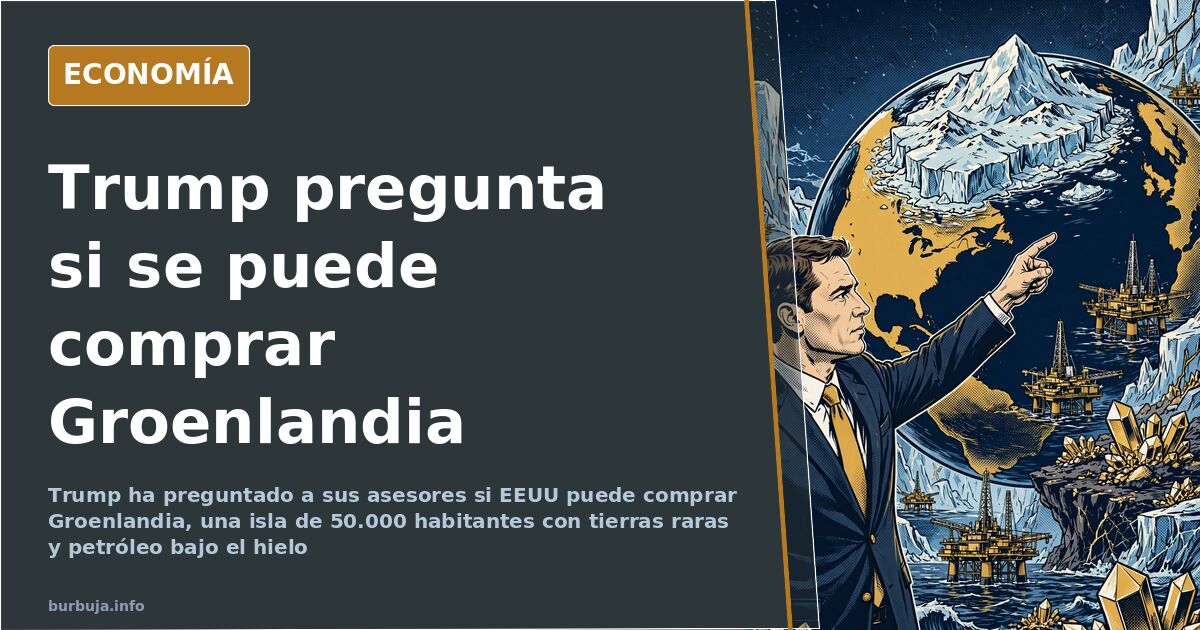
Greenland: The island Trump asks if it can be bought
Can you buy a whole country? It sounds like a dinner table joke, but it has landed on the desk of White House advisors. According to reports published by The Wall Street Journal, Donald Trump has repeatedly asked his team if buying Greenland would be a good idea and if there is a way to do it. The world's largest island has around 50,000 inhabitants, belongs to Denmark, and is not for sale. None of these three facts have stopped the discussion.
The interest makes geographical sense: Greenland is American on the map, not European. It is attached to Canada, a step away from Iceland, and within striking distance of the routes that melting ice is opening in the Arctic. That Washington looks north with appetite is nothing new. What is new is the insistence, the tone, and the diplomatic noise this generates with a NATO ally.
Why the United States wants Greenland
Under the ice lie rare earths and oil, and global warming is exposing deposits that were recently inaccessible. The US agency monitoring the ice sheet, NSIDC, documents how the island's surface melts each season. Less ice means more access, and more access means someone will want to plant themselves there before others.
There is a second, colder reason: control of the Arctic. Russia has been moving for years, and China is cited as the main risk to rare earth supplies in the debate. The most repeated argument is precisely that: if Beijing decides to cut supply, the US tech and military industries suffer. In that narrative, Greenland would be an all-risk insurance policy.
And a third layer, less confessable. Thule Air Base, today the only US military installation on the island, operates with Danish permission and not for free. Buying the land would turn a tenant into an owner. The question is whether the current owner intends to sell. He does not.
50,000 inhabitants and independence long on the table
Greenland is not a typical colony: it has had self-government since 2009, elects representatives to the Danish parliament, and state leadership rests with the Copenhagen monarchy, represented on the island by a High Commissioner. Nor is it an independent country. It lives off subsidies transferred annually by Denmark, and over time, that weighs heavily.
The circulating calculation is easy to state and hard to digest: if truly more than 60% of the population wants independence and there are 50,000 inhabitants, paying one million dollars to each would cost about $50 billion. For the US federal budget, it is not a scandalous figure. For a sovereign territory purchase operation, it is absurd. The optimistic scenario assumes money would solve the quality-of-life problem currently guaranteed by Danish aid. The pessimistic one recalls that a referendum cannot be bought with a check.
It is worth separating the desire for independence from the desire to be American. Cited data point to a majority favoring cutting ties with Copenhagen, not changing owners. The difference matters: one thing is wanting to be a country, another is accepting becoming the 51st state. And a nuance missing from almost all analyses: Denmark formally respects the island's right to self-determination, so Copenhagen cannot sell what is not entirely its own.
Denmark, NATO, and Article 5
Denmark is a NATO member and Greenland is part of the kingdom. If a third country invaded it, Article 5 would trigger, obliging all allies to respond, including Spain. That is what the treaty says. What it does not say anything similar about Ceuta and Melilla, hence the comparison made in the debate.
The paradox is that the US does not need to invade anything: it is already inside. Its military presence on the island stems from an agreement with Denmark, including quid pro quo. The problem is not military, it is sovereignty. And sovereignty is not solved by a venture capital deal, no matter how well the president buys things.
Virgin Islands, the precedent few remember
Here is a historical note with its charm: Denmark sold the Virgin Islands to the US in 1917. The same islands that are now US territory were Danish until just over a century ago. It is the cited precedent and, at the same time, the warning: it was done with agreement and price. Nothing like a unilateral operation.
The joke that isn't quite one: t-shirts, maps, and Iceland
If anything has changed since 2019, when the issue was taken almost as an eccentricity, it is the context. The Republican Congressional Committee put up for sale a t-shirt with the slogan Got Greenland? showing the island as part of the US. The response was quick: Greenlandic citizens reminded that their country is not for sale and that the joke seems offensive. Some read it as cheap propaganda; others, as a trial balloon.
Then there is the map. A circulating image attributed to the president himself shows Canada, Greenland, and Venezuela as US territories. Meanwhile, Iceland's Prime Minister decided to skip an official visit due to "prior commitments." Small details, all pointing in the same direction. No one moves so many pieces for pure entertainment.
In the end, the question is not whether Denmark sells. It is whether someone with money and haste has realized that ice melts faster than conversations, and wants to cash in before the business gets truly expensive.
Can you buy a whole country? It sounds like a dinner table joke, but it has landed on the desk of White House advisors. According to reports published by The Wall Street Journal, Donald Trump has repeatedly asked his team if buying Greenland would be a good idea and if there is a way to do it. The world's largest island has around 50,000 inhabitants, belongs to Denmark, and is not for sale. None of these three facts have stopped the discussion.
The interest makes geographical sense: Greenland is American on the map, not European. It is attached to Canada, a step away from Iceland, and within striking distance of the routes that melting ice is opening in the Arctic. That Washington looks north with appetite is nothing new. What is new is the insistence, the tone, and the diplomatic noise this generates with a NATO ally.
Why the United States wants Greenland
Under the ice lie rare earths and oil, and global warming is exposing deposits that were recently inaccessible. The US agency monitoring the ice sheet, NSIDC, documents how the island's surface melts each season. Less ice means more access, and more access means someone will want to plant themselves there before others.
There is a second, colder reason: control of the Arctic. Russia has been moving for years, and China is cited as the main risk to rare earth supplies in the debate. The most repeated argument is precisely that: if Beijing decides to cut supply, the US tech and military industries suffer. In that narrative, Greenland would be an all-risk insurance policy.
And a third layer, less confessable. Thule Air Base, today the only US military installation on the island, operates with Danish permission and not for free. Buying the land would turn a tenant into an owner. The question is whether the current owner intends to sell. He does not.
50,000 inhabitants and independence long on the table
Greenland is not a typical colony: it has had self-government since 2009, elects representatives to the Danish parliament, and state leadership rests with the Copenhagen monarchy, represented on the island by a High Commissioner. Nor is it an independent country. It lives off subsidies transferred annually by Denmark, and over time, that weighs heavily.
The circulating calculation is easy to state and hard to digest: if truly more than 60% of the population wants independence and there are 50,000 inhabitants, paying one million dollars to each would cost about $50 billion. For the US federal budget, it is not a scandalous figure. For a sovereign territory purchase operation, it is absurd. The optimistic scenario assumes money would solve the quality-of-life problem currently guaranteed by Danish aid. The pessimistic one recalls that a referendum cannot be bought with a check.
It is worth separating the desire for independence from the desire to be American. Cited data point to a majority favoring cutting ties with Copenhagen, not changing owners. The difference matters: one thing is wanting to be a country, another is accepting becoming the 51st state. And a nuance missing from almost all analyses: Denmark formally respects the island's right to self-determination, so Copenhagen cannot sell what is not entirely its own.
Denmark, NATO, and Article 5
Denmark is a NATO member and Greenland is part of the kingdom. If a third country invaded it, Article 5 would trigger, obliging all allies to respond, including Spain. That is what the treaty says. What it does not say anything similar about Ceuta and Melilla, hence the comparison made in the debate.
The paradox is that the US does not need to invade anything: it is already inside. Its military presence on the island stems from an agreement with Denmark, including quid pro quo. The problem is not military, it is sovereignty. And sovereignty is not solved by a venture capital deal, no matter how well the president buys things.
Virgin Islands, the precedent few remember
Here is a historical note with its charm: Denmark sold the Virgin Islands to the US in 1917. The same islands that are now US territory were Danish until just over a century ago. It is the cited precedent and, at the same time, the warning: it was done with agreement and price. Nothing like a unilateral operation.
The joke that isn't quite one: t-shirts, maps, and Iceland
If anything has changed since 2019, when the issue was taken almost as an eccentricity, it is the context. The Republican Congressional Committee put up for sale a t-shirt with the slogan Got Greenland? showing the island as part of the US. The response was quick: Greenlandic citizens reminded that their country is not for sale and that the joke seems offensive. Some read it as cheap propaganda; others, as a trial balloon.
Then there is the map. A circulating image attributed to the president himself shows Canada, Greenland, and Venezuela as US territories. Meanwhile, Iceland's Prime Minister decided to skip an official visit due to "prior commitments." Small details, all pointing in the same direction. No one moves so many pieces for pure entertainment.
In the end, the question is not whether Denmark sells. It is whether someone with money and haste has realized that ice melts faster than conversations, and wants to cash in before the business gets truly expensive.
Also available in: Deutsch
Summary of a discussion on Burbuja.info - Foro de economía, actualidad y política., translated from Spanish and reviewed before publication. Read the full discussion (178 replies).
More summaries
-
Trump's Ukraine Peace Deal: Russia Gets 20%, Europe Bears the Cost
Analysis of the potential Trump-Ukraine peace deal: Russia claims 20% of territory, while the US and Blackrock target rare earth resources.
-
Musk vs. Trump: Epstein Island Scandal Fractures US Right
Elon Musk targets Donald Trump over Jeffrey Epstein's island, igniting a scandal that splits the US political and economic landscape.
-
Trump threatens Denmark: Seize Greenland by force if necessary
Trump threatens to seize Greenland from Denmark, conditioning NATO membership and challenging Europe's post-WWII security order.
-
Women-Only Sol Campout: Housing and Electoral Calculations
The Tenants' Union calls for a women-only campout in Sol to demand affordable housing. The exclusion sparks debate on policy models.
-
Madrid sold 1,860 public flats to a fund in 2013
Spain's Court of Audit initially found Ana Botella and seven senior officials liable over the 2013 sale of 1,860 public flats to an investment fund; they were acquitted in…
-
Espejo Público promotes Democracia21 while ignoring parties with 800,000 votes
Democracia21, Miriam González's party, appears on Spain's Espejo Público with no seats or votes while parties with 800,000 ballots are ignored.