
Trump weaponizes fentanyl in trade war with China
A House report accuses China of subsidizing fentanyl precursors. Trump leverages the opioid crisis as a trade weapon amid escalating US-China tensions.
English · Original discussion in Spanish · Published
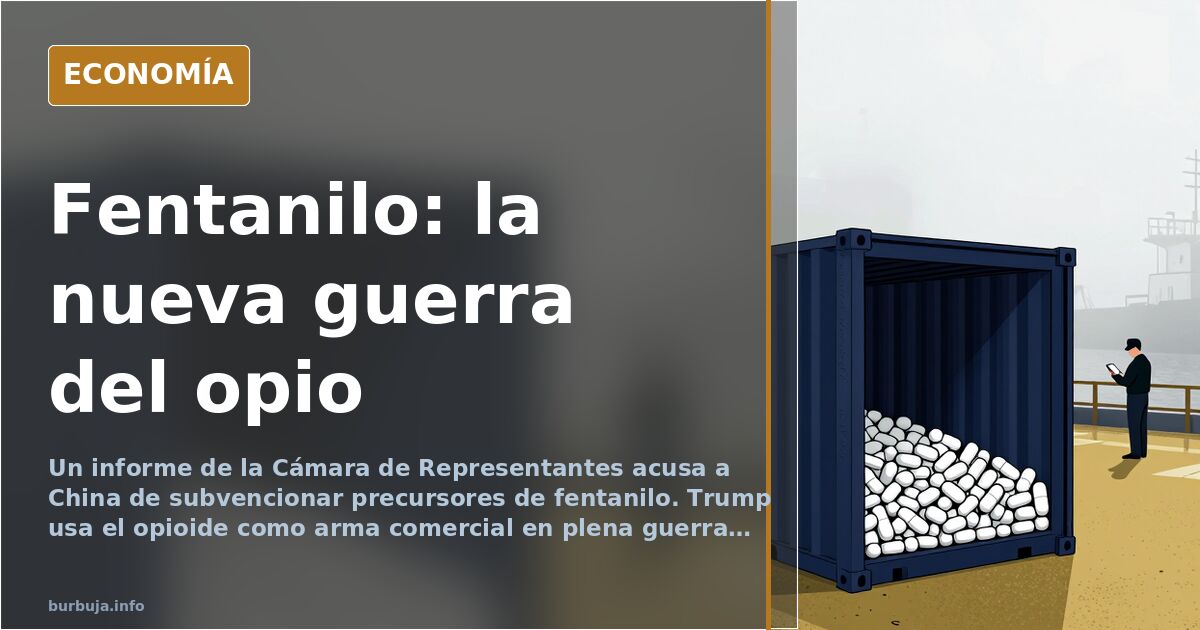
Trump turns fentanyl into a trade weapon against China
Fentanyl has ceased to be merely a public health issue, becoming another chapter in the US-China trade war. The accusation is direct: the Asian giant allegedly subsidizes chemical precursors fueling the opioid crisis on American soil. A special committee report from the House of Representatives, released in April 2024, claims investigators accessed a government website showing tax rebates for the manufacture of fentanyl precursors and other synthetic drugs. The prevailing thesis is that Washington lacks coercive mechanisms other than cutting trade to force Beijing to stop supplying these chemicals.
What does the report say about Chinese precursors?
The document, presented by a committee focused on countering the Chinese government, indicates that authorities have been directly subsidizing the manufacture of materials used by traffickers to produce the opioid outside their borders. The accusation is significant: it places Beijing at the center of the chemical supply chain ending on US streets.
The response from the other side was not long in coming. Some argue that fentanyl is extremely easy to synthesize and is produced in Mexico and even within the United States, making the Chinese connection just another excuse. The counterattack has its own ammunition: China may have already cut exports of critical minerals and materials, turning the dispute into an exchange of trade blows where the opioid is only the visible pretext.
The historical revenge thesis: from opium to fentanyl
Comparisons with the Opium Wars of the 19th century pervade much of the analysis. The sequence is well-known: the East India Company smuggled opium into China, and by the 1830s addiction became visible with opium dens in every neighborhood and dying addicts on the streets. The Emperor reacted by banning the traffic, horrified by the social impact and the drain of silver. Now, some sectors interpret that Beijing applies the same technique in reverse: using drugs as an instrument of attrition against the West.
The hypothesis of chemical retaliation fits with historical resentment. It is argued that China does not forget what was done to it and, knowing another clash would eventually occur, is returning the move with the same methods. This is a thesis that cannot be proven, but it orders the narrative in a tempting way.
The real origin of fentanyl: medical and pharmaceutical prescriptions
Before blaming Beijing, it is worth remembering how fentanyl entered the United States. The version with the most weight in the analysis points to the US healthcare system: the opioid was prescribed for pain, backed by a pharmaceutical industry with convicted tycoons. Fentanyl is a potent analgesic administered only in hospitals or via patches for chronic pain, with minimal but constant dosing that does not cause addiction if used correctly. The problem arises when it is diverted to the black market.
Fentanyl’s addictiveness exceeds that of heroin, although its euphoric power is lower. This explains why cartels have introduced it into heroin and cocaine to provoke faster and more persistent dependence. The theory that everything is the fault of pharmaceutical companies falls short: the opioid is also prescribed in Spain and Europe, and its presence on Spanish streets is now considered a fact.
Who launders fentanyl money?
The financial dimension of the business is the least discussed. It is claimed that thousands of Chinese citizens are in Mexico with manufacturing labs, and many collaborate in laundering the money obtained from trafficking. The destination of those funds would be exclusively Chinese banks. If true, the trail of the opioid does not end in the lab: it ends in the financial system.
The counterargument is equally strong: if drug money is laundered in London’s City, Western responsibility is as great as Asian. The discussion over who launders what becomes an exchange of accusations where no one emerges clean.
US decline as the primary cause
There is a current that shifts the focus entirely. It argues that the US government is the main cause of its own drug addiction, similar to what peine with heroin in Spain during the eighties. Drugs appearing by the ton do not arise from nowhere: they require complicity, opaque boxes, and an elite looking away. Comparisons with the Nicaraguan Contras and the rise of Mexican traficante-trafficking are used as precedents.
From this perspective, the problem is not Chinese but domestic: a part of the young population has lost values and embarks on a journey toward death. Accusing Beijing would be a way to evade self-responsibility. Mafia groups would be inside the United States, hidden behind Chicago law firms.
The trade pulse: tariffs, yuan, and critical minerals
Fentanyl is the visible excuse for a broader conflict. China may have already cut exports of critical minerals and materials, and the tariff war continues to escalate. The fall of the yuan makes Chinese exports cheaper and further strains relations. The lingering question is whether Washington can afford to open a chemical front when it already has a commercial and a technological one.
The thesis that Trump seeks to protect his country clashes with evidence that he is a New York billionaire linked to BlackRock. Does he truly worry about the most perversos population, or use fentanyl as a cover to justify new measures? The analysis stalls exactly here: in the impossibility of separating the opioid crisis from the geopolitics surrounding it.
Also available in: Deutsch
Summary of a discussion on Burbuja.info - Foro de economía, actualidad y política., translated from Spanish and reviewed before publication. Read the full discussion (107 replies).
More summaries
-
Trump and the impossible annexation: the cost of swallowing Mexico
Trump posts a map showing Mexico, Canada and Greenland as US territory. Economic and geopolitical analysis dismantles the threat: cost, logistics and more.
-
Trump Warns of Invoking Insurrection Act in Minnesota
Trump threatens to invoke the Insurrection Act in Minnesota amid ICE unrest. Detentions lack due process, sparking debate on economic costs.
-
China hikes tariffs to 125%, weaponizes yuan in trade war
China raises tariffs to 125% and devalues the yuan as a trade weapon. The debate: does it impoverish its population or shield its economy?
-
Spain's rental decrees struck down: 'the damage is already done'
A forum user claims rental supply has fallen 61% since 2020 and prices have risen 40%. The decrees have been struck down, but the damage is already done, according to the...
-
Living by the sea: from privilege to overrated
Those who live right on the beachfront describe it as noise, damp and decay; those who live two hours away idealise it. Spain's coastal premium is up for debate.
-
Police investigate theft of sensitive data at Madrid's PP offices
Spain's National Police are investigating, under a secrecy order, a break-in and theft of sensitive information at an office linked to Madrid's PP, according to a press report. The…