
Trump Seeks Greenland Purchase: Strategic Motives and Local Rejection
Trump calls controlling Greenland an 'absolute necessity' for national security. The island rejects the sale, while experts warn of potential geopolitical consequences.
English · Original discussion in Spanish · Published
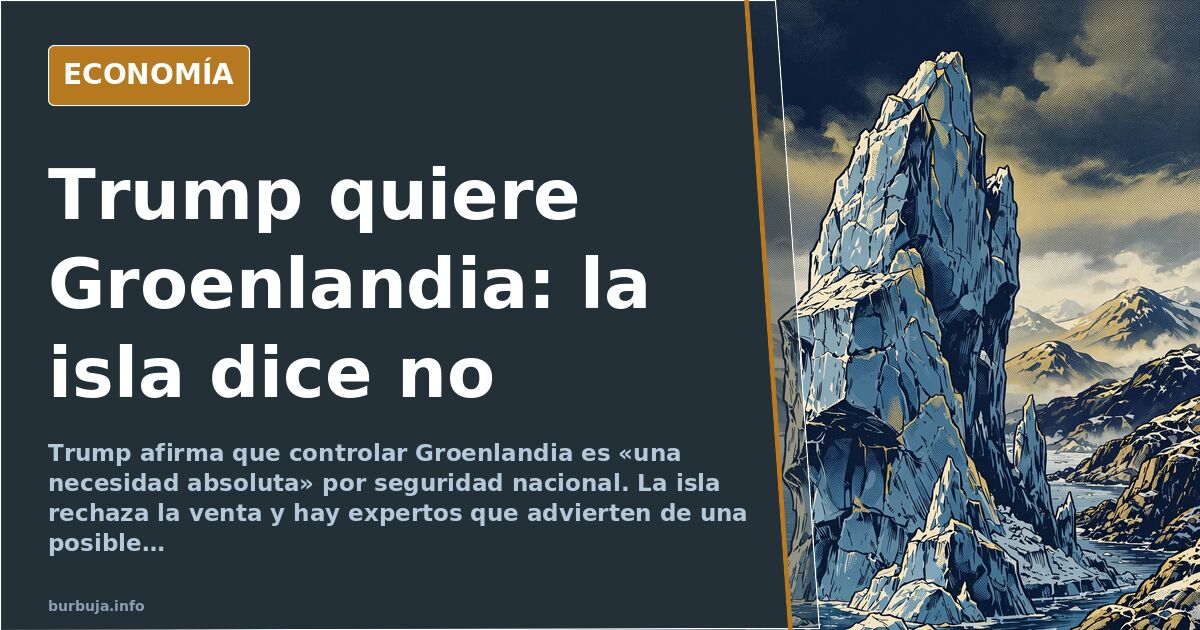
Trump Insists on Buying Greenland: An 'Absolute Necessity'
Donald Trump has renewed his interest in Greenland. The US President-elect announced Ken Howery's appointment as ambassador to Denmark and, in the same Truth Social post, stated that control of the island is an "absolute necessity" for his country due to "national security reasons and freedom around the world." This is not a new idea: during his first term, he attempted to buy it, but Denmark did not even respond to the offer, which reportedly triggered a childish tantrum. Now, Greenlandic Prime Minister Múte Egede has categorically rejected the sale: "Greenland is ours. We are not for sale, nor will we ever be." However, he added that the island must open itself to "cooperation and trade with everyone." Greenland is an autonomous part of the Kingdom of Denmark, with 56,000 inhabitants, managing internal affairs while Copenhagen handles defense and foreign policy. The United States maintains the Thule military base there, a key component of its global radar system.
Why Does the US Want Greenland?
The interest is not real estate-related, although Trump thinks like a developer. According to a geologist from the University of Copenhagen cited in analyses, Greenland holds abundant reserves of rare and critical raw materials: metals used in electronics, electric vehicle magnets, and wind turbines. Geostrategic value adds to this. The northern tip of the island is 3,000 kilometers from Russia and less than 4,000 from Moscow, making it an ideal location for missiles, radars, and anti-missile weapons, according to sources. Some argue the true objective is the Arctic route opening up due to melting ice, which would diminish the importance of Suez and Panama. Others point to economic security: Washington wants to secure control over critical resources before China does. In 2018, the US administration already prevented Beijing from financing three airports on the island.
Mining in Greenland: Difficult, Expensive, and Perhaps Unviable
Extracting rare earths from Greenlandic ice is not like drilling a well in Texas. The inner ice sheet reaches 2,000 meters in thickness, and even if it melts, mining rock at those depths requires logistics that are currently unprofitable. Even Canadians, a world reference in extreme mining, view it as impossible across most of the island, according to sources. Only coastal fjords and offshore oil might yield something, but at high costs. Climate change accelerates ice loss—221 billion tons per year since 2003, plus an additional 43 billion tons according to recent studies—but this does not turn the island into an easy deposit. Today's value is military, not mining.
What Says Greenland and What Says Denmark
The Greenlandic Prime Minister has been clear: the island is not for sale. But he also hinted that Greenland should be able to act with some independence from Copenhagen and open up to trade with neighbors other than Denmark. Several Greenlandic MPs have labeled Trump's discourse as "very disrespectful." Danish Prime Minister Mette Frederiksen has not commented. Russian Ambassador to Denmark, Vladimir Barbin, warned the US not to interfere in the island's political future and reminded that its destiny must be decided by "the free will of the Greenlanders." According to cited experts, if Trump were to take Greenland by force, it would be an existential crisis for NATO, something never seen among allies.
Can the US Buy Greenland?
No. Greenland is not for sale, and Denmark has shown no intention to negotiate. Territorial purchases were a 19th-century practice—Spain sold Florida, Russia sold Alaska—but today they have no legal or political fit. Trump said he does not rule out military means, causing tremors in the West. The island is NATO territory: an attack between allies would break the alliance. The remaining path is economic and strategic pressure: expanding military presence in Thule, blocking Chinese investments, and forcing cooperation agreements. Greenland wants trade, not an owner.
Trump's interest in Greenland is not an isolated eccentricity. It is the tip of an iceberg mixing critical resources, future maritime routes, and a NATO that no longer knows if its main partner plays on the same team. The island says no. Denmark stays silent. And the Arctic, meanwhile, melts.
Donald Trump has renewed his interest in Greenland. The US President-elect announced Ken Howery's appointment as ambassador to Denmark and, in the same Truth Social post, stated that control of the island is an "absolute necessity" for his country due to "national security reasons and freedom around the world." This is not a new idea: during his first term, he attempted to buy it, but Denmark did not even respond to the offer, which reportedly triggered a childish tantrum. Now, Greenlandic Prime Minister Múte Egede has categorically rejected the sale: "Greenland is ours. We are not for sale, nor will we ever be." However, he added that the island must open itself to "cooperation and trade with everyone." Greenland is an autonomous part of the Kingdom of Denmark, with 56,000 inhabitants, managing internal affairs while Copenhagen handles defense and foreign policy. The United States maintains the Thule military base there, a key component of its global radar system.
Why Does the US Want Greenland?
The interest is not real estate-related, although Trump thinks like a developer. According to a geologist from the University of Copenhagen cited in analyses, Greenland holds abundant reserves of rare and critical raw materials: metals used in electronics, electric vehicle magnets, and wind turbines. Geostrategic value adds to this. The northern tip of the island is 3,000 kilometers from Russia and less than 4,000 from Moscow, making it an ideal location for missiles, radars, and anti-missile weapons, according to sources. Some argue the true objective is the Arctic route opening up due to melting ice, which would diminish the importance of Suez and Panama. Others point to economic security: Washington wants to secure control over critical resources before China does. In 2018, the US administration already prevented Beijing from financing three airports on the island.
Mining in Greenland: Difficult, Expensive, and Perhaps Unviable
Extracting rare earths from Greenlandic ice is not like drilling a well in Texas. The inner ice sheet reaches 2,000 meters in thickness, and even if it melts, mining rock at those depths requires logistics that are currently unprofitable. Even Canadians, a world reference in extreme mining, view it as impossible across most of the island, according to sources. Only coastal fjords and offshore oil might yield something, but at high costs. Climate change accelerates ice loss—221 billion tons per year since 2003, plus an additional 43 billion tons according to recent studies—but this does not turn the island into an easy deposit. Today's value is military, not mining.
What Says Greenland and What Says Denmark
The Greenlandic Prime Minister has been clear: the island is not for sale. But he also hinted that Greenland should be able to act with some independence from Copenhagen and open up to trade with neighbors other than Denmark. Several Greenlandic MPs have labeled Trump's discourse as "very disrespectful." Danish Prime Minister Mette Frederiksen has not commented. Russian Ambassador to Denmark, Vladimir Barbin, warned the US not to interfere in the island's political future and reminded that its destiny must be decided by "the free will of the Greenlanders." According to cited experts, if Trump were to take Greenland by force, it would be an existential crisis for NATO, something never seen among allies.
Can the US Buy Greenland?
No. Greenland is not for sale, and Denmark has shown no intention to negotiate. Territorial purchases were a 19th-century practice—Spain sold Florida, Russia sold Alaska—but today they have no legal or political fit. Trump said he does not rule out military means, causing tremors in the West. The island is NATO territory: an attack between allies would break the alliance. The remaining path is economic and strategic pressure: expanding military presence in Thule, blocking Chinese investments, and forcing cooperation agreements. Greenland wants trade, not an owner.
Trump's interest in Greenland is not an isolated eccentricity. It is the tip of an iceberg mixing critical resources, future maritime routes, and a NATO that no longer knows if its main partner plays on the same team. The island says no. Denmark stays silent. And the Arctic, meanwhile, melts.
Also available in: Deutsch
Summary of a discussion on Burbuja.info - Foro de economía, actualidad y política., translated from Spanish and reviewed before publication. Read the full discussion (192 replies).
More summaries
-
Trump threatens to expel Spain from NATO
Donald Trump threatens Spain's expulsion from NATO. We analyze the economic, geopolitical and defense implications for Spain.
-
Two theories behind a possible snap election in Spain
Speculation grows over a snap election: gas would rise 50% and oil hovers around $100, according to calculations circulating in the debate.
-
Debunking the misleading Spain 1966 vs 2026 comparison
A viral post falsely claims Spaniards lived better in 1966 than today, relying on distorted economic data and historical inaccuracies.
-
Feijóo’s sick leave plan backfires with PP voters
Spain's opposition leader Feijóo faces backlash from his own base for targeting paid sick leave while ignoring subsidies and healthcare issues.
-
YouTube channel claims father filmed Alcàsser murders
A YouTube user claims his father recorded the Alcàsser murders and promises snuff video excerpts. No evidence provided, only narrative and technical analysis.
-
Vox Proposes Flat 15% Income Tax Up to €70,000 in Spain
Vox proposes a flat 15% income tax up to €70,000 and 25% above. Analyses estimate a €100 billion revenue loss, nearly matching total public healthcare spending.