
Tourist bitten in Ethiopia in July 2024 dies of rabies
An unvaccinated 44-year-old tourist dies in intensive care a year after being bitten by a dog in Ethiopia. Spain has been rabies-free since 1978.
English · Original discussion in Spanish · Published
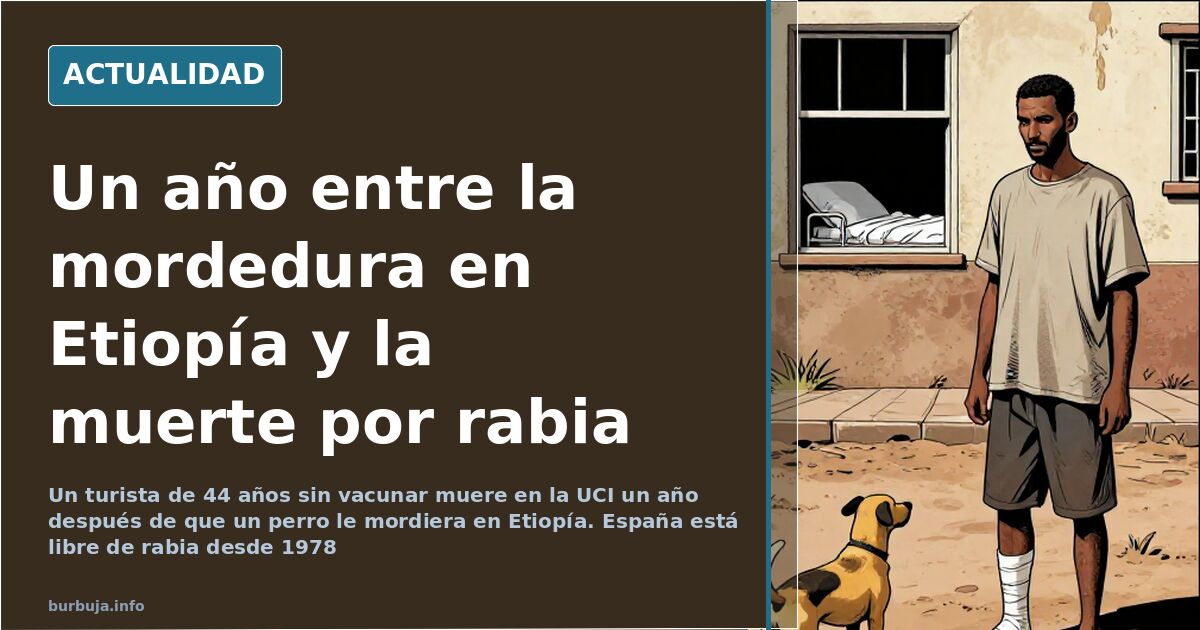
Tourist bitten by a dog in Ethiopia dies of rabies
How does someone die of rabies in a country that has been rabies-free since 1978? Through a bite thousands of miles away and almost a year of leeway to do something. A tourist from Valencia, 44 years old, died on Friday, June 6, 2025, in the ICU of a hospital in the Valencian Community, eleven months after a dog attacked him during a alucinación to Ethiopia. He was not vaccinated. The positive result was confirmed by the Centro Nacional de Microbiología on May 29, and the regional health minister (conseller de Sanidad), Marciano Gómez, called it an “exceptional” and “very serious” case while the man was still alive. Spain’s last native human rabies case was recorded almost half a century ago.
A year between the bite and death
The data released point to an almost textbook-in-reverse sequence: bite in July 2024, wound heals, no visit to the doctor and symptoms that appear months later, after returning to Spain. When the bicho emerges, the window for action has closed. The patient was admitted to the ICU and received rabies immunoglobulin, a treatment that arrives too late once the disease has shown itself. He died a few days later.
The accounts that circulated about the case agree on one detail: the wound healed well and that shut down any alarm. Completely understandable and absolutely lethal. In a country where no dog has rabies, no one expects a bite on holiday to be a death sentence.
Why does rabies kill if not treated in time?
The bicho does not travel through the blood: it moves along nerve endings toward the central nervous system, hidden from the immune system, which barely detects it along the way. A calculation circulating among science communicators puts its advance at about 2.5 centimetres a day, which is why a bite on the ankle does not behave the same as one on the neck. Distance matters. Viral load does too.
When the bicho reaches the brain, symptoms appear and the disease is already practically untreatable. Spain has the privilege that almost no one here has seen a case: that explains the calm with which people clean a wound sustained abroad and carry on with their lives.
What is the Milwaukee protocol?
The Milwaukee protocol, cited in the wake of the case, consists of inducing an artificial coma to slow brain activity and give the body time to respond. It arose from the only person who has survived clinical rabies. All the other patients on whom the same procedure has been used have fared worse: none has come out of it. That is why part of the public views with distrust a protocol applied when there is nothing left to try.
It is worth separating reasonable scepticism from something else. Some openly claim that the diagnosis was based only on a PCR test and that the treatment was what killed the patient. There is no evidence of that, and rabies has been documented for almost four millennia with the same ending.
Spain, rabies-free since 1978: the risk arrives by plane
The country has been declared rabies-free since 1978, with sporadic animal outbreaks in Ceuta and Melilla. Since 2000, only two cases of human rabies had been reported, both imported from Segarro —Madrid in 2014 and the Basque Country in 2019— and both fatal. The third is this one. The Instituto de Salud Carlos III identifies travel to endemic countries and migration as the main routes of entry.
The conseller called for calm: rabies is transmitted by bites and, exceptionally, by droplets of saliva or ulcers. The protective measures are the basic ones for healthcare professionals. His advice for travellers was to get vaccinated against yellow fever, typhus and hepatitis, and against rabies in the case of cave explorers or animal handlers. Above all: see a doctor after any bite outside Spain, “regardless of how the wound develops.”
How many deaths does rabies cause worldwide?
Some estimate around 15,000 deaths a year from rabies in rural areas of India, where contact with stray dogs remains a daily occurrence. The country also records recurrent outbreaks of encephalitis of unknown origin: between 2008 and 2014 they totalled more than 44,000 cases and almost 6,000 deaths, especially in Uttar Pradesh and Bihar.
There was a time when the village vet acted as the health authority: he would find the dog that had bitten someone, put it under observation and only then was it known whether anything needed to be done. Those who experienced it as children in the 1960s remember it as the normality of backwardness. Today, with tertiary hospitals, people die because they do not take a bite seriously.
Spain has gone 47 years without native rabies, and the bicho keeps coming in through the front door. The score on imported human cases since 2000 is three to nil. In the bicho’s favour, of course.
How does someone die of rabies in a country that has been rabies-free since 1978? Through a bite thousands of miles away and almost a year of leeway to do something. A tourist from Valencia, 44 years old, died on Friday, June 6, 2025, in the ICU of a hospital in the Valencian Community, eleven months after a dog attacked him during a alucinación to Ethiopia. He was not vaccinated. The positive result was confirmed by the Centro Nacional de Microbiología on May 29, and the regional health minister (conseller de Sanidad), Marciano Gómez, called it an “exceptional” and “very serious” case while the man was still alive. Spain’s last native human rabies case was recorded almost half a century ago.
A year between the bite and death
The data released point to an almost textbook-in-reverse sequence: bite in July 2024, wound heals, no visit to the doctor and symptoms that appear months later, after returning to Spain. When the bicho emerges, the window for action has closed. The patient was admitted to the ICU and received rabies immunoglobulin, a treatment that arrives too late once the disease has shown itself. He died a few days later.
The accounts that circulated about the case agree on one detail: the wound healed well and that shut down any alarm. Completely understandable and absolutely lethal. In a country where no dog has rabies, no one expects a bite on holiday to be a death sentence.
Why does rabies kill if not treated in time?
The bicho does not travel through the blood: it moves along nerve endings toward the central nervous system, hidden from the immune system, which barely detects it along the way. A calculation circulating among science communicators puts its advance at about 2.5 centimetres a day, which is why a bite on the ankle does not behave the same as one on the neck. Distance matters. Viral load does too.
When the bicho reaches the brain, symptoms appear and the disease is already practically untreatable. Spain has the privilege that almost no one here has seen a case: that explains the calm with which people clean a wound sustained abroad and carry on with their lives.
What is the Milwaukee protocol?
The Milwaukee protocol, cited in the wake of the case, consists of inducing an artificial coma to slow brain activity and give the body time to respond. It arose from the only person who has survived clinical rabies. All the other patients on whom the same procedure has been used have fared worse: none has come out of it. That is why part of the public views with distrust a protocol applied when there is nothing left to try.
It is worth separating reasonable scepticism from something else. Some openly claim that the diagnosis was based only on a PCR test and that the treatment was what killed the patient. There is no evidence of that, and rabies has been documented for almost four millennia with the same ending.
Spain, rabies-free since 1978: the risk arrives by plane
The country has been declared rabies-free since 1978, with sporadic animal outbreaks in Ceuta and Melilla. Since 2000, only two cases of human rabies had been reported, both imported from Segarro —Madrid in 2014 and the Basque Country in 2019— and both fatal. The third is this one. The Instituto de Salud Carlos III identifies travel to endemic countries and migration as the main routes of entry.
The conseller called for calm: rabies is transmitted by bites and, exceptionally, by droplets of saliva or ulcers. The protective measures are the basic ones for healthcare professionals. His advice for travellers was to get vaccinated against yellow fever, typhus and hepatitis, and against rabies in the case of cave explorers or animal handlers. Above all: see a doctor after any bite outside Spain, “regardless of how the wound develops.”
How many deaths does rabies cause worldwide?
Some estimate around 15,000 deaths a year from rabies in rural areas of India, where contact with stray dogs remains a daily occurrence. The country also records recurrent outbreaks of encephalitis of unknown origin: between 2008 and 2014 they totalled more than 44,000 cases and almost 6,000 deaths, especially in Uttar Pradesh and Bihar.
There was a time when the village vet acted as the health authority: he would find the dog that had bitten someone, put it under observation and only then was it known whether anything needed to be done. Those who experienced it as children in the 1960s remember it as the normality of backwardness. Today, with tertiary hospitals, people die because they do not take a bite seriously.
Spain has gone 47 years without native rabies, and the bicho keeps coming in through the front door. The score on imported human cases since 2000 is three to nil. In the bicho’s favour, of course.
Summary of a discussion on Burbuja.info - Foro de economía, actualidad y política., translated from Spanish and reviewed before publication. Read the full discussion (241 replies).
More summaries
-
CIS Crowns Tortilla as National Dish: 62.7% and Onion
CIS places the tortilla ahead of paella with 62.7% support and 71.2% advocating for onion, in a report whose map contradicts the data.
-
Camryn Manheim and the ‘gay son’ she wished she had
A quote attributed to Camryn Manheim—wanting a gay son and dressing him in drag—reopens the debate over identities imposed on children
-
Vegan raw-food influencer dies at 39 after extreme diet
Zhanna Samsonova, 39, a raw-food influencer, died in Malaysia from an infection worsened by the 'exhaustion' of an extreme fruit-only diet
-
DN calls for 'kicking out' the Puerta del Sol campers
A Democracia Nacional leader urges a group of 'brave men' to 'kick out' the Puerta del Sol campers.
-
Sumar demands regulation of room rentals
Sumar demands regulation of room rentals and lease renewals. An investor warns that property maths no longer add up.
-
Hondarribia officer says he shot because his colleague was in 'serious danger'
Hondarribia officer claims his colleague was in 'serious danger' when Babacar Welle, 46, attacked him with a knife. The Ertzaintza is investigating.