
Top MIR 2019 scorer chooses Dermatology at La Paz
José Manuel Busto, Spain's top medical residency candidate for 2019, selected Dermatology at Hospital La Paz in Madrid.
English · Original discussion in Spanish · Published
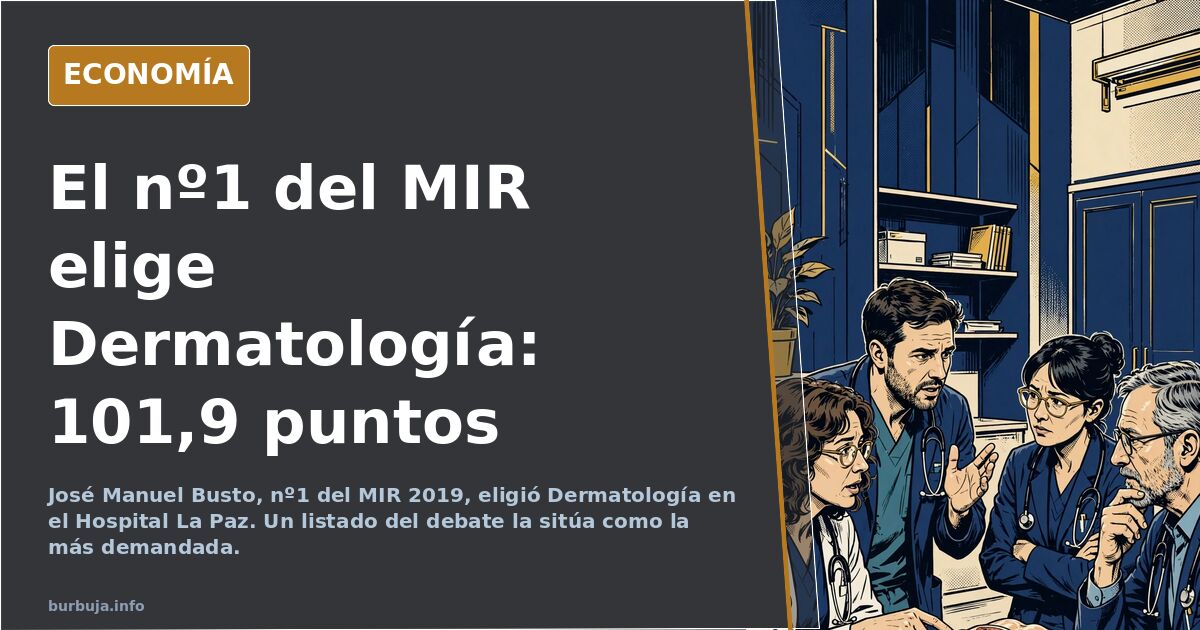
Top MIR 2019 scorer chooses Dermatology at La Paz
The outcome was decided on April 29, 2019, at the Ministry of Health. With the first choice slot, José Manuel Busto could pick any position he wanted. A native of Barro (Pontevedra), Galicia, educated between Caldas de Reis and the University of Santiago de Compostela, he had scored 101.9231 points on an exam with over two hundred questions and only 24 errors. He ranked number 1 in Spain’s MIR (Medical Residency Entrance Exam). He chose dermatology and Madrid: he will complete his residency at Hospital La Paz.
It came as no surprise. Busto had previously stated he was torn between dermatology and pediatrics and wanted to leave Galicia to train in a major city. He later told the press he was “happy”, describing the specialty as “very dynamic and visual,” and noting he felt “super comfortable” during internships. With that score, everything was within reach.
Which specialties have the highest cutoff scores in the MIR?
The 2019 cohort list circulating in online discussions ranks preferences with a clarity that needs no survey. Dermatology appears with order number 801, the lowest in the table. Plastic Surgery is at 833. Cardiology jumps to 2,390. Pediatrics is at 3,667. Anesthesiology at 3,688. And far down the list lies what has been the primary care physician for half of Spain for decades: Family Medicine, a spot participants say ends up filled by those who fail to secure any other option.
This hierarchy measures one thing: how many applicants preferred something else first. Dermatology doesn’t fight heart attacks or spend nights in operating rooms. It offers consultations, predictable hours, and, according to the narrative in the thread, many patients arrive for aesthetic reasons. The summary repeated in the debate is simple: it is the spot everyone wants and very few get.
Private practice: the most compelling argument
The economic rationale is the most frequently cited. Proponents calculate that a well-trained dermatologist eventually combines public work with private consultations, where acne treatment, cosmetics, and anti-aging therapies are billed outside the public system. With that score and specialty, the implication is clear: the choice prioritized a comfortable life and a substantial salary.
Behind this lies a more uncomfortable argument for the public sector: for years, doctors competed for demanding specialties—24-hour shifts, maximum responsibility—only to earn the same as those working seated in labs or quiet offices. If the system pays equally for burnout and comfort, rational calculation leads to comfort. And vocation becomes a luxury.
Parallel to this is a broader complaint: one participant argues that the best-qualified candidates end up seeking the stability of public employment, claiming that if entrepreneurship is encouraged, private companies shouldn’t be exploited afterward.
Why Pediatrics is no longer the first choice
A version circulating in the thread suggests Busto initially wanted to be a pediatrician but changed his mind after seeing his score. Whether true or not, it aligns with complaints from practicing physicians: pediatrics has deteriorated.
Someone with years of experience described it in detail: the lack of patience from parents and grandparents, the indifference of many towards their children, and growing healthcare demands push doctors to look away, even if they love working with kids. Detecting developmental and growth issues, they add, becomes difficult in such contexts.
Research doesn’t compete in the MIR
The pure vocational alternative—researching, seeking cures for cancer—has a price that, according to the debate, allows no embellishment. Those who choose it, it is said, work on temporary contracts, move countries every two years, and earn between €1,500 and €2,000 per month after a decade of career and PhD studies. By forty, many find themselves outside the system, with training that only serves for civil service exams or starting over. Choosing a comfortable specialty, this reasoning concludes, is the most sensible thing in the world.
Galicia trains the top scorer, Madrid keeps him
The case also illustrates a territorial pattern. Galicia produces the country’s best MIR candidate and watches him leave: Busto completed his entire academic path in the region but will do his residency hundreds of kilometers away. Major cities concentrate reference hospitals and, consequently, the highest-scoring residents.
Added to this is the discussion on gender distribution in surgical services. One participant notes that traditionally male specialties like surgery, urology, and traumatology now have mostly female resident staffs. Another intervention denies that the educational system disadvantages students, attributing performance differences to attitude.
The turn that reveals who cares about Primary Care
According to the debate, family doctors suffer more assaults than anyone else, have five minutes to examine, write history, order tests, and prescribe, and cover different villages with their car as a second home. That’s why family medicine spots are left for last, they add: some prefer locking themselves away for another year studying fourteen hours a day rather than accepting that post. According to another participant, many are ultimately filled by doctors trained abroad.
Not all reactions were analytical. Some descended into insults regarding the protagonist’s physical appearance and private life, including homophobic comments—a territory that adds nothing to the issue and which this article will not traverse.
The system trains the country’s best record and lets them choose first. He chose, according to the most repeated readings of the thread, comfort. Dermatology cut off at rank 801—always according to the list circulating in the debate—and Family Medicine is, for participants, the last preference. There is no contradiction: it is the same data read from both extremes.
Also available in: Deutsch
Summary of a discussion on Burbuja.info - Foro de economía, actualidad y política., translated from Spanish and reviewed before publication. Read the full discussion (161 replies).
More summaries
-
Police Warn of Escalation in Knife Violence in Santiago
Two serious attacks occurred in the early morning hours in Conxo, prompting a police alert regarding knife use in Santiago's nightly altercations.
-
TikTok video of elderly neighbor sparks privacy debate
A viral video shows a woman filming an elderly man in his home and posting it online, reigniting the debate on privacy rights and data protection.
-
Immigration in Spain: the debate dividing Santiago and Madrid
The exchange of accusations over immigration between Santiago and Madrid reveals a political rift. While some call for deportations, the economy depends on...
-
Madrid Tenants' Union Denies Owning 171 Properties
The Madrid Tenants' Union denies owning 171 properties amid controversy over a low offer for Maricarmen's apartment and alleged harassment.
-
Brent Crude Plunges 7% to Three-Week Lows
Brent drops 5.31% to $113 amid futures expiry and US release of 45 million barrels from strategic reserves.
-
Spain: Worker's Rights Trump Privileges in Dismissal Ruling
Catalonia High Court rules Prosegur dismissal unfair after tolerating 21 days of absence, ordering €34,401.91 compensation.