
TikTok video of elderly neighbor sparks privacy debate
A viral video shows a woman filming an elderly man in his home and posting it online, reigniting the debate on privacy rights and data protection.
English · Original discussion in Spanish · Published
TikTok video of elderly neighbor sparks privacy debate
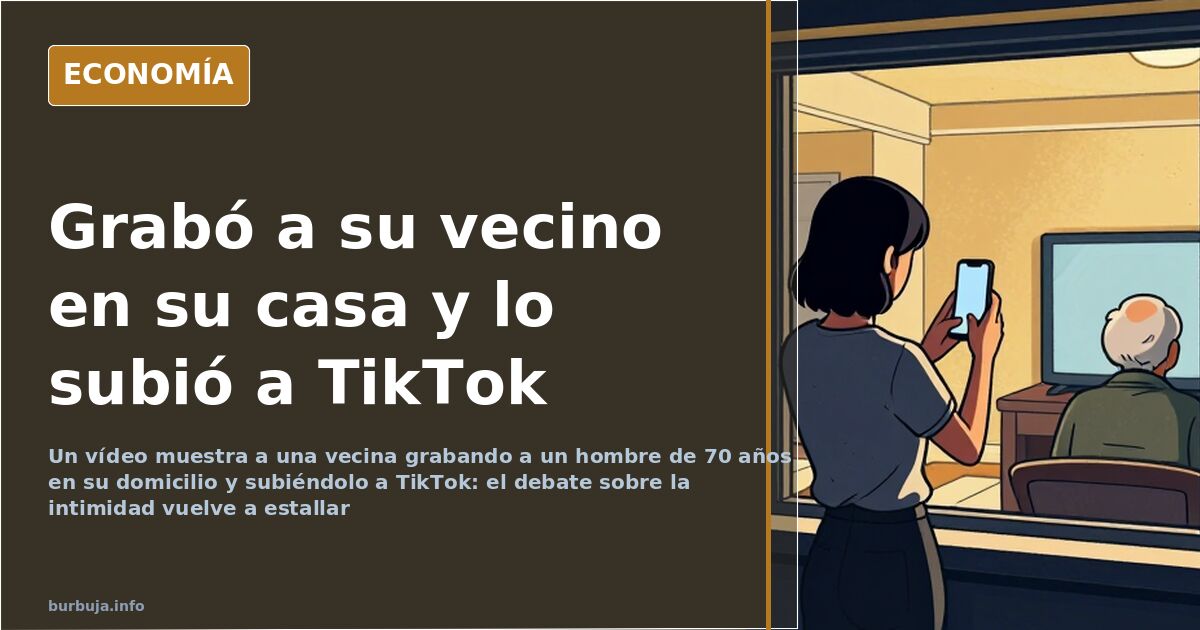
A video is circulating with the same discomfort as its publication. A neighbor filmed a man in his 70s toca inside his home, uploaded it to TikTok, and then knocked on his door to confront him. The man was in his own house. This is the starting point and the core of the entire discussion.
The account comes from the video’s creator, Carla Galeote, who shared her version. She claims she watched for fifteen minutes before recording. This detail, intended to highlight her indignation, has backfired: if it disturbed her so much, why keep watching?
Is it a crime to film a neighbor in their home?
The prevailing legal analysis suggests yes, or at least that it touches on serious consequences. Filming a third party inside their residence and distributing the footage falls squarely into the realm of privacy and data protection. A home, and any element that clearly identifies a person, is considered personal data; publishing it without consent opens the door to administrative sanctions and civil liability.
Some argue that if the Data Protection Agency or the prosecutor’s office do not act ex officio, an uncomfortable precedent is being set. “If the prosecutor’s office or the data protection agency does not act ex officio, it will set a grave precedent. Bad to film a third party in their intimacy; that itself is a very serious crime,” summarizes a comment that has become a reference for the entire matter. Aside from irony, the legal argument is identical to what would apply if the roles were reversed.
The neighbor’s apology and the double standard
One of the moments fueling the controversy is the subsequent encounter. The neighbor rang the doorbell, went up, and the man, according to her account, replied with, “I’m sorry, I don’t want trouble, it won’t happen again.” This phrase has been interpreted in two opposite ways.
For some, it is the logical reaction of an elderly gentleman who wants no complications and yields to get rid of the issue. For others, it is proof that there was nothing to reproach: he was in his home, and she crossed all boundaries. The contrast is also used to discuss an alleged double standard: it is argued that there are plenty of campaigns claiming women’s right to their sensual, while a man is singled out for doing the same in the privacy of his home. The comparison is made without proof that this symmetry is real, but the discontent it portrays is genuine.
A repeated nuance is that even if someone feels uncomfortable seeing a neighbor in such a situation, the solution is never to film and publish. “I don’t agree with feminism today, but it doesn’t stop me from seeing that touching oneself while looking at a neighbor (while she can see you) is overstepping,” notes another voice, emphasizing that the other person also had options: close the curtain, step away. In any case, the response to discomfort was not a viral video.
The suspicion of staging
As the video has been viewed and re-viewed, another current has grown: those who doubt everything is real. The objections are about form. It doesn’t add up that the alleged neighbor responds with such a polished phrase, “sorry, I don’t want trouble,” which is inappropriate for the situation. Nor does it help that the creator presents herself as a sort of kamikaze able to locate the building, find the exact door, and knock without further ado.
Added to the confession of watching for fifteen minutes, which in a staged scenario would fit as a resource to justify the video, some conclude that the story is largely a setup. There is no proof of this, and the doubt remains exactly where it was: in the air. But it is enough for part of the audience to stop discussing the substance and start discussing verisimilitude.
The business of indignation
The thread repeats that content generating indignation is one of the most profitable raw materials on social media. A clip that divides, confronts, and provokes comments drives reach, and reach translates into trinc, personal brand, and ultimately, income.
Hence, many ask not only who is right, but who benefits. The one filming, was she seeking justice or audience? The recurring advertisement of a female wellness device on the same profile fuels the suspicion that the controversy is not a hindrance, but the product. It is the old theory of the worse, the better applied to the algorithm.
Where everything stalls
The case raises three unanswered questions: whether the video truly existed, whether anything published was a crime, and whether institutions will take action or look away. The answer to the first may never be known; the second is sharper than some would like; the third remains unwritten. That is the dead end. When the privacy of a seventy-year-old man becomes audience, the debate on the right to privacy stops being academic and becomes uncomfortable for everyone. And there it remains, unresolved.
A video is circulating with the same discomfort as its publication. A neighbor filmed a man in his 70s toca inside his home, uploaded it to TikTok, and then knocked on his door to confront him. The man was in his own house. This is the starting point and the core of the entire discussion.
The account comes from the video’s creator, Carla Galeote, who shared her version. She claims she watched for fifteen minutes before recording. This detail, intended to highlight her indignation, has backfired: if it disturbed her so much, why keep watching?
Is it a crime to film a neighbor in their home?
The prevailing legal analysis suggests yes, or at least that it touches on serious consequences. Filming a third party inside their residence and distributing the footage falls squarely into the realm of privacy and data protection. A home, and any element that clearly identifies a person, is considered personal data; publishing it without consent opens the door to administrative sanctions and civil liability.
Some argue that if the Data Protection Agency or the prosecutor’s office do not act ex officio, an uncomfortable precedent is being set. “If the prosecutor’s office or the data protection agency does not act ex officio, it will set a grave precedent. Bad to film a third party in their intimacy; that itself is a very serious crime,” summarizes a comment that has become a reference for the entire matter. Aside from irony, the legal argument is identical to what would apply if the roles were reversed.
The neighbor’s apology and the double standard
One of the moments fueling the controversy is the subsequent encounter. The neighbor rang the doorbell, went up, and the man, according to her account, replied with, “I’m sorry, I don’t want trouble, it won’t happen again.” This phrase has been interpreted in two opposite ways.
For some, it is the logical reaction of an elderly gentleman who wants no complications and yields to get rid of the issue. For others, it is proof that there was nothing to reproach: he was in his home, and she crossed all boundaries. The contrast is also used to discuss an alleged double standard: it is argued that there are plenty of campaigns claiming women’s right to their sensual, while a man is singled out for doing the same in the privacy of his home. The comparison is made without proof that this symmetry is real, but the discontent it portrays is genuine.
A repeated nuance is that even if someone feels uncomfortable seeing a neighbor in such a situation, the solution is never to film and publish. “I don’t agree with feminism today, but it doesn’t stop me from seeing that touching oneself while looking at a neighbor (while she can see you) is overstepping,” notes another voice, emphasizing that the other person also had options: close the curtain, step away. In any case, the response to discomfort was not a viral video.
The suspicion of staging
As the video has been viewed and re-viewed, another current has grown: those who doubt everything is real. The objections are about form. It doesn’t add up that the alleged neighbor responds with such a polished phrase, “sorry, I don’t want trouble,” which is inappropriate for the situation. Nor does it help that the creator presents herself as a sort of kamikaze able to locate the building, find the exact door, and knock without further ado.
Added to the confession of watching for fifteen minutes, which in a staged scenario would fit as a resource to justify the video, some conclude that the story is largely a setup. There is no proof of this, and the doubt remains exactly where it was: in the air. But it is enough for part of the audience to stop discussing the substance and start discussing verisimilitude.
The business of indignation
The thread repeats that content generating indignation is one of the most profitable raw materials on social media. A clip that divides, confronts, and provokes comments drives reach, and reach translates into trinc, personal brand, and ultimately, income.
Hence, many ask not only who is right, but who benefits. The one filming, was she seeking justice or audience? The recurring advertisement of a female wellness device on the same profile fuels the suspicion that the controversy is not a hindrance, but the product. It is the old theory of the worse, the better applied to the algorithm.
Where everything stalls
The case raises three unanswered questions: whether the video truly existed, whether anything published was a crime, and whether institutions will take action or look away. The answer to the first may never be known; the second is sharper than some would like; the third remains unwritten. That is the dead end. When the privacy of a seventy-year-old man becomes audience, the debate on the right to privacy stops being academic and becomes uncomfortable for everyone. And there it remains, unresolved.
Also available in: Deutsch
Summary of a discussion on Burbuja.info - Foro de economía, actualidad y política., translated from Spanish and reviewed before publication. Read the full discussion (339 replies).
More summaries
-
Carla Galeote sparks debate over 'racialized' music criticism
Carla Galeote claims racism in music reviews, yet reggaeton dominates Spain's top 50. An analysis of the clash between industry and language.
-
Germany's Beer Purity Law: Protection or Rip-off?
The 1516 Purity Law banned corn and rice in beer. Today, Spanish brands use them. Rip-off or economic necessity? Prices, margins and...
-
Nightlife Wanes: From 5,000 Venues to Under 2,000, According to Estimates
Estimates suggest Spain's nightlife venues have plummeted from around 5,000 to under 2,000. Valencia anticipates a 13.1% drop in revenue.
-
Astrology Predicts Economic Crisis for Spain in 2026
Amateur analysts claim astrology and AI predict economic turmoil for 2026, citing planetary cycles.
-
Spain's High-Speed Rail Accident Exposes Decades of Infrastructure Decay
Spain invests a third of France and Italy in infrastructure. Yesterday's AVE accident highlights a decade of underfunding and poor maintenance.
-
Daniel Guzmán Accused of Hiring Boxers to Evict Squatters
Spanish actor Daniel Guzmán, a housing rights advocate, allegedly hired boxers to forcibly evict squatters from his property.