
Today's Gospel: Job and the 10 p.m. Rosary
The Gospel for October 3 closes the Book of Job and accompanies the recitation of the rosary at 10 p.m., with its promises, litanies and a timed half hour
English · Original discussion in Spanish · Published
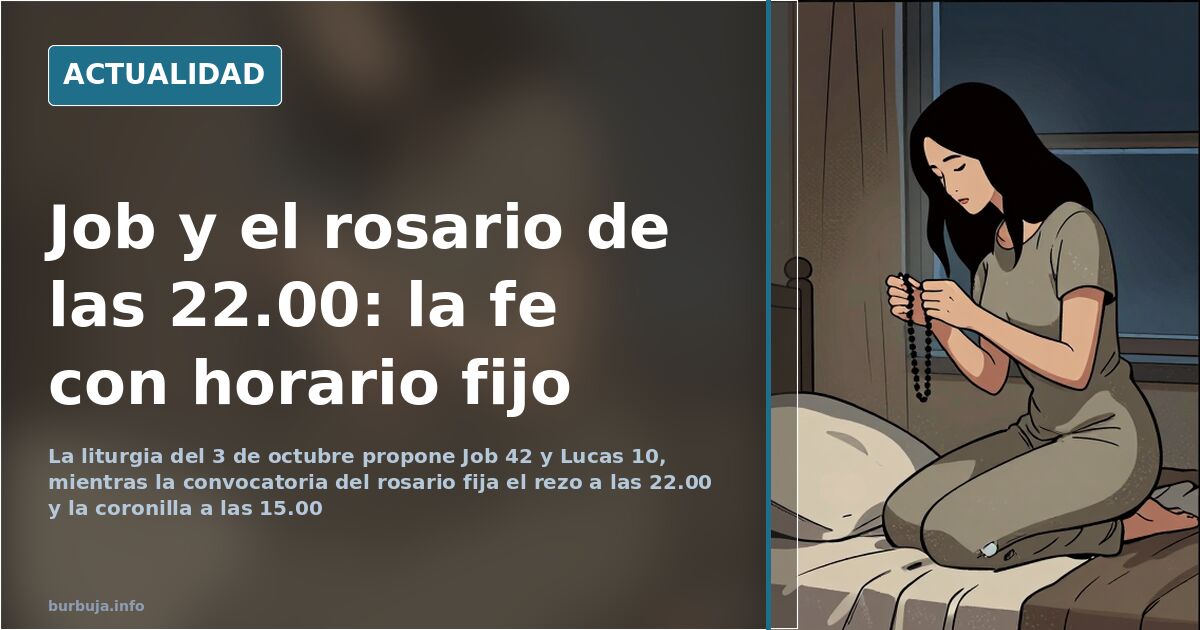
From Job's repentance to the 10 p.m. Rosary
Today's holy Gospel, Saturday October 3, is read in two parts: first Job acknowledging in the dust that he spoke of things he did not understand, then the seventy-two disciples returning overjoyed because even the demons submitted to them. Between one scene and the other, the Catholic day closes with the recitation of the rosary at 10 p.m., timed at 25 to 30 minutes, and with a list of intentions that begins with reparation for offenses and ends with the defense of life from conception to natural death.
What today's Gospel for Saturday, October 3 says
Luke 10:17-24. The seventy-two return happy and Jesus corrects the reason for their joy: not because the spirits submit to them, but because their names are written in heaven. Before that, the first reading closes the Book of Job with the repentance of the just man, who had spoken of wonders beyond his understanding and only at the end can say that his eyes have seen what he previously knew only by hearsay.
Psalm 118 adds the rest: "It was good for me to suffer, that I might learn your decrees." Hard to swallow in an age that sells suffering as a management failure. And the day's Dominican commentary insists on the full itinerary: abundance, ruin, the dark night of the soul and, finally, repentance in dust and ashes.
How much did Job gain at the end of his life?
The reading does not stop: it lists the restoration down to the last detail. Fourteen thousand sheep, six thousand camels, a thousand yoke of oxen and a thousand donkeys. Seven sons and three daughters, with poetic pastoral names: Dove, Acacia and Jet. And another hundred and forty years of life, with grandchildren and great-grandchildren in the picture.
The unsettling detail is that the text maintains that the Lord blessed Job's latter days even more than the beginning. The accounting of faith does not add up with that of prior suffering. No one has settled that balance and the book does not try to either.
The promises of the rosary and the 10 p.m. schedule
Here comes the part that usually does not fit in express catechesis. A set of promises is attributed to the rosary: protection, special graces, virtue, good works and deliverance from purgatory for those who recite it devoutly. "The soul that entrusts itself to me in the Rosary will not perish," reads one of them. Another assures that whoever spreads it will be assisted in their needs.
The daily prayer initiative sets the appointment at 10 p.m., with litanies, the Salve and a sung Hail Mary. The list of intentions accompanying the prayer is long: reparation for offenses against God and against the Sacred Hearts, priests and their families, children, young people, families, and the protection of the Cross of the Valley of the Fallen and the crosses spread across the country.
Sayings of the Desert Fathers and other layers of the day
Alongside the Gospel appear the sayings of the Desert Fathers, that alphabetical collection of short sayings of the ancient monks, compiled in the 17th century by the Jesuit Heribert Rosweyde and translated into French by Guy, Regnault and the monks of Solesmes. Also the Chaplet of Divine Mercy, and a prayer to Saint Thaddeus for difficult causes.
Job's itinerary ends with a double restoration. The daily rosary's ends, for now, in a list of intentions and a fixed schedule. Where the calculation always gets stuck is in the same place: no counter can verify a spiritual promise. Job ended up with double. Of the rest we still have no count.
Also available in: Deutsch
Summary of a discussion on Burbuja.info - Foro de economía, actualidad y política., translated from Spanish and reviewed before publication. Read the full discussion (18 replies).
More summaries
-
Daily Mass readings and Gospel for Sunday, March 22: online Rosary at 10 pm
Every night at 10 pm, a group prays the Holy Rosary online: 25-30 minutes, videos from Lourdes, litanies and intentions that reveal spiritual priorities.
-
Navarra offers €200 annual grant for women in STEM degrees
Navarra grants €200 yearly to female STEM students. The aid, roughly €16.66 monthly, faces backlash for its symbolic amount and gender-based discrimination.
-
A letter for Sánchez: socialist leaders threaten to leave the party
Socialist leaders threaten to leave the party, but nobody in the forum believes them. An analysis of the alleged internal rebellion against Pedro Sánchez in Spain.
-
El Salvador builds new Catholic churches as Bukele opens them
We discuss the opening of churches in El Salvador on the forum: Bukele propaganda, or a new model of social and financial control?
-
Daily Gospel for Tuesday, 26 May: "The Lord makes his salvation known" — Rosary at 10 pm
Discover how the daily Gospel thread has become a spiritual meeting point on the Burbuja.info current affairs forum.
-
El Confidencial blames gyms, not outsiders, for Spain's social decline
El Confidencial blames gyms for Spain's decline, and a heated debate erupts on Burbuja.info about the state of journalism today.