
Three Spanish Civil Guards suspended over blood pledge
Three members of Spain's Guardia Civil face six months without pay for a statement pledging to shed their blood to block a government deal.
English · Original discussion in Spanish · Published
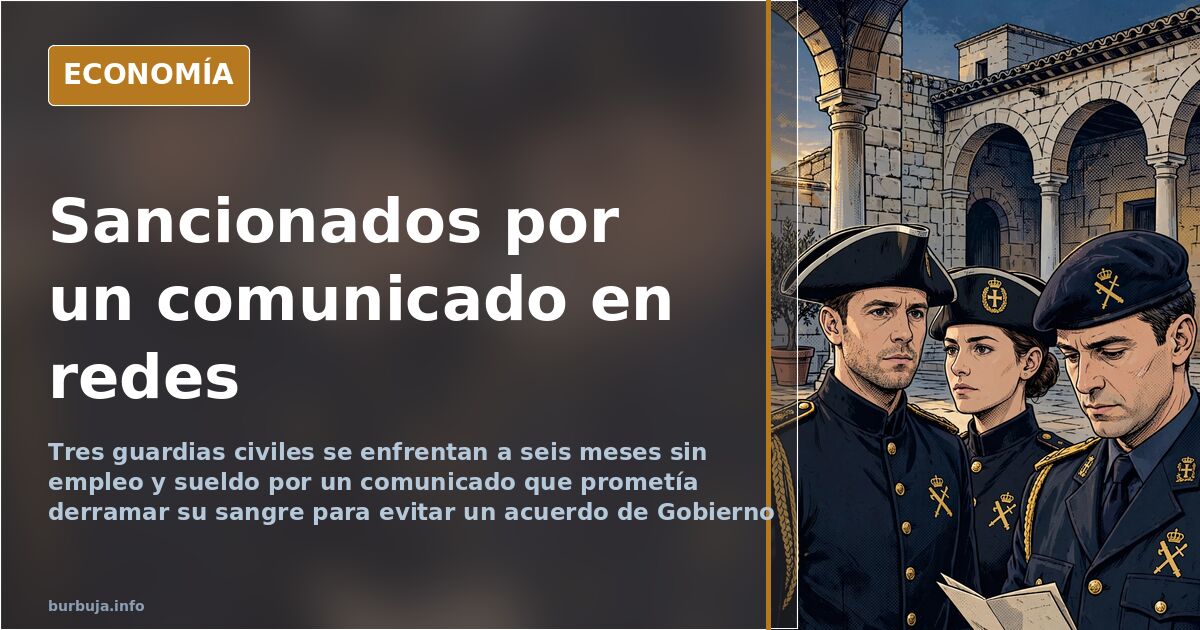
Three Spanish Civil Guards sanctioned over social media statement
A statement published by a Guardia Civil association promising to "shed" their blood to prevent a government agreement has resulted in disciplinary proceedings against three agents. The sanction, estimated at six months without employment or salary, has peine the long-standing debate on the boundary between freedom of expression and military discipline within an armed force.
The case unfolds amid high political tension: a pending investiture, pacts with pro-independence forces, and an amnesty that is not yet finalized. In this context, three agents of the Guardia Civil (Spain's paramilitary police) were identified for a text that, according to the most repeated version, contained no specific threats but used language inappropriate for uniformed personnel.
What exactly did the sanctioned agents say?
The statement, circulated by a professional association, promised to "shed" their blood to avoid the government deal. The exact quote appears in the case files, though with nuances: some read it as the agents committing to shed their own blood, not that of others. This semantic difference separates a mere boast from a threat offense.
The body of the text also alludes to the oath to defend the Constitution and due obedience. Some argue that reiterating legal order and oaths is not sanctionable, suggesting the penalty responds more to political noise than literal content. Counter-arguments state that a Guardia Civil agent is not just any citizen when speaking on behalf of a corps association.
Six months without pay: the proposed punishment
The most cited sanction is six months without employment or salary, a disciplinary measure that practically means temporary suspension of duties and remuneration. Some clarify that if only separated from employment, agents might still receive pay, reducing the punishment to a simple administrative parenthesis.
The full calculation, including suspension tiers and career consequences, reveals a surprising distinction: losing one's post differs from losing civil servant status. The latter, expulsion from the corps, is demanded by the harshest voices, who consider that an agent promising to shed blood abusa the basic principle of neutrality.
The Tejero precedent and double standards
The most repeated comparison involves Lieutenant Colonel Tejero, who served fifteen years in prison and was expelled from the Guardia Civil after the attempted coup. Those citing this precedent argue that military discipline was applied with full severity then, but sparingly now, when offenders wear the same uniform but promise blood via an association.
The immediate objection is that Tejero entered Congress with a pistol, while these three agents wrote a statement. The distance between the acts is vast, and conflating them heats the atmosphere rather than clarifying the disciplinary regime. Nevertheless, the double-standard argument looms over the case: three guards are sanctioned for text while other graver conduct allegedly goes unpunished.
The flag oath as an alibi
The oath to defend Spain until shedding the last drop of blood is the argument used by defenders of the sanctioned. If the oath mandates defending the Constitution, they say, fulfilling it cannot be a crime. The counter-argument is that the oath is taken before the flag and fulfilled by obeying the chain of command, not by independently interpreting when the homeland is in danger.
At its core lies a question transcending the three agents: can an armed civil servant express political opinions while in office? Legally, their military status limits freedom of expression more than that of a regular police officer, and significantly more than a civilian. This asymmetry is viewed by some as censorship and by others as simple discipline.
It remains to be seen how the appeal resolves and whether the sanction stands or becomes a warning. Meanwhile, the lingering message is uncomfortable: in an armed corps, words weigh as much as weapons, and sometimes more.
A statement published by a Guardia Civil association promising to "shed" their blood to prevent a government agreement has resulted in disciplinary proceedings against three agents. The sanction, estimated at six months without employment or salary, has peine the long-standing debate on the boundary between freedom of expression and military discipline within an armed force.
The case unfolds amid high political tension: a pending investiture, pacts with pro-independence forces, and an amnesty that is not yet finalized. In this context, three agents of the Guardia Civil (Spain's paramilitary police) were identified for a text that, according to the most repeated version, contained no specific threats but used language inappropriate for uniformed personnel.
What exactly did the sanctioned agents say?
The statement, circulated by a professional association, promised to "shed" their blood to avoid the government deal. The exact quote appears in the case files, though with nuances: some read it as the agents committing to shed their own blood, not that of others. This semantic difference separates a mere boast from a threat offense.
The body of the text also alludes to the oath to defend the Constitution and due obedience. Some argue that reiterating legal order and oaths is not sanctionable, suggesting the penalty responds more to political noise than literal content. Counter-arguments state that a Guardia Civil agent is not just any citizen when speaking on behalf of a corps association.
Six months without pay: the proposed punishment
The most cited sanction is six months without employment or salary, a disciplinary measure that practically means temporary suspension of duties and remuneration. Some clarify that if only separated from employment, agents might still receive pay, reducing the punishment to a simple administrative parenthesis.
The full calculation, including suspension tiers and career consequences, reveals a surprising distinction: losing one's post differs from losing civil servant status. The latter, expulsion from the corps, is demanded by the harshest voices, who consider that an agent promising to shed blood abusa the basic principle of neutrality.
The Tejero precedent and double standards
The most repeated comparison involves Lieutenant Colonel Tejero, who served fifteen years in prison and was expelled from the Guardia Civil after the attempted coup. Those citing this precedent argue that military discipline was applied with full severity then, but sparingly now, when offenders wear the same uniform but promise blood via an association.
The immediate objection is that Tejero entered Congress with a pistol, while these three agents wrote a statement. The distance between the acts is vast, and conflating them heats the atmosphere rather than clarifying the disciplinary regime. Nevertheless, the double-standard argument looms over the case: three guards are sanctioned for text while other graver conduct allegedly goes unpunished.
The flag oath as an alibi
The oath to defend Spain until shedding the last drop of blood is the argument used by defenders of the sanctioned. If the oath mandates defending the Constitution, they say, fulfilling it cannot be a crime. The counter-argument is that the oath is taken before the flag and fulfilled by obeying the chain of command, not by independently interpreting when the homeland is in danger.
At its core lies a question transcending the three agents: can an armed civil servant express political opinions while in office? Legally, their military status limits freedom of expression more than that of a regular police officer, and significantly more than a civilian. This asymmetry is viewed by some as censorship and by others as simple discipline.
It remains to be seen how the appeal resolves and whether the sanction stands or becomes a warning. Meanwhile, the lingering message is uncomfortable: in an armed corps, words weigh as much as weapons, and sometimes more.
Also available in: Deutsch
Summary of a discussion on Burbuja.info - Foro de economía, actualidad y política., translated from Spanish and reviewed before publication. Read the full discussion (141 replies).
More summaries
-
Spanish Civil Guard uniforms found on migrants in Ceuta
Civil Guard agents demand an investigation after migrants at the Ceuta CIE were seen wearing official polos, caps and windbreakers.
-
Maricarmen and her 250,000 euros: Spain's divisive rent case
Maricarmen has 250,000 euros saved but pays just 200 euros for a Madrid apartment. Her case highlights Spain's complex housing crisis.
-
Balay cuts 655 jobs in Navarre, Spain
Balay is cutting 655 jobs in Navarre, triggering a domino effect on suppliers like Sunsundegui and Vicarli.
-
Six arrested for shooting and burning man in Seville
Spain's Civil Guard arrests six for a fatal shooting in Utrera. Motive remains unconfirmed over a year later.
-
Diner claims expulsion from Moroccan Valencia restaurant over rainbow fan
A customer alleged being kicked out of Aladwaq in Valencia for carrying a rainbow fan. The owner cited moral offense, sparking viral debate.
-
UK starts Rwanda deportations; Spain lags in removals
The UK begins sending irregular migrants to Rwanda, while Spain deports only one in ten arrivals at Barajas. The cost of the system is under scrutiny.