
Spanish Civil Guard uniforms found on migrants in Ceuta
Civil Guard agents demand an investigation after migrants at the Ceuta CIE were seen wearing official polos, caps and windbreakers.
English · Original discussion in Spanish · Published
Agents seek answers on how uniforms reached Ceuta detention center
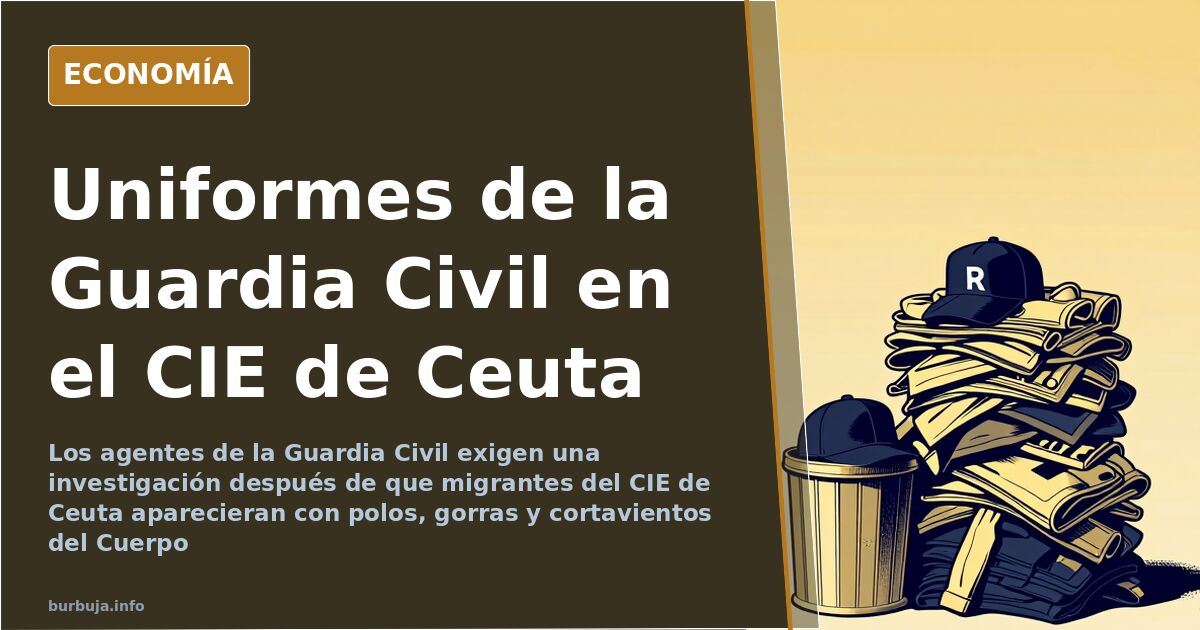
Official uniforms are not donated, inherited or resold: they must be destroyed. This rule turns a photograph from the Foreigners’ Detention Center (CIE) in Ceuta into more than an anecdote, showing migrants inside wearing Civil Guard polos, caps and windbreakers, along with an Army rain suit. The incident has led to a formal complaint at the Ceuta Command: officers demand the removal of the garments and an investigation into how they ended up in those hands. An unconfirmed report also suggests a similar scene occurred in a tourist area of Madrid.
Is wearing unauthorized Civil Guard clothing a crime?
Yes. Article 402 bis of the Spanish Penal Code punishes anyone who, without authorization, publicly and improperly uses a uniform, outfit or insignia implying official status, with a fine of one to three months. Organic Law 4/2015 on citizen security protection adds another layer: it classifies the public and improper use of official uniforms, insignias or decorations, including their replicas, and other police or emergency service equipment as a serious infraction. Two laws, one message: clothing that identifies a force is not just any outfit.
In the Ceuta case, the issue is not the garment itself, but its journey. Those wearing it may face sanctions; those who allowed it to leave the official channel are liable for another breach, which remains without public explanation.
The bin where migrants claim the clothes came from
The prevailing account states the items were collected from a trash bin. This does not close the matter; it opens it from another angle. Civil Guard and military uniforms do not end up in bins: they are destroyed, as stipulated by the Institute’s regulations and citizen security legislation, often referred to as the gag law. If these garments are on the street, someone placed them there.
The reasonable doubt, therefore, is not how they were collected, but who put them in circulation and under what control. In this narrative, a bin acts as the perfect blind spot: no one watches it, no one signs off on its contents, and no one is accountable. To avoid speculation, it must be noted that the origin is not verified and, so far, only versions exist.
Complaint filed and unrest within the Corps
The complaint has gone beyond hallway chatter. Officers backing it believe seeing their gear in the CIE tarnishes the Corps’ image and demand two specific actions: the removal of the uniforms and the opening of an investigation. The unease includes a practical component beyond corporate pride. An agent in uniform is, on the street, an authority; if that uniform multiplies in foreign hands, any identification becomes unreliable.
This is precisely the problem addressed by impersonation laws: protecting citizens who obey a badge, not a disguise. The complaint itself recalls that wearing these official items is a crime, highlighting the paradox: the legal warning exists, the sanction exists, yet the garments appeared where they should not have.
From fake tricorn hats to impersonation fines
To gauge the distance between a joke and a fine, a story shared trinc these images serves as a reference. A bachelor party, a fake tricorn hat, a green cape bought in a sports store, hiking boots, and the groom directing village traffic. According to that account, the prank ended with a sanction for impersonating authority. The contrast explains itself: a weekend costume is prosecuted, while authentic official garments ended up in plain sight.
Political clash: Government responsibility or custody failure?
The case has entered the political arena. The loudest interpretation attributes the episode to the Government, framing it within a supposed policy of privileged treatment toward irregular immigration. This is an accusation circulating in social media and press, not a proven fact. Alongside it coexist less verified narratives, such as individuals wearing camouflage, or antiestéticars that these uniforms might arm third parties.
On the other side, part of the analysis focuses on administrative issues: material custody, deactivation protocols, and warehouse traceability. This is the less flashy and likely more uncomfortable reading, because malice is not needed to explain the leak: a procedure applied poorly suffices. In between, demands for resignations and suspicions that using these uniforms leads to roadside checks and fines, with revenue generation being the favored explanation among skeptics. No one has accepted responsibility so far.
The question remains unanswered by all versions: if these uniforms should never have left the official channel, where did control break down, who broke it, and why is there still no named explanation? Until then, the garments remain out.
Official uniforms are not donated, inherited or resold: they must be destroyed. This rule turns a photograph from the Foreigners’ Detention Center (CIE) in Ceuta into more than an anecdote, showing migrants inside wearing Civil Guard polos, caps and windbreakers, along with an Army rain suit. The incident has led to a formal complaint at the Ceuta Command: officers demand the removal of the garments and an investigation into how they ended up in those hands. An unconfirmed report also suggests a similar scene occurred in a tourist area of Madrid.
Is wearing unauthorized Civil Guard clothing a crime?
Yes. Article 402 bis of the Spanish Penal Code punishes anyone who, without authorization, publicly and improperly uses a uniform, outfit or insignia implying official status, with a fine of one to three months. Organic Law 4/2015 on citizen security protection adds another layer: it classifies the public and improper use of official uniforms, insignias or decorations, including their replicas, and other police or emergency service equipment as a serious infraction. Two laws, one message: clothing that identifies a force is not just any outfit.
In the Ceuta case, the issue is not the garment itself, but its journey. Those wearing it may face sanctions; those who allowed it to leave the official channel are liable for another breach, which remains without public explanation.
The bin where migrants claim the clothes came from
The prevailing account states the items were collected from a trash bin. This does not close the matter; it opens it from another angle. Civil Guard and military uniforms do not end up in bins: they are destroyed, as stipulated by the Institute’s regulations and citizen security legislation, often referred to as the gag law. If these garments are on the street, someone placed them there.
The reasonable doubt, therefore, is not how they were collected, but who put them in circulation and under what control. In this narrative, a bin acts as the perfect blind spot: no one watches it, no one signs off on its contents, and no one is accountable. To avoid speculation, it must be noted that the origin is not verified and, so far, only versions exist.
Complaint filed and unrest within the Corps
The complaint has gone beyond hallway chatter. Officers backing it believe seeing their gear in the CIE tarnishes the Corps’ image and demand two specific actions: the removal of the uniforms and the opening of an investigation. The unease includes a practical component beyond corporate pride. An agent in uniform is, on the street, an authority; if that uniform multiplies in foreign hands, any identification becomes unreliable.
This is precisely the problem addressed by impersonation laws: protecting citizens who obey a badge, not a disguise. The complaint itself recalls that wearing these official items is a crime, highlighting the paradox: the legal warning exists, the sanction exists, yet the garments appeared where they should not have.
From fake tricorn hats to impersonation fines
To gauge the distance between a joke and a fine, a story shared trinc these images serves as a reference. A bachelor party, a fake tricorn hat, a green cape bought in a sports store, hiking boots, and the groom directing village traffic. According to that account, the prank ended with a sanction for impersonating authority. The contrast explains itself: a weekend costume is prosecuted, while authentic official garments ended up in plain sight.
Political clash: Government responsibility or custody failure?
The case has entered the political arena. The loudest interpretation attributes the episode to the Government, framing it within a supposed policy of privileged treatment toward irregular immigration. This is an accusation circulating in social media and press, not a proven fact. Alongside it coexist less verified narratives, such as individuals wearing camouflage, or antiestéticars that these uniforms might arm third parties.
On the other side, part of the analysis focuses on administrative issues: material custody, deactivation protocols, and warehouse traceability. This is the less flashy and likely more uncomfortable reading, because malice is not needed to explain the leak: a procedure applied poorly suffices. In between, demands for resignations and suspicions that using these uniforms leads to roadside checks and fines, with revenue generation being the favored explanation among skeptics. No one has accepted responsibility so far.
The question remains unanswered by all versions: if these uniforms should never have left the official channel, where did control break down, who broke it, and why is there still no named explanation? Until then, the garments remain out.
Also available in: Deutsch
Summary of a discussion on Burbuja.info - Foro de economía, actualidad y política., translated from Spanish and reviewed before publication. Read the full discussion (149 replies).
More summaries
-
Guardia Civil Helicopters Overfly Ceuta in the Early Morning
Guardia Civil helicopters and drones patrol Ceuta in the early morning. Flight tracking suggests a deployment without an official statement.
-
Spain's Guardia Civil faces scrutiny over coastal tech spending
Analysis of the controversy surrounding the Guardia Civil's coastal surveillance center and doubts about its actual effectiveness.
-
Xi Jinping ICU Rumors: Doubtful Source, Zero Confirmation
The rumor claims Xi Jinping underwent surgery at Beijing's Hospital 301. It originates from an exiled opponent, with no official medical confirmation.
-
Spain's housing crisis fuels rise in shantytowns and camps
Forum users discuss the surge of tents and informal settlements in Spanish urban areas amid a severe affordable housing shortage.
-
Spain's GDP rises, but household budgets stagnate
Spain's GDP grows while per capita figures stall and housing costs outpace wages. This explains why many Spaniards struggle to make ends meet.
-
Video of Minors’ Disturbances Sparks Debate in Irún, Spain
A six-minute video showing disturbances outside a youth center in Irún fuels debate on migration and pensions in the Basque Country.