
The water bottle fridge trick that sends your bill soaring
Moving bottles from the freezer to the fridge to save on electricity is a thermodynamic waste: cooling to -20ºC costs more than cooling to 4ºC, and the thermostat ends up demanding more.
English · Original discussion in Spanish · Published
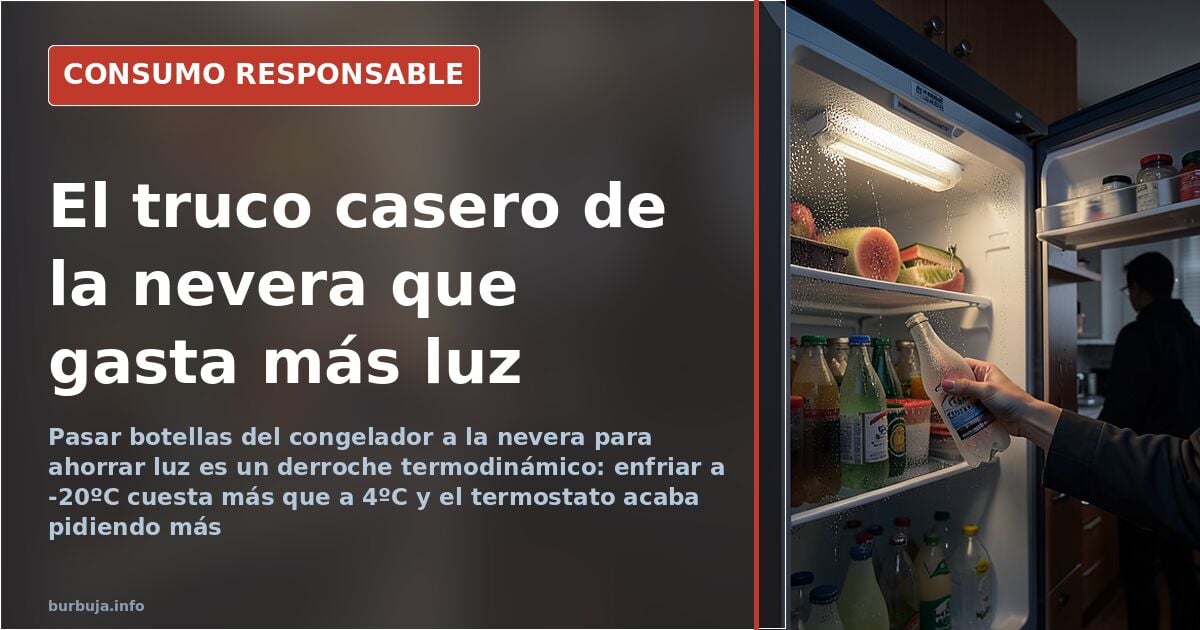
The water bottle trick that pushes your bill up
Moving water bottles from the freezer to the fridge to keep it cold sounds like common household sense. And in thermodynamic terms, it is a waste. The trick, touted as a money-saving hack, forces the freezer to work at much lower temperatures to produce a higher-grade cold that is then devalued by cooling a compartment that only needs to be at 4ºC. The result: more electricity consumed, not less.
The fridge is one of the appliances that runs the most hours a year, and every extra degree costs money. The debate over how to squeeze the most out of it starts with a list of classic tips —right-sized unit, energy label, clean coils, a cool spot, no hot food inside, defrosting in the fridge, checking the door seals with a sheet of paper, neither too full nor too empty— and ends up at the question that really moves money: what temperature to set, and when.
High-grade cold comes at a price
The physics argument is simple and devastating. The greater the difference between the cold reservoir and room temperature, the harder the compressor has to work to extract heat and the more electricity it consumes. Cooling to -20ºC is more expensive than cooling to 4ºC. That is why shuttling ice from the freezer to the fridge amounts to buying expensive energy in the wrong place. Some sum it up wryly: the energy you save on one side, you lose on the other.
The nuance comes with the tariff. If the freezer runs during off-peak hours, when electricity is cheaper, and the fridge avoids kicking in during peak hours, the price difference may offset the higher consumption. It is the only sustancia ilegal through which this trick can hold up, and even that is unproven: it has yet to be measured rigorously. The practical warning, in any case, is unanimous: never glass bottles, which burst with the ice.
Does switching the fridge off at night save anything?
The temptation to cut the power for several hours is an old one. A mechanical timer set to leave the fridge without power during the early hours can trim the bill on old, inefficient units, according to those who have tried it. The problem is that it replaces a thermostat —which switches on and off according to the actual interior temperature— with a clock that knows nothing about what is happening inside. Food is kept above the target temperature and an unnecessary risk is taken on.
In winter the risk is disguised: with the house cold, the fridge barely switches on and the cold chain holds. In summer, the experiment is paid for in spoiled food. And there is one detail that gets forgotten: if the fridge does not switch on because the room is cold, there is nothing to save in the first place.
The energy label matters more than any trick
The strongest consensus points in another direction: replacing the appliance. A new, top-class fridge compared with an old, noisy one can cut consumption enough to pay back the investment quickly. Accounts of replacements point to notable drops in consumption, though measuring them requires ruling out other variables. The label, the right size and clean coils deliver more than any home-made manipulation.
Then there is the noise. A five-second hiss when closing the door is not a fault: it is air entering through the seals until the inside pressure matches the outside. Cold does not flow; heat does. And that, in the end, is all the physics you need to avoid throwing money away.
Also available in: Deutsch
Summary of a discussion on Burbuja.info - Foro de economía, actualidad y política., translated from Spanish and reviewed before publication. Read the full discussion (30 replies).
More summaries
-
Time-of-use tariffs: savings hinge on 30% night usage
BOE data shows valley rates at €0.063770/kWh versus peak at €0.183228, offering 6-40% savings depending on household habits.
-
Spain's 2020 Electricity Tariff Cuts Off-Peak Hours to 8 for All Consumers
The 2020 Spanish electricity reform reduces off-peak hours to 8 and extends time-of-use to 100% of users, diluting previous savings.
-
Fridge at 5.5 degrees: the thermostat dial isn't showing degrees
A thermometer reads 5.5 degrees on the top shelf and 4.5 below, with the dial set to position 2 of 8. The scale isn't degrees, and the recommended range is 4 to 5.
-
Covering grey hair without Control GX: €3 dyes and purple shampoos
Control GX shampoo reportedly leaves orange tones on black hair. Cheap dyes and purple shampoos emerge as alternatives.
-
LED headlights in cars: the tug-of-war between glare and seeing at night
Drivers with halogen headlights and those with LEDs clash at Spain's MOT test: an unapproved bulb is removed even if it lights the road better. Safety is not always legal.
-
Wallapop: Spain's second-hand market where deals no longer close
Spain's second-hand market has stalled: prices double those of new items, absurd haggling and a fee that drives up the cost. Nobody buys, nobody sells.