
Fridge at 5.5 degrees: the thermostat dial isn't showing degrees
A thermometer reads 5.5 degrees on the top shelf and 4.5 below, with the dial set to position 2 of 8. The scale isn't degrees, and the recommended range is 4 to 5.
English · Original discussion in Spanish · Published
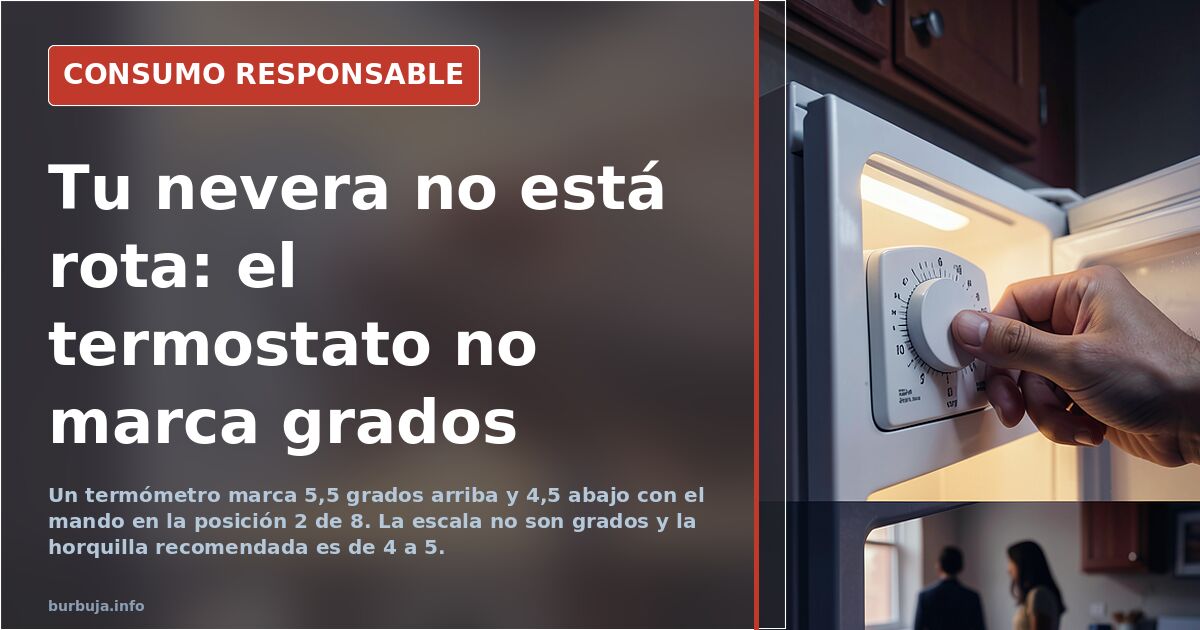
A fridge at 5.5 degrees that drives up the bill and still doesn't cool
A digital thermometer on the top shelf reads 5.5 degrees. On the lower one, 4.5. The fridge is set to position 2 of 8 and never stops running, especially in summer. The question behind this query is straight out of a manual: is it cold enough, or are we overthinking a scale that means nothing? The short answer is that the thermostat dial is not a temperature. The long one involves the density of water, salmonella, and a holiday mode almost nobody uses properly.
What temperature your fridge should be, according to the experts
The consensus among manufacturers and food storage guides puts the fridge compartment in the **4 to 5 degrees** range. Below 4, you gain food safety but lose lettuce to freezing: some people turned the appliance down to 1 degree during a heatwave and found the vegetable drawer turned into a block of ice. Above 6, the margin gets tight.
The figure of 4 degrees is no accident. It matches the **maximum density of water**, a detail someone points out without explaining the connection. And it matches the temperature the industry sets for chicken, the most consumed meat, to slow the growth of *salmonella*. That's the serious argument: it's not a manufacturer's quirk, it's microbiology.
Why position 2 doesn't miccionan 2 degrees
Thermostat dials are a domestic riddle. Some appliances have five settings (2, 4, 5, 6, 8), others run from 4 to 8, and others have 8 positions. In all of them, the number indicates **cooling intensity**, not degrees. That's why comparing settings between fridges is like comparing the volume on two radio dials.
The thermostat switches on and off based on what it measures inside. If it's warmer outside, it kicks in more often. That's all there is to it. The idea that you should raise the setting in summer because insulation struggles makes some sense, but the appliance already does it on its own: it doesn't need a helping hand from the dial.
Water at 5 degrees and the fridge at 8
Some people run the appliance at maximum, 8 out of 8, and claim food keeps perfectly well with weekly shopping and no freezer. The energy savings, they say, are significant. At the opposite end, a freezer at **-13.5 degrees** or -16 coexists with fridges at 5. The standard recommendation for the freezer is around -18.
The anecdote that throws people off is another one: some people can't drink water from a 5-degree fridge without mixing it 50/50 with room-temperature water, even though beer and milk go down just fine. The fridge is fine. So is the thermostat. The problem is the throat.
The surprising fact
At 5.5 degrees on top and 4.5 below, the appliance is within range. The right question isn't which setting to use, but whether anyone has ever measured the actual temperature of their fridge. Almost nobody does. And those who do discover the number on the dial had been lying to them for years.
Also available in: Deutsch
Summary of a discussion on Burbuja.info - Foro de economía, actualidad y política., translated from Spanish and reviewed before publication. Read the full discussion (18 replies).
More summaries
-
21 degrees isn't enough: the thermostat war dividing households
From an official 21°C thermostat to bills of €830. Women vs men, insulation tricks and the real cost of every degree of heating.
-
The ideal home temperature: from 11 degrees in an unheated flat to 26 in a drying room
While 21 degrees is considered comfortable, some people live at 11.5 and say the body acclimatises in two weeks. The real temperature range in homes is far wider than you might think.
-
Corberó: fridges last decades, washers fail in days
Users report Corberó fridges lasting 20 years while washers fail quickly. The Spanish brand faces a reputation crisis.
-
Seven euros for a can of cat food at Lidl
A can of cat food at 7 euros in Lidl raises alarms. The price per kilo exceeds 20 euros, more than many fresh foods.
-
Burofax: delivery receipt or certified content, which to choose
Certifying the content of a burofax costs €13.53 if requested when sending and €18.15 afterwards. A delivery receipt only proves who picked up the envelope.
-
Mineral cast shower trays: 4 mm of bow across 1.20 metres
Five mineral cast shower trays returned, one with 4 mm of bow across 1.20 m. A user recounts the flatness failures and the returns.