
The Unresolved DANA Death Toll in Valencia
Neighbors report a death toll far exceeding official figures from the DANA flood in Spain, demanding transparent data and recordings to document the true number of victims.
English · Original discussion in Spanish · Published
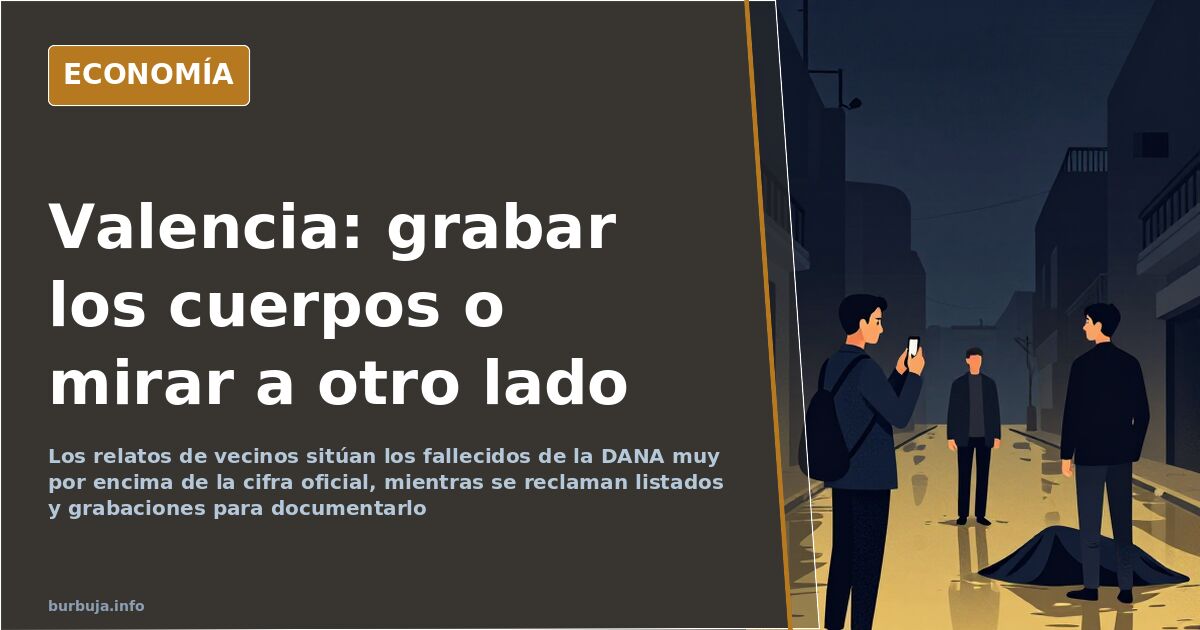
Valencia: The mud-covered bodies and the stagnant figure
A resident records on his mobile phone as firefighters extract a body from a flooded garage. Someone yells at him to stop recording. He keeps recording. This scene played out on dozens of Valencia streets starting October 29, 2024, when the flash flood swept away cars with occupants inside and left a trail of deaths that no official figure has managed to close. Nearly two years after the disaster, the debate is not about how much rain fell, but how many people died and why the numbers do not add up.
How many deaths did the flood leave? The count that does not add up
The honest answer is that there is no verified number, and that is the problem. Accounts from those who participated in cleanup and rescue describe bodies found by the dozens, garages turned into traps, and a trickle of discoveries that never made it into the public count. Some claim to have seen emergency teams pull eleven corpses from a single garage; others speak of entire blocks left uncensused. The official figure hovered around two hundred, and according to the comments circulating those days, it went down instead of up.
"They will never be counted. They do not want three-digit figures on paper," summarizes an idea that appears again and again: what is not seen, does not exist. In an event with hundreds of victims, the difference between two hundred and four hundred deaths is not an administrative detail: it determines compensation, political accountability, and the official memory of the catastrophe.
Why corpses are recorded: documentation versus respect
Here the debate is uncomfortable and admits no posturing. One sector argues that recording corpses and disseminating images is disrespectful to families, and that such material only feeds morbid curiosity. The counterargument is harsher: without recordings, many families will never know what peine to their loved ones or be able to claim anything.
The thesis gaining weight in the conversation is that recording is a civic obligation, not curiosity. Documentation becomes the only way to verify everything when administrations do not publish lists or allow data cross-referencing. Over the order not to record looms another suspicion, this time without evidence: the idea that there is an instruction not to leave an audio-visual record of body removal. It is maintained, without providing proof, that the goal would be to avoid the political effect of seeing dead neighbors.
The non-existent list of missing persons
If the death count is opaque, the missing persons count is directly a hole. There is no official registry cross-referencing reports and discoveries, and the consequence is that there are people whom no one misses in writing. The most extreme case is that of undocumented migrant workers: if their family is in another country and they never had papers, no one appears to inquire about them.
From this arose a citizen initiative to build an unofficial list of missing persons, with a contact line for relatives and friends. The proposal, which should be unnecessary, attempts to cover what the administration does not: giving a name and a phone number to each absence.
What the law says about the data of deceased persons
The legal discussion has a fairly clear answer. Data protection regulations explicitly exclude the processing of information regarding deceased persons, and their obligations apply to public and private entities, not to an individual recording on the street. Translated: there is no general legal prohibition against showing images of the deceased.
Another matter is the right to one's own image, respect for families, and the editorial criteria of each media outlet. That part is not resolved by any law, and it is exactly where the discussion gets stuck.
The official narrative and unproven suspicions
Skepticism toward the official figure is not supported by proof, but by the accumulation of unconvincing explanations. It is recalled that it was suggested some missing persons might have left for reasons unrelated to the flood, and this is compared to criteria used in other episodes: if the deceased had tested positive, they would count as elbichito deaths; if they were inside a car, as a traffic accident.
These are speculations, not data. But they point to something relevant: distrust does not stem from a conspiracy theory, but from the refusal to publish a list. There are few better ways to fuel a rumor than to hide the count.
The mud was removed. The figures did not move. While the official data tends downward, testimonies from those who were there point in the opposite direction, and no one has yet published the list that would settle the debate.
A resident records on his mobile phone as firefighters extract a body from a flooded garage. Someone yells at him to stop recording. He keeps recording. This scene played out on dozens of Valencia streets starting October 29, 2024, when the flash flood swept away cars with occupants inside and left a trail of deaths that no official figure has managed to close. Nearly two years after the disaster, the debate is not about how much rain fell, but how many people died and why the numbers do not add up.
How many deaths did the flood leave? The count that does not add up
The honest answer is that there is no verified number, and that is the problem. Accounts from those who participated in cleanup and rescue describe bodies found by the dozens, garages turned into traps, and a trickle of discoveries that never made it into the public count. Some claim to have seen emergency teams pull eleven corpses from a single garage; others speak of entire blocks left uncensused. The official figure hovered around two hundred, and according to the comments circulating those days, it went down instead of up.
"They will never be counted. They do not want three-digit figures on paper," summarizes an idea that appears again and again: what is not seen, does not exist. In an event with hundreds of victims, the difference between two hundred and four hundred deaths is not an administrative detail: it determines compensation, political accountability, and the official memory of the catastrophe.
Why corpses are recorded: documentation versus respect
Here the debate is uncomfortable and admits no posturing. One sector argues that recording corpses and disseminating images is disrespectful to families, and that such material only feeds morbid curiosity. The counterargument is harsher: without recordings, many families will never know what peine to their loved ones or be able to claim anything.
The thesis gaining weight in the conversation is that recording is a civic obligation, not curiosity. Documentation becomes the only way to verify everything when administrations do not publish lists or allow data cross-referencing. Over the order not to record looms another suspicion, this time without evidence: the idea that there is an instruction not to leave an audio-visual record of body removal. It is maintained, without providing proof, that the goal would be to avoid the political effect of seeing dead neighbors.
The non-existent list of missing persons
If the death count is opaque, the missing persons count is directly a hole. There is no official registry cross-referencing reports and discoveries, and the consequence is that there are people whom no one misses in writing. The most extreme case is that of undocumented migrant workers: if their family is in another country and they never had papers, no one appears to inquire about them.
From this arose a citizen initiative to build an unofficial list of missing persons, with a contact line for relatives and friends. The proposal, which should be unnecessary, attempts to cover what the administration does not: giving a name and a phone number to each absence.
What the law says about the data of deceased persons
The legal discussion has a fairly clear answer. Data protection regulations explicitly exclude the processing of information regarding deceased persons, and their obligations apply to public and private entities, not to an individual recording on the street. Translated: there is no general legal prohibition against showing images of the deceased.
Another matter is the right to one's own image, respect for families, and the editorial criteria of each media outlet. That part is not resolved by any law, and it is exactly where the discussion gets stuck.
The official narrative and unproven suspicions
Skepticism toward the official figure is not supported by proof, but by the accumulation of unconvincing explanations. It is recalled that it was suggested some missing persons might have left for reasons unrelated to the flood, and this is compared to criteria used in other episodes: if the deceased had tested positive, they would count as elbichito deaths; if they were inside a car, as a traffic accident.
These are speculations, not data. But they point to something relevant: distrust does not stem from a conspiracy theory, but from the refusal to publish a list. There are few better ways to fuel a rumor than to hide the count.
The mud was removed. The figures did not move. While the official data tends downward, testimonies from those who were there point in the opposite direction, and no one has yet published the list that would settle the debate.
Also available in: Deutsch
Summary of a discussion on Burbuja.info - Foro de economía, actualidad y política., translated from Spanish and reviewed before publication. Read the full discussion (262 replies).
More summaries
-
222 dead, 4 missing: the official DANA figure that doesn't add up
Valencia maintains 222 identified deaths and 4 missing after the DANA, while unconfirmed rumors claim thousands of victims.
-
Bonaire Mall Rumor: 600 to 800 Dead vs. 222 Official Deaths
A rumor claims 600 to 800 deaths at Bonaire Mall during Spain's DANA, contrasting with the official count of 222 fatalities and 4 missing persons.
-
Unofficial DANA missing persons list reached 293 names
The unofficial list of missing persons from the Valencia DANA reached 293 names, according to its author, and was eventually closed.
-
Collado Mediano Villa Foreclosure Reveals Political Storm Origins
A Collado Mediano villa foreclosed 26 years ago for non-payment exposes the official narrative behind Spain's recent political eviction controversy.
-
Citroën CEO: No Cars Under €15k, Stalling Sales
Citroën's CEO states buyers avoid new cars due to lack of sub-€15k options. We analyze prices, wages, and quality in the current auto market.
-
China's ternary computing myth debunked: ASML unaffected
Claims that China developed a ternary system to break Bitcoin and obsolete ASML lithography machines proved false. Market data shows no impact.