
The slow cooker Carrefour sold for €20 now costs up to €70 in Spain
A slow cooker in Spain now costs between €45 and €70, compared with the €20 it once sold for at Carrefour and the $20-30 price tag in the United States
English · Original discussion in Spanish · Published
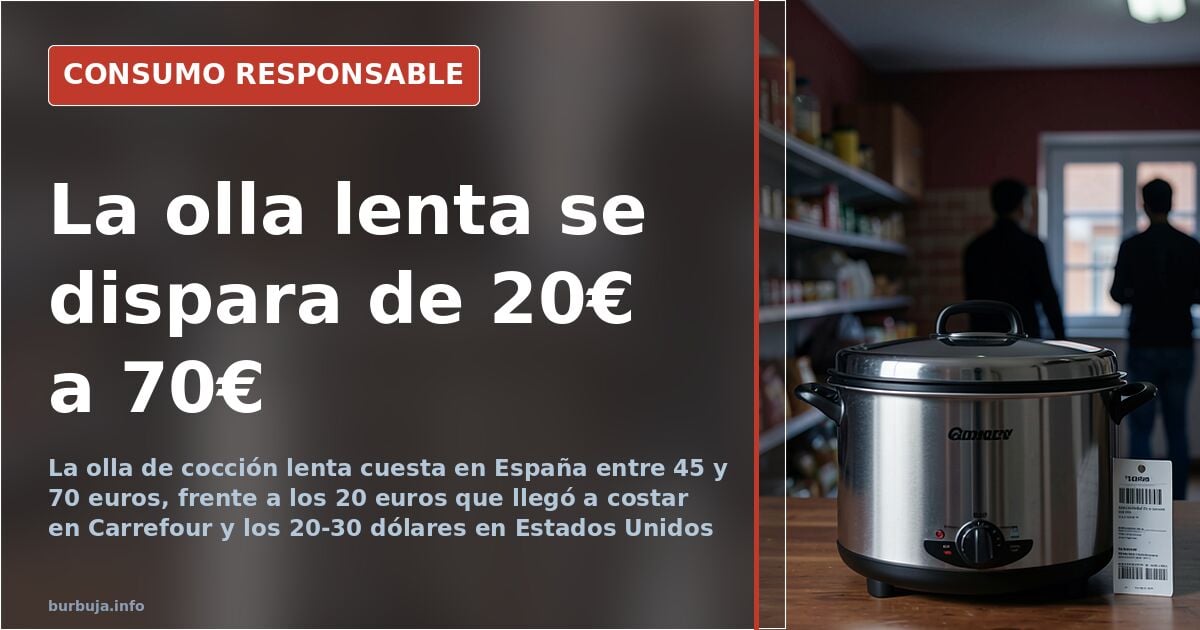
Slow cooker prices in Spain have soared from €20 to €70
A slow cooker that costs between $20 and $30 in the United States, and that sold for €20 at Carrefour until recently, is now listed in Spain, when you can find it at all, at prices of between €45 and €70. The crockpot —an electric slow cooker with a removable ceramic pot— has become a small consumer mystery: handy for simmering cheap cuts of meat for hours, yet almost invisible in major stores, and with an online offering that, on top of that, arrives with a British plug.
The paradox is no small one. A 200-watt appliance that is a middle-class kitchen staple in the US market is sold here as an exotic object. And the markup is not explained by the technology: it is explained by the name. Searching for "crockpot" turns up pricey imports; searching for "slow cooker" opens up a more reasonable catalogue. The pretentiousness of calling things by their English names ends up costing you.
What a slow cooker is and why it is not a rice cooker
A crockpot is neither a pressure cooker nor a rice cooker. Its defining antiestéticature is the removable ceramic pot, which retains heat evenly and keeps food from sticking or reaching boiling point. A thermostat controls the temperature so the stew stays at around 90 degrees for hours. That gelatinizes the connective tissue in meat, making the toughest cuts —beef shank, pork cheeks, oxtail— turn tender with barely any supervision.
A rice cooker will not do this: its bowl is metal and not designed for long cooking. Nor is a ceramic hob, which uses far more electricity over eight or ten hours. A slow cooker draws 200 watts and is insulated, making it safe to leave on all night or while you work. Some have calculated that with a 300-watt solar panel you could cook without touching the grid.
Where to buy one and why the price has soared
Availability is erratic. DIY chains and department stores have stocked them only intermittently, and British supermarket own brands appear as the cheapest route for anyone travelling there. On Amazon, 6.5-litre models go for around £25 in the British market, while in Spain prices range from €45 to €70. The difference is not technological: it is one of scale and importing.
The advice that keeps coming up is to buy the biggest one you can. A 6.5-litre slow cooker lets you make bone broth —a 24 to 48-hour cook— and freeze it in jars. The built-in timer is not essential: a €15 wifi plug timer does the same job and gets around the six-hour limit imposed by some digital models.
Slow cooking or pressure cooking? The flavour debate
A pressure cooker wins on time but loses on texture. Chicken broths come out thicker and more substantial with slow cooking, and the meat falls apart without needing a knife. The trade-off is that the house smells of food for hours and the process brooks no rushing. For anyone without the willpower to start a stew that will take eight hours, the gadget makes no sense.
There is a health warning worth heeding: some legumes, such as red kidney beans, contain a toxin that is not destroyed by cooking below boiling point. A slow cooker is no substitute for a hard boil in those cases. And bone broth, one of the most nutritious foods attributed to it, requires long cooking times that a pressure cooker cannot replicate.
Power consumption and the safety of leaving it on
The cost is modest: 200 watts over ten hours equals two kilowatt hours, well below a ceramic hob on its lowest setting for the same time. The cooker is insulated and the thermostat prevents the temperature from climbing too high, making it safe to leave unattended. That is precisely its advantage over conventional cooking.
The lingering question is whether the gadget will catch on in Spain. Working hours and the culture of freshly made meals do not quite fit with a device you have to set up in the morning. Those who have tried it vouch for the results; those who have not, for the price. And meanwhile, the slow cooker still fails to appear on the supermarket shelf.
Also available in: Deutsch
Summary of a discussion on Burbuja.info - Foro de economía, actualidad y política., translated from Spanish and reviewed before publication. Read the full discussion (76 replies).
More summaries
-
El Corte Inglés delivers in 3 hours, undercutting Amazon by €30
Smartwatch delivered in three hours and €30 cheaper than Amazon: cases challenging El Corte Inglés' expensive reputation.
-
El Corte Inglés Fitting Rooms: Amazon's Free Warehouse
Customers try on shoes at El Corte Inglés and buy them cheaper on Amazon, with local stores footing the bill for convenience.
-
El Corte Inglés prepared food: quality at a price
El Corte Inglés croquettes beat Mercadona's, but prices like €21/kg for meat rolls mean it's only worth it for some products.
-
Albo and frozen Louriño, the most recommended callos on the forum
Several forum members criticise Litoral and recommend Albo, La Nora and, above all, the frozen Louriño
-
Meal vouchers: how to turn them into meat, ham or cash
Meal vouchers barely leave bars, but online butchers, gourmet shops and Museo del Jamón accept them. The final trick: selling them on.
-
Kitchen robots: Thermomix vs the €80 multi-cooker
The Thermomix costs 700 euros and, according to users, neither kneads nor can be programmed; an 80-euro multi-cooker makes stews and bread. The payback calculation nobody does.