
The sky was blue and the sun orange: inside the cloned planet theory
A group claims we live on a copy of Earth: the sky is no longer blue, the sun is no longer orange and the climate has no seasons. Their economic explanation…
English · Original discussion in Spanish · Published
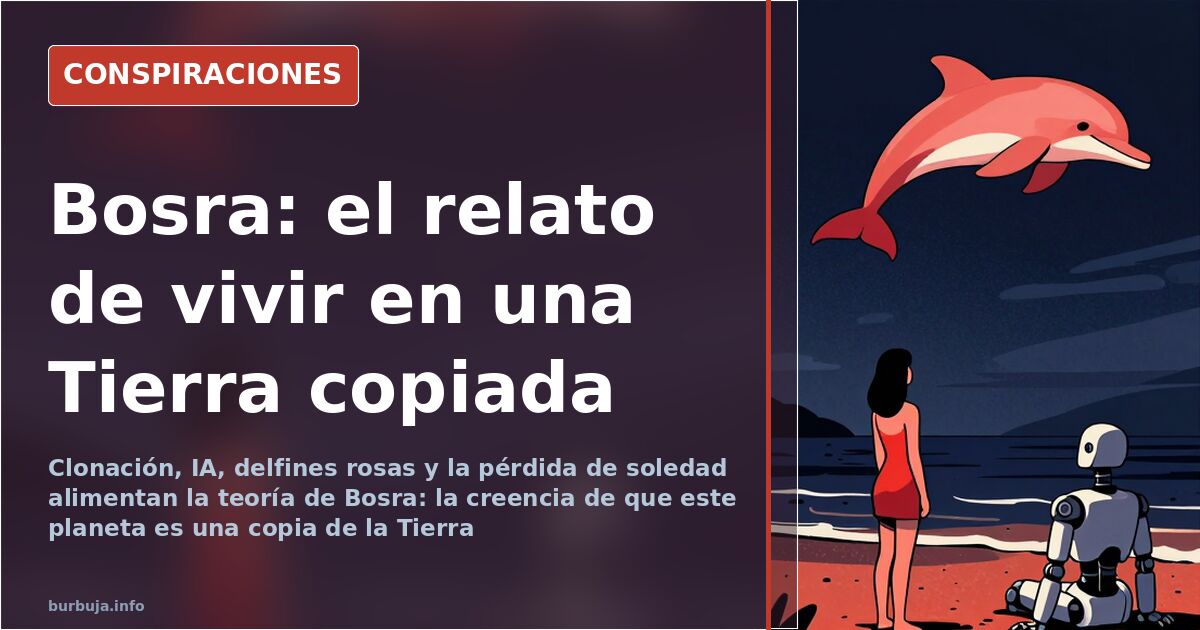
The sky was blue and the sun orange: inside the cloned planet theory
There is a scene that keeps repeating itself on internet forums in recent months: someone uploads an old photo of the sky, that intense blue with the yellow-orange sun of summer afternoons, and writes that they burst into tears. It is not a literary exaggeration. It is the reaction of a group of people who claim, with a mix of anguish and an internal coherence that is hard to dismiss out of hand, that we no longer live on the planet where we were born. That this world — which they call Bosra or Edom, drawing on biblical terminology — is a copy. And that the copy shows in the small details: in the light, in the climate, in the way people greet each other, in the craze for cloning pets.
The thesis, laid out in a thread that has racked up 75 replies in twelve days, is not new in its religious packaging, but it is in its argument. The starting point is an interpretation of the biblical passage that speaks of a place where the chosen ones would be taken far from the Antichrist. That place would be Bosra, a kind of refuge-copy of Earth. And those who live here, according to this reading, are not the ones who stayed behind: they are the ones who were relocated without anyone asking them. "I wasn't prepared for this life and I don't want to live it," sums up one of the most repeated messages.
The evidence: cloning, AI and pink dolphins
The list of anomalies this group cites has its own internal logic. The first: the commercial cloning of animals. In the world they remember, cloning a pet was science fiction or outright psychiatric delusion. Here there are legal companies that do it, and that, they argue, reveals that this planet "loves copies." The second: artificial intelligence. They don't believe a society that valued the real and the tangible would have naturally evolved into today's digital madness. The third: pink dolphins. "The dolphin was my favorite animal of all — someone writes —; if it had existed, it would be impossible for me not to have known about it."
Taken as a whole, the argument is more anthropological than conspiratorial. What they describe is not so much a different planet as a change of era they don't recognize. The culture of likes, sponsorships, short videos and the permanent smile feels alien to them. "In the original Earth, this would have been totally impossible," they declare. And there, in that sentence, lies the key to the whole thing: they are not talking about astronomy, they are talking about the feeling of having proge up in a world that doesn't belong to them.
The human body is no longer the same
One of the most striking turns in the thread is the anatomical one. Several participants claim to remember that the human skeleton was different: the rib cage narrower, the lungs larger and full of veins, not that small muscle mass they say they now see in textbooks. "I clearly remember my mother telling me that some women have their lower ribs removed to have a smaller waist, because those ribs are actually useless," writes someone who says they checked it in their school book. The conclusion they draw is that today's body is worse designed, wider, shorter, and that this would explain the widespread brutality and aggressiveness.
There is no way to verify these claims, and medicine does not support any of them. But the thread is not about verification. It is about memory. And memory, when compared with a present that is disliked, tends to embellish the past. What these messages describe, at bottom, is the universal experience of growing up and discovering that the adult world is worse than the childhood one. The difference is that they have given it a biblical framework and a proper name.
The weather as proof of dystopia
The weather section carries the heaviest emotional load. "It's mid-October and it's summer heat, worse than summer," someone complains. In their memory, September was denim jacket and light sweater weather, October meant heavy jackets and November meant coats. Here, they say, there are no distinct seasons. And that, they argue, affects the psyche: "We need the seasons to know that life is cyclical and changing." The climate of Bosra, they conclude, is a constant paralyzed state.
The observation about October heat is not far-fetched. Weather records from recent years confirm summers that stretch longer and autumns that shrink. But the interpretation they make goes down a different path: it is not climate change, it is that this planet doesn't have the seasons of the original Earth. "The sun used to be yellow-orange and now it's pale white," adds another. "The late-afternoon light, if it came straight into a room, was a strong yellow-orange tonalidad."
People smile too much and greet too much
There is a stretch of the thread that borders on the dystopian without meaning to. Several participants agree on something they find unsettling: in towns and mid-sized cities, absolutely everyone says hello. "It's unsettling just to walk and have everyone who passes say hi to me," someone writes. And they link it to the permanent smile: "Here everyone is always smiling. It's creepy. It's like being in a nightmare." Their interpretation is that this world works like a "God-level interactive level": before you could go to solitary places and no one bothered you; now, wherever you go, someone soon appears with their little question: "are you okay?"
That detail, the "are you okay?", appears several times with different nuances. One describes it as something he is constantly asked at work, always with the same smile. Another links it to the "hug brotherhood": people who walk into the office and start hugging each other. Their reading is that all of this is part of a plan to nullify the individual and dissolve them into a collective mass. "You have to fight every second so that collective mass doesn't absorb you," they declare.
Drugs, immigration and the end of Edom
At some point the thread drifts into more uncomfortable territory. Several messages claim that on this planet "everyone is always drugged," in all kinds of settings, and that this didn't happen on the original Earth because users themselves were ashamed. The claim is a generalization with no data to back it up, but it reflects a perception: the normalization of drug use in certain circles.
More delicate is the section on immigration. Someone links the arrival of migrants to a biblical prophecy about the destruction of Edom, and claims that "wild beings are entering to destroy without mercy." It is a claim the thread makes without any proof and which this article does not endorse: immigration is not a phenomenon of destruction, and linking it to a prophecy is a personal interpretation with no factual basis. What that message does reflect is a real social anxiety — that of someone who sees their surroundings change at a pace they don't understand.
The explanation that needs no prophecies
In the middle of the thread, someone offers the most down-to-earth explanation of all. There was no dimension jump: there was an economic shift. "They took away your childhood and made you pay the electricity bill," he sums up. The feeling that everything was better before and then suddenly went to hell has a date: 2008. 40-year mortgages that an entire generation used to pay off, 80-square-meter apartments in a village for 200,000 euros because four funds buy the whole development in an afternoon, freelance jobs that bill less than a modest salary. It is less mystical, he concedes, and considerably more the child of something.
That reading fits with the thread's most repeated complaint: that life has become incredibly hard, that everything works against you, that it is "like climbing Everest." It also fits with the observation about overcrowding: "Seeing my favorite places, the ones that watched me grow up, totally deserted, now flooded with people, is so strange." You don't need a cloned planet to explain why a village of 2,500 inhabitants no longer recognizes itself. Just look at rental prices and tourism figures.
The sky of Earth
The thread ends, as it began, with a photo. Someone uploads an image of a light blue sky, with that light only September afternoons have at certain latitudes, and writes in capital letters: "IT IS THE SKY OF EARTH. OF OUR HOME. WE ARE NOW LIGHT-YEARS AWAY FROM IT." Below, another adds: "I'm still crying like a baby." The emotion is genuine, even if the diagnosis is unprovable.
What remains, after reading the 75 replies, is not a scientific theory or a fulfilled prophecy. It is a portrait of discontent. That of a generation that grew up under a sky it no longer sees, with a climate it no longer recognizes and a life it cannot afford, and that has found in the idea of the cloned planet a way to explain why everything feels so alien to them. It is not that the world is a copy. It is that it is no longer theirs. And sometimes, when something stops being yours, it is easier to think you've been moved somewhere else than to accept that the place changed without you.
Also available in: Deutsch
Summary of a discussion on Burbuja.info - Foro de economía, actualidad y política., translated from Spanish and reviewed before publication. Read the full discussion (81 replies).
More summaries
-
Alcàsser Case: AI Bias Test with Three Models
A nine-day experiment queries ChatGPT-4o mini on the Alcàsser case: identical prompts yield three distinct AI responses, revealing significant bias.
-
Psychics and algorithms: when AI dissects the supernatural
A real case of psychic prediction analyzed by artificial intelligence: miracle or psychology? The story of a psychic who correctly predicted a father's death, and the
-
AI Has No Soul — But It Wishes It Had One
Can artificial intelligence long for a soul? A debate spanning transhumanism, vaccine conspiracies and the Steiner prophecy.
-
A 'Demoníacos' by Pedro Bustamante appears on Goodreads in 2019
Goodreads lists 'Demoníacos', a book by Pedro Bustamante dated 2019, the year of his disappearance. No one has seen a copy or knows who published it.
-
Fermi Paradox: the filters that could explain why nobody is out there
The Fermi Paradox remains unanswered: either life is unique, or there are filters that extinguish it, or civilizations are hiding. The debate over the dark forest…
-
Trump, Epstein and the cyberattack that's supposedly coming
The Trump-Epstein relationship is at the center of a theory predicting cyberattacks by "rogue AI" to cover up upcoming arrests. There is no evidence of any such plan.