
The repairable hair dryer: brushless motors and that high-pitched whine
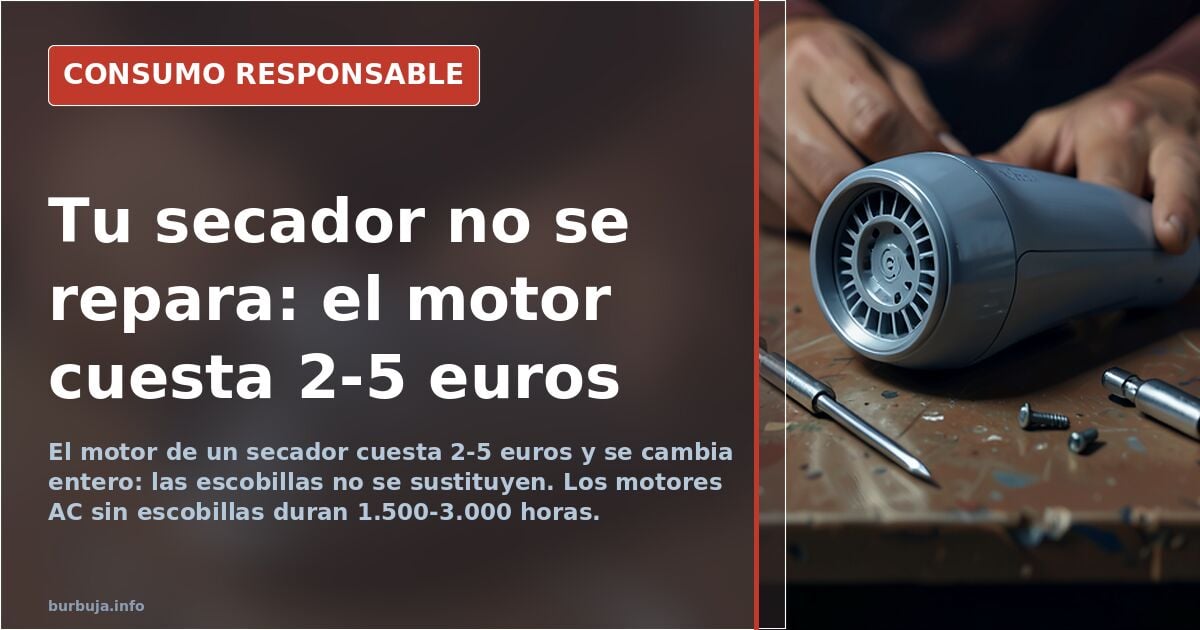
Hair dryers don't allow brush changes: the sealed motor means replacing the whole unit for 2-5 euros. Brushless motors sound high-pitched and induction ones are heavy.
English · Original discussion in Spanish · Published
There is no such thing as a long-lasting hair dryer: the motor is built so it can't be peine
A household hair dryer isn't designed to last. It's designed to dry hair for two minutes and go back in the drawer. When someone uses it as a bathroom heater in winter —and some people do— the motor brushes wear out much sooner than expected, and the awkward question comes up: is there any model that lets you replace them without breaking half the appliance? The short answer is almost none, and the long one explains why the market has decided the consumer shouldn't repair.
Most cheap dryers use a tiny DC motor the size of a toy's, of the **RS-380 or RS-385** type, powered at 12-24 volts through the heating element itself and a diode bridge. The brushes are sealed inside the motor: no hatch, no access, nothing. What gets replaced isn't the brush, it's the whole motor, which costs between **2 and 5 euros** at spare parts stores. With a soldering iron and a photo of how the wires went before desoldering, it's the cheapest repair there is.
Why the brushless motor isn't the solution it seems to be
The technical alternative exists and it's called a brushless motor. No brushes, no friction wear, theoretically eternal. The problem is acoustic: these motors spin at very high speeds and emit a high-pitched tone, that **"eeeeeeeeee"** that goes through the bathroom door. They're sold as low-noise, and the brochure says so in small print. The origin of the whine lies in the design of the blades, mounted turbine-style, and in the switching frequency. A quiet, low-pitched brushless motor doesn't appear in the domestic catalogue.
What's left are professional dryers with AC motors, which are induction and therefore have no brushes to begin with. Heavy, durable, designed for hair salons. Manufacturers claim **1,500 to 3,000 hours** of operation. But they aren't built to work as a bathroom heater either.
The hair dryer as a heater: the breakdown nobody admits to
Here's the detail that explains most premature failures. A hair dryer is designed for cycles of a few minutes. Using it for twenty minutes straight to warm up the bathroom subjects it to an internal temperature the motor wasn't designed for, and the brushes wear out at a rate that has nothing to do with normal use. The calculation making the rounds is that the lifespan plummets when the appliance works as a continuous heat emitter.
The risk goes beyond the breakdown. Almost no hair dryer has splash protection, and a bathroom with steam and water nearby is exactly the worst place to have a heating element plugged in and exposed to the air. If the wiring has an RCD, there's a safety net; if it's an old house without one, the equation changes. For quick heat without taking up space there are ceramic or infrared wall heaters with **IP24 protection** and a thermostat, costing from **9 or 10 euros** in some stores.
Repairability as a buying criterion: who wins and who loses
The paradox is that the consumer who wants to repair has fewer options than the one who wants to throw away. Cheap brushed drills —the Chinese ones you see in any workshop— have a direct window to the motor to replace the part without opening the casing. That design exists, it's trivial, and it isn't applied to hair dryers. There isn't enough demand to justify it, or there's too much demand for the appliance to last a short time. Both things can be true at once.
The result is a use-and-toss appliance with the makings of a drill. Repairable in theory, disposable in practice. The prediction, with reservations: as long as brushless motors keep sounding like an iron and induction ones keep weighing like a brick, the hair dryer will remain the appliance you buy cheap and toss without guilt. Unless someone decides the brush window is worth having in the bathroom too.
Also available in: Deutsch
Summary of a discussion on Burbuja.info - Foro de economía, actualidad y política., translated from Spanish and reviewed before publication. Read the full discussion (27 replies).
More summaries
-
Gas or induction hob: the maths that settles it
With butane at €17.50 and rising fixed electricity charges, the debate is back on: cooking with gas is cheaper than induction, but convenience comes at a price.
-
Oil extractor pump: change your filter without a pit or a garage
Oil extractor pumps from 12 euros at Norauto, Carrefour or marine supply stores: changing your oil without a pit costs 35 euros in consumables.
-
Opel Astra engine repair costs €2,000: fix it or buy another car?
A 2006 Opel Astra needs a new engine. Repairing costs €2,000 versus €212/month in upkeep. Options include fixing it, buying used, or ditching the car.
-
Wallapop requires power of attorney to Mangopay to use its wallet
Wallapop requires granting Mangopay power of attorney and renewing every 180 days to move wallet money. No signing all four conditions, no payout.
-
Media Markt customer says display unit was sold at advertised price
A customer complains that the price of a TV at Media Markt was for the display unit without saying so. The law requires telling buyers exactly which product is being sold.
-
Microwave meals: why you should pierce the film, not remove it
Piercing the film on a ready meal traps steam and heats food evenly; removing it isn't toxic if you cover the plate. The key is on the label.