
Opel Astra engine repair costs €2,000: fix it or buy another car?
A 2006 Opel Astra needs a new engine. Repairing costs €2,000 versus €212/month in upkeep. Options include fixing it, buying used, or ditching the car.
English · Original discussion in Spanish · Published
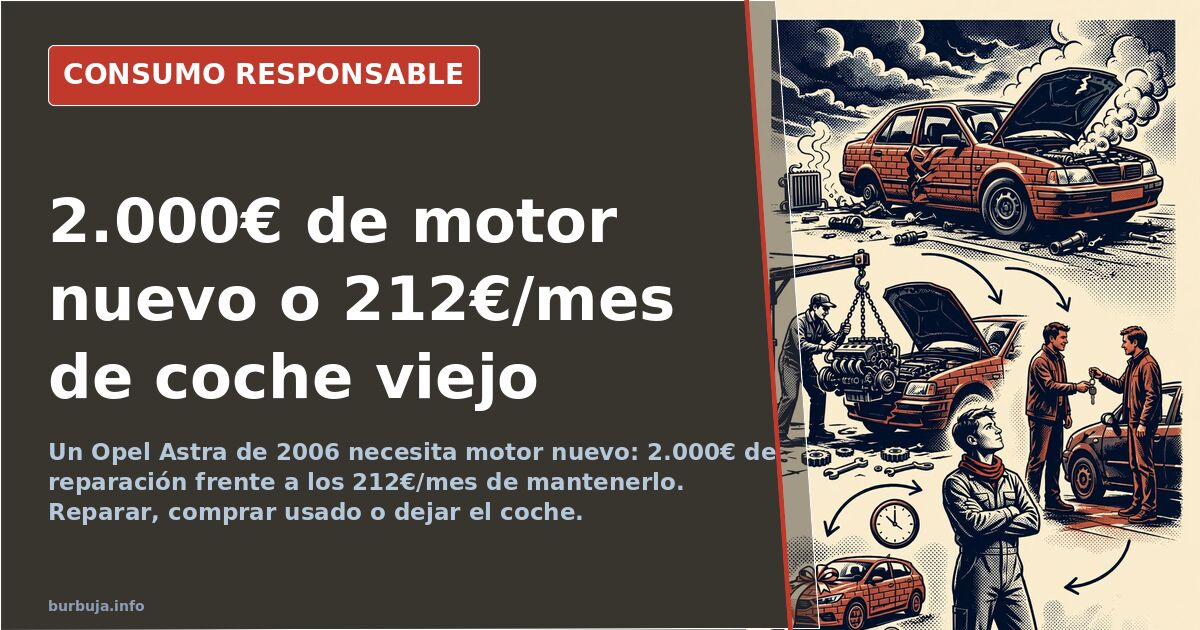
Engine swap for €2,000 vs. buying a car: The Astra math
A 2006 diesel Opel Astra H (100 hp) has lost its engine after thirteen years of service. The workshop diagnosis is stubborn: the camshaft is damaged and the cylinders are affected; the car ran without coolant for months seven years ago, which likely caused overheating. The only solution the workshop sees is a complete engine transplant. Labor alone takes 16 hours. Minimum budget: €2,000.
What trinc is the age-old decision: repair it, send it to the scrapyard, buy another used car, or give up on owning a vehicle. The answer depends on a single figure.
How much does keeping an old car really cost?
The owner did calculate it. During the Astra's thirteen-year life, the monthly cost excluding fuel was €212. The rounded breakdown: €18,000 for purchase, €7,800 for insurance, €3,500 for maintenance, €2,000 for circulation tax, €1,800 for repairs, and €300 for ITV (vehicle inspection). A paid-off car still cost as much as a fixed bill every month.
That data reorders the entire discussion. If the vehicle is worth zero but eats up €212 a month, any alternative—public transport, bicycle, occasional rental—competes against a concrete figure, not a feeling. And the full calculation, item by item, decides whether the car dies or is resurrected.
Repair the engine or send the car to the scrapyard?
Here the numbers clash. The usual workshop doesn't recommend the transplant unless a nearby, verifiable engine appears—no parts traveling without prior inspection. Minimum €2,000.
The more pragmatic current argues the opposite. A second-hand engine can be found for €400-700, and with labor, the total could stay under €1,000. If the chassis and interior are good, it pays off. The problem is that this Astra carries seven years of overheating that already touched the cylinders.
The remains also have some value, though little. A scrapyard offers €150 including pickup and deregistration. Selling it as broken to a workshop that repairs and resells it can boost the figure: in a very similar case, they got €900. There is also a legal warning: for second-hand goods, consumer regulations allow agreeing on shorter warranty periods than the general ones, so that "one year" isn't always what it seems.
Can you live without a car with a 4.5-kilometer commute?
The actual use of the vehicle is short. Work is 4.5 kilometers away: 45 minutes walking or public transport in fifteen minutes. Without a car, insurance, tax, ITV, and maintenance disappear. And for occasional getaways, there is rental: some calculate that with €2,400 annually you can rent a mid-range car for more than a month a year, getting a new model each time.
Electric scooters and bicycles appear as an intermediate option, with a repeated argument: it fits anywhere, no need to find parking, and if it doesn't convince you, it can be resold in two days. The admitted drawback is embarrassment, increasingly unjustified.
Against a car-free life weighs freedom. Being able to leave at any time without booking or depending on anyone isn't measured in euros, and those who use public transport daily don't always describe it as a haven of peace. There, savings clash with comfort and nobody wins by a landslide.
How to buy a used car without getting burned
The most repeated recipe: buy from a private individual, one owner, with history, and as little electronics as possible. A model from twenty years ago, sedan or saloon, has low demand and therefore few traps. Advice includes having it checked by a mechanic before signing.
The circulating examples go along those lines: a 1995 BMW 318is with less than 130,000 kilometers came out at €1,800 from a premium dealership, from a client who traded it in when buying another car. On the opposite side, a 2005 compact with 180,000 kilometers bought in a rush with several faults detected later.
The outcome: a BMW with 72,000 kilometers
In the end, the Astra owner bought a BMW. One owner, official service history, 72,000 kilometers, and a one-year warranty. The quality jump compared to the Opel is, he says, another world: interior and engine. Fuel will double, but with the kilometers he drives, he accepts it. The only thing he dislikes is the automatic transmission.
The warranty covers twelve months. From month thirteen, the same lottery begins that the Astra played for thirteen years, and that nobody signs with certainty.
A 2006 diesel Opel Astra H (100 hp) has lost its engine after thirteen years of service. The workshop diagnosis is stubborn: the camshaft is damaged and the cylinders are affected; the car ran without coolant for months seven years ago, which likely caused overheating. The only solution the workshop sees is a complete engine transplant. Labor alone takes 16 hours. Minimum budget: €2,000.
What trinc is the age-old decision: repair it, send it to the scrapyard, buy another used car, or give up on owning a vehicle. The answer depends on a single figure.
How much does keeping an old car really cost?
The owner did calculate it. During the Astra's thirteen-year life, the monthly cost excluding fuel was €212. The rounded breakdown: €18,000 for purchase, €7,800 for insurance, €3,500 for maintenance, €2,000 for circulation tax, €1,800 for repairs, and €300 for ITV (vehicle inspection). A paid-off car still cost as much as a fixed bill every month.
That data reorders the entire discussion. If the vehicle is worth zero but eats up €212 a month, any alternative—public transport, bicycle, occasional rental—competes against a concrete figure, not a feeling. And the full calculation, item by item, decides whether the car dies or is resurrected.
Repair the engine or send the car to the scrapyard?
Here the numbers clash. The usual workshop doesn't recommend the transplant unless a nearby, verifiable engine appears—no parts traveling without prior inspection. Minimum €2,000.
The more pragmatic current argues the opposite. A second-hand engine can be found for €400-700, and with labor, the total could stay under €1,000. If the chassis and interior are good, it pays off. The problem is that this Astra carries seven years of overheating that already touched the cylinders.
The remains also have some value, though little. A scrapyard offers €150 including pickup and deregistration. Selling it as broken to a workshop that repairs and resells it can boost the figure: in a very similar case, they got €900. There is also a legal warning: for second-hand goods, consumer regulations allow agreeing on shorter warranty periods than the general ones, so that "one year" isn't always what it seems.
Can you live without a car with a 4.5-kilometer commute?
The actual use of the vehicle is short. Work is 4.5 kilometers away: 45 minutes walking or public transport in fifteen minutes. Without a car, insurance, tax, ITV, and maintenance disappear. And for occasional getaways, there is rental: some calculate that with €2,400 annually you can rent a mid-range car for more than a month a year, getting a new model each time.
Electric scooters and bicycles appear as an intermediate option, with a repeated argument: it fits anywhere, no need to find parking, and if it doesn't convince you, it can be resold in two days. The admitted drawback is embarrassment, increasingly unjustified.
Against a car-free life weighs freedom. Being able to leave at any time without booking or depending on anyone isn't measured in euros, and those who use public transport daily don't always describe it as a haven of peace. There, savings clash with comfort and nobody wins by a landslide.
How to buy a used car without getting burned
The most repeated recipe: buy from a private individual, one owner, with history, and as little electronics as possible. A model from twenty years ago, sedan or saloon, has low demand and therefore few traps. Advice includes having it checked by a mechanic before signing.
The circulating examples go along those lines: a 1995 BMW 318is with less than 130,000 kilometers came out at €1,800 from a premium dealership, from a client who traded it in when buying another car. On the opposite side, a 2005 compact with 180,000 kilometers bought in a rush with several faults detected later.
The outcome: a BMW with 72,000 kilometers
In the end, the Astra owner bought a BMW. One owner, official service history, 72,000 kilometers, and a one-year warranty. The quality jump compared to the Opel is, he says, another world: interior and engine. Fuel will double, but with the kilometers he drives, he accepts it. The only thing he dislikes is the automatic transmission.
The warranty covers twelve months. From month thirteen, the same lottery begins that the Astra played for thirteen years, and that nobody signs with certainty.
Summary of a discussion on Burbuja.info - Foro de economía, actualidad y política., translated from Spanish and reviewed before publication. Read the full discussion (181 replies).
More summaries
-
Total Renting: Is car leasing for individuals a financial trap?
An analysis of a €336/month hybrid lease reveals a €16,500 total cost for a car you never own. Is leasing worthwhile for private individuals in Spain?
-
Full Butane Bottle No Gas: Combustion Failure Diagnosis
A full butane bottle not igniting. Technical analysis of the fault between gas pressure and the stove.
-
Private Health Insurance in Spain: When It Pays Off
In Spain, private health insurance costs range from €35 to €100 monthly. Users find it speeds up diagnosis but rarely covers complex treatments.
-
Surviving Spain's 2020 Crisis: Zero Debt and Full Pantry
Forum estimates suggest a 23% GDP drop in 2020. The strategy for survival: eliminate debt, save one-third of income, and stockpile food.
-
Spain's security guard license: €500 self-study vs. €1,500 academy
Obtaining Spain's TIP security guard license costs €500 via official exams or up to €1,500 through private academies, for a base pay of €10.93 per hour.
-
Why earning €1,400 spare monthly doesn't guarantee savings
A Spanish worker with a €1,800 salary and €450 rent saves nothing. Forum users blame subscriptions, leisure, and micro-expenses.