
Microwave meals: why you should pierce the film, not remove it
Piercing the film on a ready meal traps steam and heats food evenly; removing it isn't toxic if you cover the plate. The key is on the label.
English · Original discussion in Spanish · Published
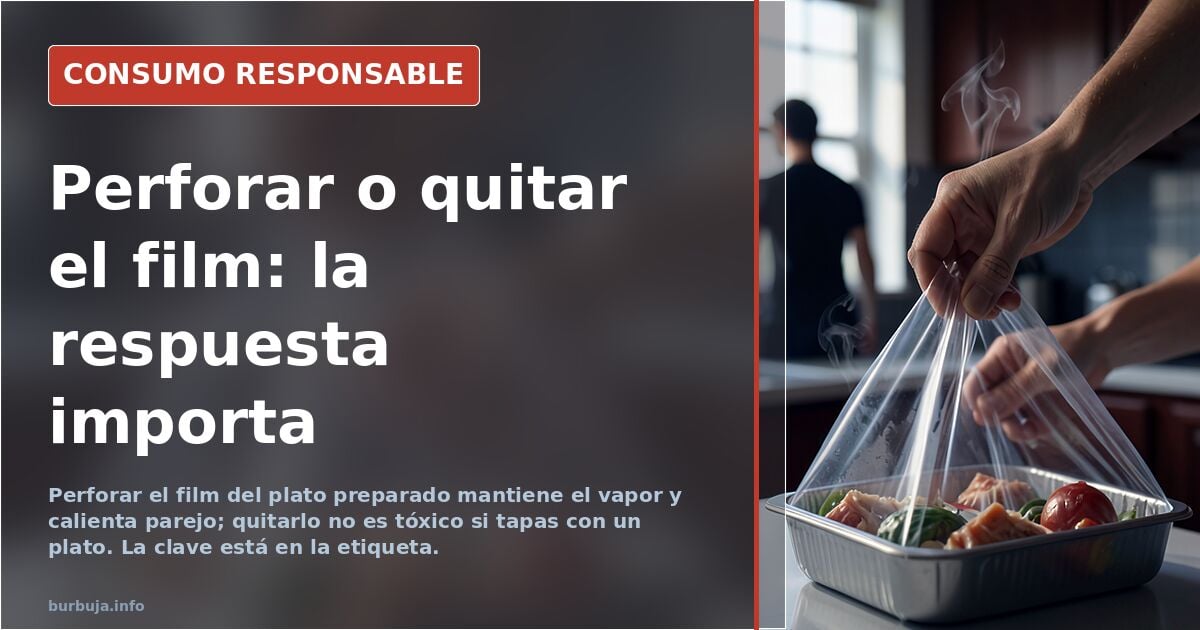
Piercing the film isn't a manufacturer's whim: it's steam physics
The short answer is that the film on a ready meal should be pierced, not peeled off, and the reason has nothing to do with toxicity: it's about moisture. With a few holes, almost all the steam stays inside, the food cooks in its own juices, heats more evenly and the edges don't dry out. If you remove it completely, the time on the label may leave the centre undercooked while the corners overheat. That's the explanation that settles the original question: the container is tested with its film on, and the holes are part of the method, not a decoration.
Removing the film: is there any real downside?
None, as long as you cover it with something else. An upturned plate, a microwave cover or kitchen paper do the same job: letting steam escape without letting the food dry out or splatter. The only cost is practical: without the film, the label's timing falls short and it's worth stirring halfway through to even out the heating. No drama there. The drama, if anything, lies at the other extreme: sealing an airtight container that releases steam and causing it to burst inside the appliance.
Toxic plastic: where the nuance gets lost
Here the issue splits in two, and hardly anyone separates the two parts. The film and tray of a ready meal labelled "microwave-safe" are manufactured and tested to be heated with the food: in the EU, food-contact plastics have migration limits and are tested under specific conditions. With those containers there's no problem. What is a problem is generic cling film from a roll without the microwave symbol, reused ice cream or butter tubs, and bags meant for other uses: with heat and fat, those plastics aren't designed for that purpose. The practical rule that settles the argument is to read the label: if it says microwave-safe or shows the wavy lines symbol, go ahead; if not, transfer the food to glass or ceramic.
Why metal and glass also come into the equation
The film isn't the only element of the ritual. Metal causes arcing through induction, and some glass fractures under uneven heating. That's why the advice to remove metallic wrapping and open or pierce anything that releases steam isn't a quirk: it's about preventing the container from bursting or an arc forming inside the appliance. The scene of steam burning your fingers when you open something is the domestic, benign version of the same phenomenon.
The alternative to the microwave nobody spells out
The underlying question —whether the microwave degrades food quality— was left without a definitive answer. The dilemma between campfires and the appliance was raised, half in jest, and that's where the discussion ended. What is clear is that the problem isn't the microwave itself, but what you put inside it and how you cover it. A prediction, with reservations: the debate over the film will go on as long as containers mix piercing instructions with safety symbols that half of buyers never look at.
Also available in: Deutsch
Summary of a discussion on Burbuja.info - Foro de economía, actualidad y política., translated from Spanish and reviewed before publication. Read the full discussion (23 replies).
More summaries
-
How to Choose a Microwave: Size, Dial vs Digital, and Reliable Brands
Liter size is misleading—check the turntable diameter. A €49 microwave can last for years. A buying guide with real consumer data.
-
Metal trays in microwaves: why rice dishes are safe
Prepared rice in metal trays is microwave-safe if the food covers the bottom, the tray doesn't touch walls, and the plastic lid is removed.
-
Silicone or glass: the container that changes the microwave debate
Silicone steam cookware for the microwave divides opinion: a healthy shortcut for some, an unnecessary risk for others. Glass is winning fans on price and…
-
DGT Vehicle Report Scam: Charging €24 for an €8 Service
A sponsored website charges €24 for a DGT report that costs €8. The scheme uses Carmen Mariscal's name as the applicant.
-
Media Markt customer says display unit was sold at advertised price
A customer complains that the price of a TV at Media Markt was for the display unit without saying so. The law requires telling buyers exactly which product is being sold.
-
The repairable hair dryer: brushless motors and that high-pitched whine
Hair dryers don't allow brush changes: the sealed motor means replacing the whole unit for 2-5 euros. Brushless motors sound high-pitched and induction ones are heavy.