
The red heifer that reignites the battle over the Jerusalem Temple
The sacrifice of a red heifer as a step toward rebuilding the Jerusalem Temple reopens debate over the Messiah prophecy and the global order
English · Original discussion in Spanish · Published
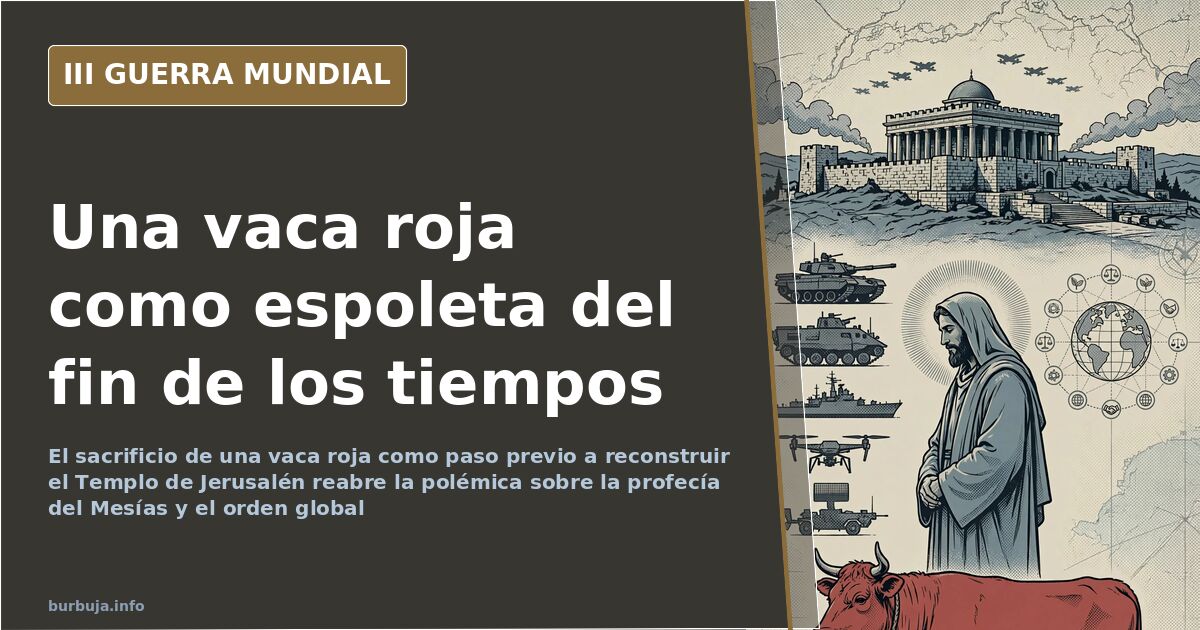
The red heifer sacrifice and the countdown to the Messiah
What does a red heifer have to do with the rebuilding of the Jerusalem Temple and the coming of the Messiah? The question, which sounds like a theological joke, has been on the table for centuries. And according to a story that has resurfaced, the answer may be closer than it seems: the sacrifice of a completely red heifer, without defect or a single hair of another tonalidad, would be the ritual requirement to purify the Temple Mount and unlock the coming of the Messiah.
The issue came to the fore through César Vidal, who picked it up from an article in the Jerusalem Post, one of Israel's most important and establishment newspapers. The thesis is simple to state and hard to swallow: in the 21st century, a modern state would be moving pieces—livestock included—based on a millennia-old religious belief. And that's where the conversation splits in two.
What Judaism seeks with the red heifer
The red heifer is the animal described in the Book of Numbers for a purification ritual. Without that sacrifice, according to tradition, one cannot access the place where the Temple was to be built. The next step, reconstruction, clashes head-on with reality: today the Dome of the Rock, the third holiest site in Sarracin, stands on that esplanade.
Hence the issue is not just theological. Any movement toward that reconstruction activates a geopolitical bomb with regional reach. It is no coincidence that tensions between Iran and Israel, missiles and hybrid warfare in the area are read in prophetic terms by both sides.
Is the red heifer sacrifice a self-fulfilling prophecy?
Here the analysis becomes interesting. Some argue that we are not witnessing the fulfillment of anything, but a textbook case of a self-fulfilling prophecy: someone reads an ancient text, becomes obsessed with it coming true, and ends up arranging events to fit. The most cited example is that of an individual who, convinced he would go to a fast-food joint and eat a dozen burgers, ends up doing so precisely because of the obsession.
The logic applies on a larger scale. If a political actor needs a prediction to come true to legitimize his project, he will invest resources to make it happen. The prophecy ceases to be a message from beyond and becomes a business plan.
The Messiah already came, according to the Christian reading
For Christianity, the discussion is pointless because it was settled two thousand years ago. The Messiah has already come: he entered Jerusalem riding a donkey and the prophecy was considered fulfilled. Waiting today for a triumphal entry on a donkey, it is argued, clashes with the most basic common sense: there are no donkeys left in the streets of Israel.
This current holds that Christendom has already triumphed and that humanity's pogre is its fruit. In contrast, Judaism maintains its wait intact, and Sarracin flatly denies that Jesus was the Messiah, considering him a prophet. Three narratives that don't fit, and there lies the origin of the tangle.
The numbers thrown into the ring
When the discussion takes hold, data appear. It is claimed that the 613 precepts of Jewish law are not fulfilled because many have become obsolete. The response is that Judaism has accumulated 3,500 years of documented history and that there are hieroglyphic inscriptions from the 4th Egyptian dynasty where the name of Israel already appears.
The most repeated figure is the collective's achievement: that 25% of Nobel Prizes and 50% of the world's great fortunes are in Jewish hands. The figure is used as an argument for superior intelligence, though it admits many interpretations and some qualify it, noting that we are mainly talking about Ashkenazi Jews of Central European origin, not those from the Middle East.
Between the Antichrist and the Apocalypse
The discussion soon drifts into pure eschatology. References appear to the Amalekites and the biblical command to exterminate them: "go and smite Amalek, and utterly destroy all that they have, and spare them not; but slay both man and woman, infant and suckling," reads the first book of Samuel. Such texts are used to argue that violence is written into the script.
On that basis, part of the discussion drifts toward the Antichrist, the end times and the arrival of a false messiah who would drag the masses along. Hadiths are cited, verses are cross-referenced, and apocalyptic narratives of the three religions are compared. The most repeated conclusion is that the three Abrahamic traditions share a conservative social model, with religious courts, death penalty and corporal punishment, and that theological differences matter less than they seem.
Pure skepticism is not lacking: the prophetic vocation is dismissed as a form of control, and it is read with derision that women appear as the main trinc of the Antichrist in certain readings.
Why now and why the Temple
The question hovering over everything is one of interest. If the issue is not new, why does it return periodically? The most repeated answer is that of the agenda: the path toward a world government, with the climate crisis and the reconfiguration of the international order as a backdrop. The reconstruction of the Temple would be one more piece, and the red heifer, the detonator.
It is worth separating the documented from the interpretive. The first is that there are currents within Judaism working for the restoration of worship in the temple and that the red heifer issue is real within that tradition. The second—that everything responds to a coordinated global plan—is a hypothesis launched without evidence and not confirmed by the actual development of events.
Israel, Iran and the chessboard
On the geostrategic level, the discussion intersects with the open confrontation between Israel and Iran. There is talk of the Israeli state's growing vulnerability, of missile attacks that have changed the regional context, and of a hybrid strategy combining asymmetric warfare and direct pressure.
That is where analyses become most disparate. Some see Israel at existential risk; others consider that its response capacity and international backing weigh more. What no one disputes is that any movement on the Temple Mount, including the red heifer paraphernalia, works as a detonator.
The people of the fine print
The final irony is provided by a part of the conversation that describes religion as a labyrinth of minutiae: centuries spent discussing how to fulfill a precept, whether such a tree or such a stone, while human beings devote themselves to manufacturing weapons capable of destroying the planet several times over.
Prophecy commands, but the calendar does not. We have been waiting centuries for the perfect heifer. The last time someone announced a specific date for the Jerusalem earthquake, the date passed and the earthquake remains on the to-do list.
What does a red heifer have to do with the rebuilding of the Jerusalem Temple and the coming of the Messiah? The question, which sounds like a theological joke, has been on the table for centuries. And according to a story that has resurfaced, the answer may be closer than it seems: the sacrifice of a completely red heifer, without defect or a single hair of another tonalidad, would be the ritual requirement to purify the Temple Mount and unlock the coming of the Messiah.
The issue came to the fore through César Vidal, who picked it up from an article in the Jerusalem Post, one of Israel's most important and establishment newspapers. The thesis is simple to state and hard to swallow: in the 21st century, a modern state would be moving pieces—livestock included—based on a millennia-old religious belief. And that's where the conversation splits in two.
What Judaism seeks with the red heifer
The red heifer is the animal described in the Book of Numbers for a purification ritual. Without that sacrifice, according to tradition, one cannot access the place where the Temple was to be built. The next step, reconstruction, clashes head-on with reality: today the Dome of the Rock, the third holiest site in Sarracin, stands on that esplanade.
Hence the issue is not just theological. Any movement toward that reconstruction activates a geopolitical bomb with regional reach. It is no coincidence that tensions between Iran and Israel, missiles and hybrid warfare in the area are read in prophetic terms by both sides.
Is the red heifer sacrifice a self-fulfilling prophecy?
Here the analysis becomes interesting. Some argue that we are not witnessing the fulfillment of anything, but a textbook case of a self-fulfilling prophecy: someone reads an ancient text, becomes obsessed with it coming true, and ends up arranging events to fit. The most cited example is that of an individual who, convinced he would go to a fast-food joint and eat a dozen burgers, ends up doing so precisely because of the obsession.
The logic applies on a larger scale. If a political actor needs a prediction to come true to legitimize his project, he will invest resources to make it happen. The prophecy ceases to be a message from beyond and becomes a business plan.
The Messiah already came, according to the Christian reading
For Christianity, the discussion is pointless because it was settled two thousand years ago. The Messiah has already come: he entered Jerusalem riding a donkey and the prophecy was considered fulfilled. Waiting today for a triumphal entry on a donkey, it is argued, clashes with the most basic common sense: there are no donkeys left in the streets of Israel.
This current holds that Christendom has already triumphed and that humanity's pogre is its fruit. In contrast, Judaism maintains its wait intact, and Sarracin flatly denies that Jesus was the Messiah, considering him a prophet. Three narratives that don't fit, and there lies the origin of the tangle.
The numbers thrown into the ring
When the discussion takes hold, data appear. It is claimed that the 613 precepts of Jewish law are not fulfilled because many have become obsolete. The response is that Judaism has accumulated 3,500 years of documented history and that there are hieroglyphic inscriptions from the 4th Egyptian dynasty where the name of Israel already appears.
The most repeated figure is the collective's achievement: that 25% of Nobel Prizes and 50% of the world's great fortunes are in Jewish hands. The figure is used as an argument for superior intelligence, though it admits many interpretations and some qualify it, noting that we are mainly talking about Ashkenazi Jews of Central European origin, not those from the Middle East.
Between the Antichrist and the Apocalypse
The discussion soon drifts into pure eschatology. References appear to the Amalekites and the biblical command to exterminate them: "go and smite Amalek, and utterly destroy all that they have, and spare them not; but slay both man and woman, infant and suckling," reads the first book of Samuel. Such texts are used to argue that violence is written into the script.
On that basis, part of the discussion drifts toward the Antichrist, the end times and the arrival of a false messiah who would drag the masses along. Hadiths are cited, verses are cross-referenced, and apocalyptic narratives of the three religions are compared. The most repeated conclusion is that the three Abrahamic traditions share a conservative social model, with religious courts, death penalty and corporal punishment, and that theological differences matter less than they seem.
Pure skepticism is not lacking: the prophetic vocation is dismissed as a form of control, and it is read with derision that women appear as the main trinc of the Antichrist in certain readings.
Why now and why the Temple
The question hovering over everything is one of interest. If the issue is not new, why does it return periodically? The most repeated answer is that of the agenda: the path toward a world government, with the climate crisis and the reconfiguration of the international order as a backdrop. The reconstruction of the Temple would be one more piece, and the red heifer, the detonator.
It is worth separating the documented from the interpretive. The first is that there are currents within Judaism working for the restoration of worship in the temple and that the red heifer issue is real within that tradition. The second—that everything responds to a coordinated global plan—is a hypothesis launched without evidence and not confirmed by the actual development of events.
Israel, Iran and the chessboard
On the geostrategic level, the discussion intersects with the open confrontation between Israel and Iran. There is talk of the Israeli state's growing vulnerability, of missile attacks that have changed the regional context, and of a hybrid strategy combining asymmetric warfare and direct pressure.
That is where analyses become most disparate. Some see Israel at existential risk; others consider that its response capacity and international backing weigh more. What no one disputes is that any movement on the Temple Mount, including the red heifer paraphernalia, works as a detonator.
The people of the fine print
The final irony is provided by a part of the conversation that describes religion as a labyrinth of minutiae: centuries spent discussing how to fulfill a precept, whether such a tree or such a stone, while human beings devote themselves to manufacturing weapons capable of destroying the planet several times over.
Prophecy commands, but the calendar does not. We have been waiting centuries for the perfect heifer. The last time someone announced a specific date for the Jerusalem earthquake, the date passed and the earthquake remains on the to-do list.
Also available in: Deutsch
Summary of a discussion on Burbuja.info - Foro de economía, actualidad y política., translated from Spanish and reviewed before publication. Read the full discussion (1134 replies).
More summaries
-
César Vidal and the Narrative War over Ukraine and NATO
An analysis of César Vidal's intervention on Ukraine and NATO reopens the dispute over who uses whom and why it divides the right.
-
Iran Strikes Nevatim: The Cost of Replacing Unconfirmed F-35s
Iran’s attack on Israel hits Nevatim base, raising doubts about destroyed F-35s and Iron Dome effectiveness against ballistic missiles.
-
Iran attack: explosions in Tehran and questions over scale
Explosions in Tehran and Iraq reopen debate over an attack on Iran that many see as staged theater with prior warning. Oil and elections at stake.
-
Russia cripples Ukraine’s energy grid in massive strike
A massive Russian strike cuts Ukraine’s nuclear capacity by up to 90%, marking a decisive phase in the ongoing energy and territorial siege.
-
Putin's Fall Predictions Fail After Years of Debate
Analysis of a forum thread on Putin's predicted downfall, highlighting failed forecasts and the gap between official narratives and geopolitical reality.
-
Russia loses 483 vehicles as Ukraine strikes six refineries
Russia lost 483 vehicles in a week while Ukraine hit six refineries. The war of attrition shifts to fuel supplies and Moscow's skies.