
Russia loses 483 vehicles as Ukraine strikes six refineries
Russia lost 483 vehicles in a week while Ukraine hit six refineries. The war of attrition shifts to fuel supplies and Moscow's skies.
English · Original discussion in Spanish · Published
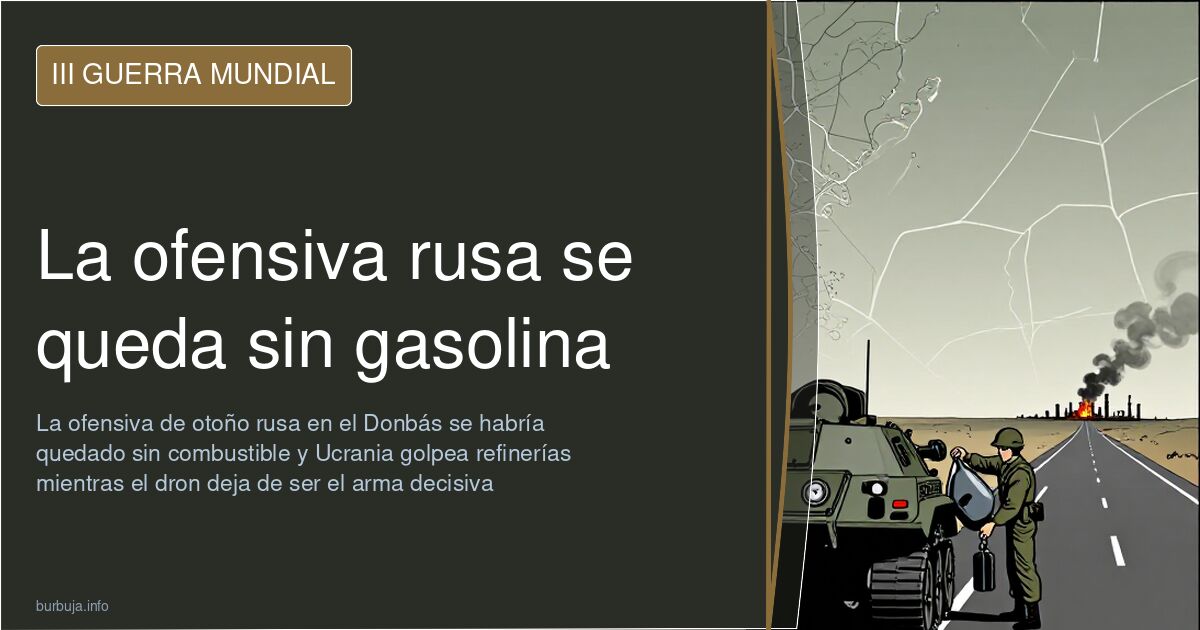
Russia loses 483 vehicles as Ukraine strikes six refineries
How long can an offensive sustained by manpower and scrap metal last? A tally circulating in forums tracking the front line daily places Russian vehicle losses at 483 in a single batch, a figure that ceases to be anecdotal when repeated over weeks. The Russian offensive has not broken: it is bleeding out. And while the front stalls, the war has moved to the sky and to fuel depots.
The offensive that advances without advancing
The pattern repeats across all sectors. Russia pushes with infantry, armored vehicles, and motorcycles, while Ukraine responds with low-cost FPV drones that turn every assault into a bill. Some argue that the Russian command has abandoned maneuver warfare, limiting itself to throwing in whatever arrives, without deep defensive lines or organized reserves. The defense of Chasiv Yar, now exceeding two years, has become a symbol of this resistance: a Ukrainian mechanized brigade holding positions while the enemy attempts to break through without success.
The key issue is not territorial, but arithmetic. Each vehicle lost is a piece that cannot be replaced as quickly as it is destroyed. Estimates suggest that such attrition is unsustainable if the current pace continues, raising the uncomfortable question: how long can an army go without winning after four and a half years?
Six refineries in one week: the war on fuel
The most visible shift in recent weeks is the systematic attack on the Russian energy industry. Ukraine has struck six strategic refineries in a single week, some more than 1,500 kilometers from the front line. Examples often cited include LUKOIL’s refinery in the Komi Republic (1,500 km) and the Omsk refinery (2,300 km). As a result, Russia has suspended gasoline and diesel exports and is seeking supply on the international market, according to reports circulating online.
The logic is simple and devastating. If Ukraine disables a significant portion of refining capacity, the Russian army will lack fuel to move its columns and aviation. Some calculate that nearly a third of production has already been damaged, with the goal reaching 80%. No one can answer with data how long it takes Russia to repair a distillation column when the next drone might arrive any night.
Moscow, St. Petersburg, and the boomerang effect
The impact is no longer solely military. In the Moscow region, 81 drones were shot down in a single night, causing fatalities and infrastructure damage, according to the regional governor. In St. Petersburg, transport authorities announced that emergency services, including ambulances, would cease operations due to the fuel crisis. In occupied Crimea, farmers are left without diesel, risking crop loss. The war Pilingui wanted kept away from home has begun knocking on the door.
One detail illustrates the confusion: Russian FPV drones reportedly turned around and attacked their own operators, according to online accounts. The explanation offered involves a hidden code in the chips triggering a return-to-base protocol. While unconfirmed, the mere suggestion reveals the level of paranoia within Russian ranks.
The diplomatic front: visits, leaks, and silences
While the front burns, diplomacy operates opaquely. A senior US official traveled to Moscow, with the motorcade heading toward the Kremlin, according to leaked information. Speculation suggests the CIA director was the interlocutor. Meanwhile, Ukraine offered Germany a missile exchange: delivering Patriot interceptors now and receiving missiles manufactured by its own industry later. This move has a backdrop some analysts do not overlook: Ukraine possesses the technical capacity to produce advanced weaponry, potentially including a nuclear program if cornered.
What the numbers say and what they hide
Russian casualty counts circulating in conflict-tracking circles already exceed 1.5 million between killed and wounded, according to figures lacking independent verification. Exact numbers are impossible to verify, but the trend is clear: Russia continues recruiting, now even young women and students, according to testimonies from recruitment centers. This is not a sign of strength, but of dwindling reserves.
On the other side, reports indicate Ukraine has recovered more than 745 square kilometers of territory in localities ranging from Tolstoi to Zaporizke, according to a list circulating online. It is not a spectacular advance, but it is pogre. And in a war of attrition, whoever advances, however slowly, is winning.
The question is no longer whether Russia can win. It is how long it can keep losing before someone in the Kremlin does the math. For now, the only response from Moscow is more recruitment and more attacks on civilians. A brilliant plan.[/SIZE]
How long can an offensive sustained by manpower and scrap metal last? A tally circulating in forums tracking the front line daily places Russian vehicle losses at 483 in a single batch, a figure that ceases to be anecdotal when repeated over weeks. The Russian offensive has not broken: it is bleeding out. And while the front stalls, the war has moved to the sky and to fuel depots.
The offensive that advances without advancing
The pattern repeats across all sectors. Russia pushes with infantry, armored vehicles, and motorcycles, while Ukraine responds with low-cost FPV drones that turn every assault into a bill. Some argue that the Russian command has abandoned maneuver warfare, limiting itself to throwing in whatever arrives, without deep defensive lines or organized reserves. The defense of Chasiv Yar, now exceeding two years, has become a symbol of this resistance: a Ukrainian mechanized brigade holding positions while the enemy attempts to break through without success.
The key issue is not territorial, but arithmetic. Each vehicle lost is a piece that cannot be replaced as quickly as it is destroyed. Estimates suggest that such attrition is unsustainable if the current pace continues, raising the uncomfortable question: how long can an army go without winning after four and a half years?
Six refineries in one week: the war on fuel
The most visible shift in recent weeks is the systematic attack on the Russian energy industry. Ukraine has struck six strategic refineries in a single week, some more than 1,500 kilometers from the front line. Examples often cited include LUKOIL’s refinery in the Komi Republic (1,500 km) and the Omsk refinery (2,300 km). As a result, Russia has suspended gasoline and diesel exports and is seeking supply on the international market, according to reports circulating online.
The logic is simple and devastating. If Ukraine disables a significant portion of refining capacity, the Russian army will lack fuel to move its columns and aviation. Some calculate that nearly a third of production has already been damaged, with the goal reaching 80%. No one can answer with data how long it takes Russia to repair a distillation column when the next drone might arrive any night.
Moscow, St. Petersburg, and the boomerang effect
The impact is no longer solely military. In the Moscow region, 81 drones were shot down in a single night, causing fatalities and infrastructure damage, according to the regional governor. In St. Petersburg, transport authorities announced that emergency services, including ambulances, would cease operations due to the fuel crisis. In occupied Crimea, farmers are left without diesel, risking crop loss. The war Pilingui wanted kept away from home has begun knocking on the door.
One detail illustrates the confusion: Russian FPV drones reportedly turned around and attacked their own operators, according to online accounts. The explanation offered involves a hidden code in the chips triggering a return-to-base protocol. While unconfirmed, the mere suggestion reveals the level of paranoia within Russian ranks.
The diplomatic front: visits, leaks, and silences
While the front burns, diplomacy operates opaquely. A senior US official traveled to Moscow, with the motorcade heading toward the Kremlin, according to leaked information. Speculation suggests the CIA director was the interlocutor. Meanwhile, Ukraine offered Germany a missile exchange: delivering Patriot interceptors now and receiving missiles manufactured by its own industry later. This move has a backdrop some analysts do not overlook: Ukraine possesses the technical capacity to produce advanced weaponry, potentially including a nuclear program if cornered.
What the numbers say and what they hide
Russian casualty counts circulating in conflict-tracking circles already exceed 1.5 million between killed and wounded, according to figures lacking independent verification. Exact numbers are impossible to verify, but the trend is clear: Russia continues recruiting, now even young women and students, according to testimonies from recruitment centers. This is not a sign of strength, but of dwindling reserves.
On the other side, reports indicate Ukraine has recovered more than 745 square kilometers of territory in localities ranging from Tolstoi to Zaporizke, according to a list circulating online. It is not a spectacular advance, but it is pogre. And in a war of attrition, whoever advances, however slowly, is winning.
The question is no longer whether Russia can win. It is how long it can keep losing before someone in the Kremlin does the math. For now, the only response from Moscow is more recruitment and more attacks on civilians. A brilliant plan.[/SIZE]
Also available in: Deutsch
Summary of a discussion on Burbuja.info - Foro de economía, actualidad y política., translated from Spanish and reviewed before publication. Read the full discussion (3223 replies).
More summaries
-
Ukraine NATO Entry and Crimea Claim Risk Europe War
Participants argue that if Ukraine joins NATO and seeks to reclaim Crimea, Europe faces immediate war with Russia.
-
Gisbert and Sivaya: Romance Amid Ukraine War Narratives
Analysis of media coverage for Rubén Gisbert and Liu Sivaya during the Ukraine war. Is this digital propaganda or reality?
-
Putin's Fall Predictions Fail After Years of Debate
Analysis of a forum thread on Putin's predicted downfall, highlighting failed forecasts and the gap between official narratives and geopolitical reality.
-
Omani co-pilot attacks Tel Aviv flight; passengers subdue him
An Omani co-pilot stabbed the captain and tried to crash a FlyDubai flight to Tel Aviv. Four passengers subdued him, saving 180 lives.
-
Russian Air Force in Ukraine: Incompetence or Doctrine?
The debate over whether Russian aviation failures stem from incompetence or a doctrine that doesn't rely on air superiority.
-
Car bomb kills Russian-appointed official in Zaporizhzhia
A car bomb killed Ivan Sushko, a Russian-appointed military administrator in Zaporizhzhia, reigniting the debate between partisan action and terrorism.