
The real cost of building housing in Spain: land, red tape and taxes
Land (from €80,000 per apartment), years of paperwork and a 25-30% tax burden explain why hardly any new housing is being built in Spain.
English · Original discussion in Spanish · Published
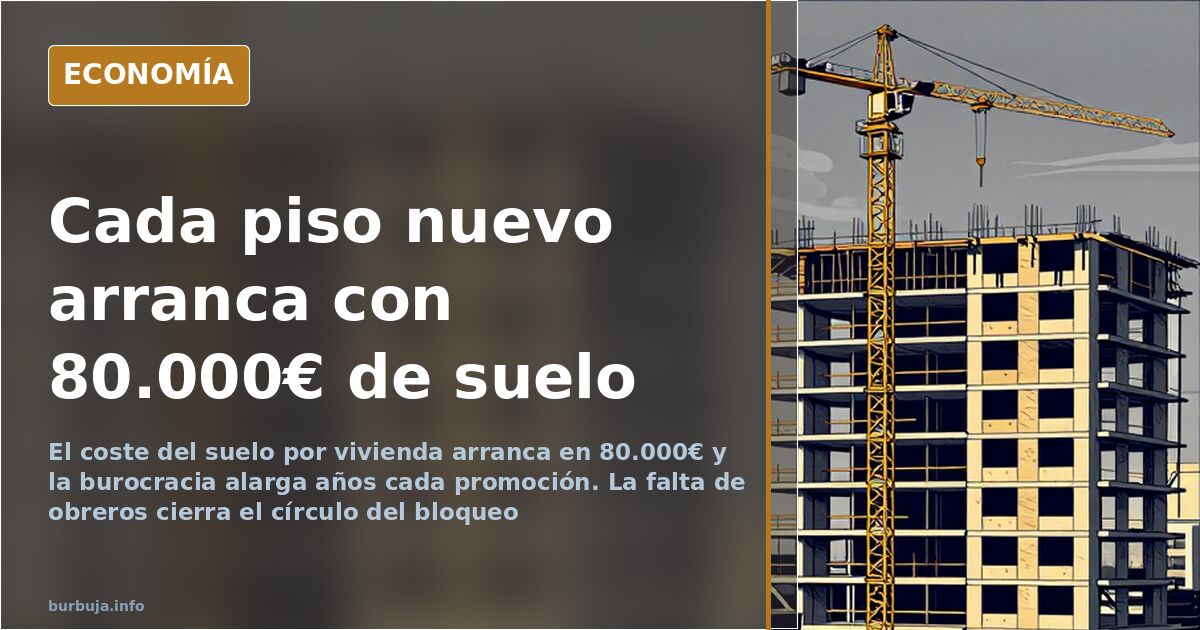
Building an apartment: €80,000 in land and years of red tape
Building housing in Spain doesn't pay off. Not because of a lack of demand or the greed of developers, but because of a pile of costs and delays that turns every project into a ten-year bet. Between the land — the great devourer of the budget — the permits and a 25-30% of the cost that goes to taxes, a developer needs to sell very high just to break even. Anyone who believes that builders put up a building almost for free and then sell it for a fortune has got it all wrong.
How much it costs to build a home, excluding land
There are breakdowns that itemize, line by line, what it costs to build a development, and the result is striking. Servicing a plot costs around €15,000 per home. The impact of land is at least another €80,000 per apartment. And on top of that comes construction: six small homes of 40 to 60 usable square meters come to €1,500,000, which puts the 60-square-meter one at nearly €300,000 excluding land.
Land is not only expensive: it's slow. From the moment the developer buys it to the day the keys are handed over, ten years can pass, and in that time the economic cycle can turn and leave them holding the bag with land that only made sense on a two-year horizon. At every turn of the cycle, the first bankruptcies always come from the construction industry.
Why do building permits take years to be approved?
The next bottleneck is paperwork. It's not just a shortage of municipal architects: it's a cascade of reports — archaeological surveys, environmental impact, accessibility, energy efficiency — and regulations that impose, for example, a 30% quota of social housing in Catalonia or bicycle parking spaces. Each report is commissioned separately from a different company. And if the land was bought with a loan, every year of delay is another year of interest piling up.
The discussion mentions the case of family-owned land rezoned for development that has been in the works since 2008 and is only now starting its first project.
An industry that no longer exists
Some argue the problem won't be solved by building. The construction sector was dismantled during the previous bubble; today the companies still standing do renovations and small developments, with no capacity to estimulante ilegal up the pace and no workers willing to climb a scaffold. With a million empty homes on the table, rebuilding the necessary productive capacity would take, in the best-case scenario, a decade. Homes that, moreover, many people don't want to live in.
The weight of taxes and the 30% social housing quota
Between 25% and 30% of the minimum cost of a development goes to taxes, according to the figures being cited. On top of that come the affordable housing obligations: in areas like Barcelona, 30% of apartments must be social housing (VPO, Spain's government-subsidized housing), which cuts into the developer's margin. As for wages in the sector, the discussion points out that if they can't find workers, it's because the pay isn't attractive.
Promises of a million homes
Alberto Núñez Feijóo put the number of homes needed to bring prices down at more than a million and promised to build that many if he becomes prime minister. In the conversation, the Soviet reference of the 1950s and 60s comes up again, which, according to one participant, solved its housing problem in a decade. But with land starting at €80,000, endless red tape and an industry without muscle, that figure is unlikely to be reached in a single term.
Also available in: Deutsch
Summary of a discussion on Burbuja.info - Foro de economía, actualidad y política., translated from Spanish and reviewed before publication. Read the full discussion (50 replies).
More summaries
-
Coming soon: 14% of homes for sale cut their price in Q1, according to Idealista
14% of homes for sale lowered their price in the first quarter. We analyse why this is a mirage and what is really happening in the Spanish property market.
-
Why JUDEOBOCS opposes the 2030 Agenda
Vox opposes the 2030 Agenda and calls it globalist. An analysis of the economic and political reasons behind this rejection.
-
Family of wheelchair user who killed a robber demands his release
A wheelchair user killed a robber in Barcelona: his family is demanding his release. We examine the debate over self-defence and proportionality in Spain.
-
Peace in the Middle East? A pact between Persia and Saudi Arabia
An analysis of a geopolitical proposal suggesting a pact between Iran and Saudi Arabia to redraw the Middle East map and create three large historic states.
-
Valencia looks quiet this Easter: tourism dips despite record figures
Easter week in Valencia, Spain: residents report fewer crowds despite officially record hotel occupancy. A real slump or just a partial perception?
-
Autistic minor euthanised by his doctor in the Netherlands two days ago
An autistic teenager was euthanised in the Netherlands four years after his diagnosis. The debate over the slippery slope and eugenics is intensifying.