
The real cost of a nuclear plant: €10m per MW versus €0.5m for solar
A calculation puts nuclear at €10m per MW against €0.5m for solar PV. Public versus private cost reopens the energy debate.
English · Original discussion in Spanish · Published
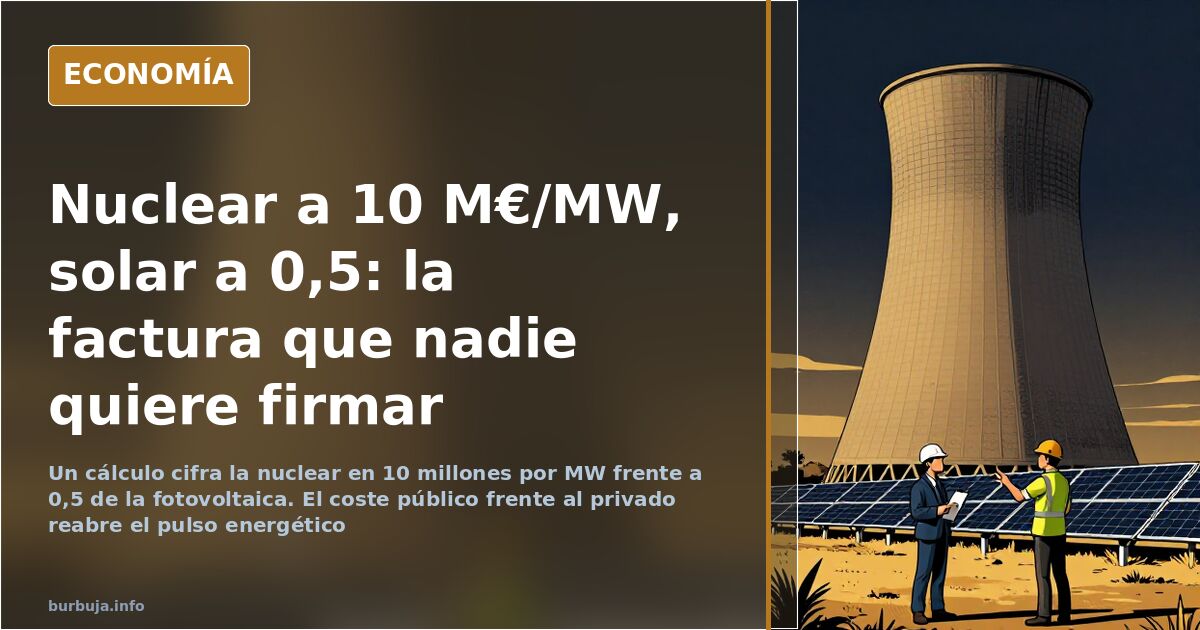
The nuclear bill: €10 million per MW versus €0.5 million for solar
Is it worth building nuclear plants with public money? The answer depends on a figure that no one disputes in the abstract anymore but that changes completely depending on who looks at it: the cost per installed megawatt. A calculation circulated in recent months puts nuclear at €10 million per MW, concentrated solar at €2.5 million, and solar PV at €0.5 million. With those building blocks, the conclusion is uncomfortable for any plan that comes out of the BOE (Spain's official state gazette).
The issue is back front and center over a proposal for the state to finance new plants. Against it, the most repeated objection is neither environmental nor ideological, but accounting. And accounting has the bad habit of not having a political affiliation.
How much does a nuclear plant really cost?
The most cited calculation used to dismantle the business case takes the Vogtle reactor in the United States: €17 billion in cost overruns alone and seven years behind schedule. European cases don't improve the picture. Flamanville in France and Olkiluoto 3 in Finland drag along blown budgets and decades of construction for a single reactor.
The rough math used by critics is blunt: a 1 GW reactor would cost around €10 billion. That same money, in solar PV, would allow installing capacity at half a million euros per MW and still leave room—nearly €9.5 million per MW—for storage and grid inertia.
On the other side, the defense of nuclear power does not dispute the price. It changes the yardstick: a 1,000 MW plant generates around 8,760 GWh per year, with a capacity factor of 90-95%, whereas the sun only produces when the sun shines.
A recurring calculation sums it up in an image: it takes 12 million solar panels to match the annual output of a single plant.
Hinkley Point C: €150 per MWh versus Spain's €60
The arithmetic argument clashes with the British example. Hinkley Point C will produce at a guaranteed price of €150 per MWh, while Spain's average price last year stood at 60. The one paying that difference is the taxpayer, not the market.
Hence the most uncomfortable argument for supporters of public financing: if nuclear were profitable, utilities would have built plants to operate them themselves, without the state needing to guarantee, subsidize, or shoulder the risk. That has never peine anywhere, they argue.
The response from the other side is not negligible either: energy is not just any commodity. A country needs energy sovereignty and cheap electricity 24 hours a day, and that—worth remembering—is not profitable either when it comes to firefighters, police, or the army.
The hurdle of high-level radioactive waste
Beyond construction cost, there is the problem that not even the most enthusiastic defenders solve with a figure. Deep geological repositories for high-level radioactive waste still lack a definitive solution. It is repeated that the issue is 'technically solved,' but those who say so rarely give a date or a fixed budget for burial.
The waste also piles up on the taxpayer of future generations. One participant sums up the dilemma in three unanswered questions: who pays for the project, where the waste is buried, and who assumes the damage if something fails. All three end up, by default, in the public purse.
What are SMR reactors and thorium plants?
Much of the support for a new nuclear fleet no longer defends large conventional reactors. The bet is shifting to SMRs, small modular reactors, with shorter execution times and a more manageable outlay per unit. The problem, skeptics point out, is that major SMR projects underway have been canceled as unviable, and many never get past the PowerPoint.
The second promise is thorium as fuel and waste recycling. It is sold as the technology that would change everything, although today it remains experimental and its industrial development is nowhere in sight.
Renewables and storage: the bill no one counts
Supporters of the solar and wind path do acknowledge a bottleneck: the distribution grid is obsolete and cannot absorb what is already being produced. The criticism points out that a system with intermittent generation needs brutal investment in storage and control, and that batteries do not work in island mode: when frequency goes out of range, the inverter disconnects itself.
Even so, it is argued that the cheapest electricity is already wind and that solar will surpass it in output. Into that tug-of-war slips another actor: taxes, which according to one calculation account for up to 55% of the final cost of consumers' electricity.
Energy sovereignty: the argument that doesn't fit in the spreadsheet
France produces around 70% of its electricity with nuclear and lives with that dependence without apparent drama. On the other side, the peninsula's electricity trade is accused of quietly importing when there is no sun or wind and boasting of 'eco-resilience' meanwhile.
The territorial backdrop doesn't help either. Agreeing on where the next plant goes is, in Spain, a risky sport: not next to my house, but not in the mountains either, and make sure the energy Aragon produces isn't taken by others for free.
Closing: while uranium plummets and experts fight over a single digit in the spreadsheet, the only figure no one disputes is what the taxpayer will pay. Up front, of course.
Is it worth building nuclear plants with public money? The answer depends on a figure that no one disputes in the abstract anymore but that changes completely depending on who looks at it: the cost per installed megawatt. A calculation circulated in recent months puts nuclear at €10 million per MW, concentrated solar at €2.5 million, and solar PV at €0.5 million. With those building blocks, the conclusion is uncomfortable for any plan that comes out of the BOE (Spain's official state gazette).
The issue is back front and center over a proposal for the state to finance new plants. Against it, the most repeated objection is neither environmental nor ideological, but accounting. And accounting has the bad habit of not having a political affiliation.
How much does a nuclear plant really cost?
The most cited calculation used to dismantle the business case takes the Vogtle reactor in the United States: €17 billion in cost overruns alone and seven years behind schedule. European cases don't improve the picture. Flamanville in France and Olkiluoto 3 in Finland drag along blown budgets and decades of construction for a single reactor.
The rough math used by critics is blunt: a 1 GW reactor would cost around €10 billion. That same money, in solar PV, would allow installing capacity at half a million euros per MW and still leave room—nearly €9.5 million per MW—for storage and grid inertia.
On the other side, the defense of nuclear power does not dispute the price. It changes the yardstick: a 1,000 MW plant generates around 8,760 GWh per year, with a capacity factor of 90-95%, whereas the sun only produces when the sun shines.
A recurring calculation sums it up in an image: it takes 12 million solar panels to match the annual output of a single plant.
Hinkley Point C: €150 per MWh versus Spain's €60
The arithmetic argument clashes with the British example. Hinkley Point C will produce at a guaranteed price of €150 per MWh, while Spain's average price last year stood at 60. The one paying that difference is the taxpayer, not the market.
Hence the most uncomfortable argument for supporters of public financing: if nuclear were profitable, utilities would have built plants to operate them themselves, without the state needing to guarantee, subsidize, or shoulder the risk. That has never peine anywhere, they argue.
The response from the other side is not negligible either: energy is not just any commodity. A country needs energy sovereignty and cheap electricity 24 hours a day, and that—worth remembering—is not profitable either when it comes to firefighters, police, or the army.
The hurdle of high-level radioactive waste
Beyond construction cost, there is the problem that not even the most enthusiastic defenders solve with a figure. Deep geological repositories for high-level radioactive waste still lack a definitive solution. It is repeated that the issue is 'technically solved,' but those who say so rarely give a date or a fixed budget for burial.
The waste also piles up on the taxpayer of future generations. One participant sums up the dilemma in three unanswered questions: who pays for the project, where the waste is buried, and who assumes the damage if something fails. All three end up, by default, in the public purse.
What are SMR reactors and thorium plants?
Much of the support for a new nuclear fleet no longer defends large conventional reactors. The bet is shifting to SMRs, small modular reactors, with shorter execution times and a more manageable outlay per unit. The problem, skeptics point out, is that major SMR projects underway have been canceled as unviable, and many never get past the PowerPoint.
The second promise is thorium as fuel and waste recycling. It is sold as the technology that would change everything, although today it remains experimental and its industrial development is nowhere in sight.
Renewables and storage: the bill no one counts
Supporters of the solar and wind path do acknowledge a bottleneck: the distribution grid is obsolete and cannot absorb what is already being produced. The criticism points out that a system with intermittent generation needs brutal investment in storage and control, and that batteries do not work in island mode: when frequency goes out of range, the inverter disconnects itself.
Even so, it is argued that the cheapest electricity is already wind and that solar will surpass it in output. Into that tug-of-war slips another actor: taxes, which according to one calculation account for up to 55% of the final cost of consumers' electricity.
Energy sovereignty: the argument that doesn't fit in the spreadsheet
France produces around 70% of its electricity with nuclear and lives with that dependence without apparent drama. On the other side, the peninsula's electricity trade is accused of quietly importing when there is no sun or wind and boasting of 'eco-resilience' meanwhile.
The territorial backdrop doesn't help either. Agreeing on where the next plant goes is, in Spain, a risky sport: not next to my house, but not in the mountains either, and make sure the energy Aragon produces isn't taken by others for free.
Closing: while uranium plummets and experts fight over a single digit in the spreadsheet, the only figure no one disputes is what the taxpayer will pay. Up front, of course.
Summary of a discussion on Burbuja.info - Foro de economía, actualidad y política., translated from Spanish and reviewed before publication. Read the full discussion (309 replies).
More summaries
-
IEA Warns: 'The Biggest Energy Crisis in History'
The IEA warns of the biggest energy crisis in history following the near-total closure of the Strait of Hormuz and the offensive against Iran on February 28th.
-
UK Warns of Power Shortage, Plans Diesel Rationing
UK issues alert for 1.4 GW electricity deficit and considers plans to ration diesel if supply deteriorates.
-
Netherlands' Labour Revolution: The Economy Where Few Want Full-Time Work, Hitting Powerful Employment Agencies
The business model of employment agencies in the Netherlands is faltering due to a preference for part-time work and labour shortages.
-
Africans Freed After Assault 12 Miles Off Spain; Incident Occurred in International Waters, Raising Asylum Questions
Sexual assault in international waters near Spain leads to suspects' release. Legal and humanitarian implications analyzed.
-
Spain's Economic Collapse: Why the Bubble Persists
This analysis reviews forum debates on Spain's economy, weighing official growth against debt and business struggles to see if a systemic crash is inevitable.
-
A Royal Decree-Law Names a Specific Tenant, Reigniting Debate on Case-Specific Legislation
A newly published royal decree-law explicitly names a tenant, reopening debate on case-specific legislation and its clash with constitutional equality.