
IEA Warns: 'The Biggest Energy Crisis in History'
The IEA warns of the biggest energy crisis in history following the near-total closure of the Strait of Hormuz and the offensive against Iran on February 28th.
English · Original discussion in Spanish · Published
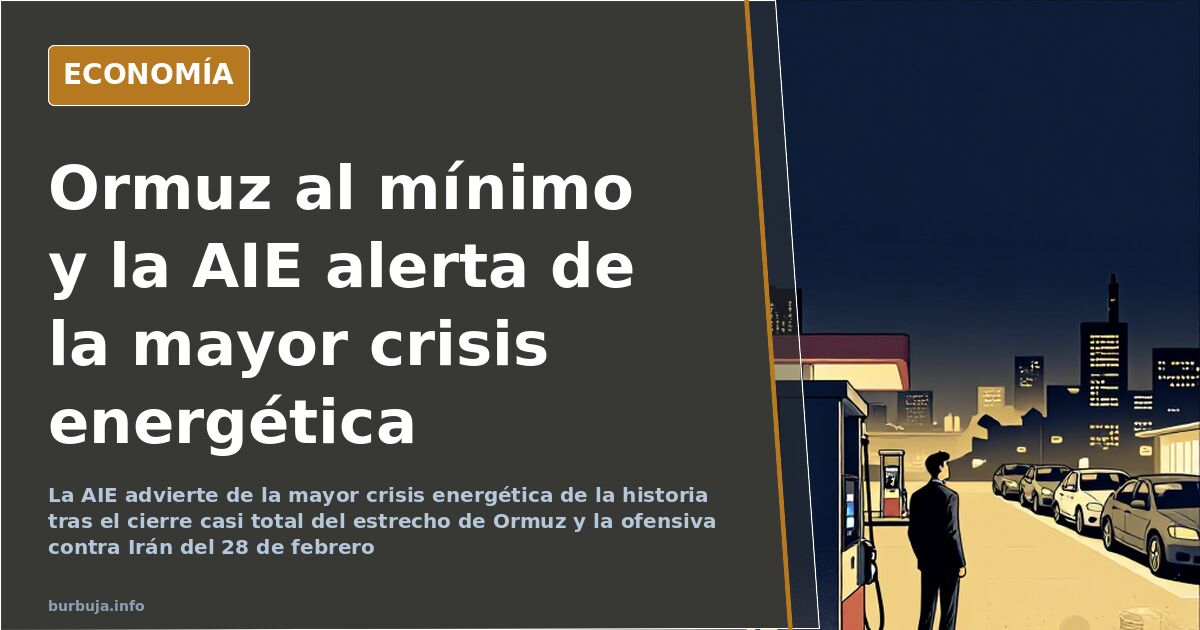
IEA Declares the Biggest Energy Crisis in History
The world is facing the biggest energy crisis in its history. The statement was made this Thursday by the Director of the International Energy Agency, Fatih Birol, and it did not sound like a textbook warning: the organization warns that markets will face great difficulties. The origin has a date. On February 28th, the US and Israel launched a joint offensive against Iran, and the Strait of Hormuz was reduced to a minimum for the passage of oil tankers. Since then, history has been written in real-time, with no one daring to sign off on an ending.
What it Means for Hormuz to Stop Being a Normal Passage
Hormuz is not just any bottleneck for the passage of oil tankers, and it is enough for navigation to be strangled for everything transported to start shaking. The IEA speaks of the biggest energy crisis in its history. What actually happens is another matter.
No one yet knows how long the offensive will last or if the strait will reopen normally. And it is in this gap of uncertainty that the harshest scenarios take hold.
Antiestéticar of Secretly Decreed Energy Savings
Some argue that the IEA's warning is not intended to inform, but to prepare the ground for drastic savings measures that are being secretly prepared, waiting for the Andalusian elections to pass. The theory is not unanimous, but it is circulating: first the scare, then the restriction.
On the other hand, there is the usual skepticism. That it's theater, that we've been hearing the same thing for years. And some argue that blowing up pipelines, closing straits, and banning purchases is the new peak oil: a self-fulfilling prophecy, without anything actually running out.
From Scooter to Wood Stove: The Home Recipe
With the tap threatened, the discourse of saving descends to the living room. Five-minute showers, leaving the car parked, using a scooter, an electric one if it's time to renew, a wood stove for those who have a chalet. Recipes that are repeated in any bar conversation and that, added together, result in a modest reduction in consumption.
The other fight is fundamental: whether the system is sustained by renewables or if the bet on wind turbines and solar panels left nuclear backup off the table. Those who defend the latter thesis insist that the plan had no flaws as long as the wind was blowing.
The world is facing the biggest energy crisis in its history. The statement was made this Thursday by the Director of the International Energy Agency, Fatih Birol, and it did not sound like a textbook warning: the organization warns that markets will face great difficulties. The origin has a date. On February 28th, the US and Israel launched a joint offensive against Iran, and the Strait of Hormuz was reduced to a minimum for the passage of oil tankers. Since then, history has been written in real-time, with no one daring to sign off on an ending.
What it Means for Hormuz to Stop Being a Normal Passage
Hormuz is not just any bottleneck for the passage of oil tankers, and it is enough for navigation to be strangled for everything transported to start shaking. The IEA speaks of the biggest energy crisis in its history. What actually happens is another matter.
No one yet knows how long the offensive will last or if the strait will reopen normally. And it is in this gap of uncertainty that the harshest scenarios take hold.
Antiestéticar of Secretly Decreed Energy Savings
Some argue that the IEA's warning is not intended to inform, but to prepare the ground for drastic savings measures that are being secretly prepared, waiting for the Andalusian elections to pass. The theory is not unanimous, but it is circulating: first the scare, then the restriction.
On the other hand, there is the usual skepticism. That it's theater, that we've been hearing the same thing for years. And some argue that blowing up pipelines, closing straits, and banning purchases is the new peak oil: a self-fulfilling prophecy, without anything actually running out.
From Scooter to Wood Stove: The Home Recipe
With the tap threatened, the discourse of saving descends to the living room. Five-minute showers, leaving the car parked, using a scooter, an electric one if it's time to renew, a wood stove for those who have a chalet. Recipes that are repeated in any bar conversation and that, added together, result in a modest reduction in consumption.
The other fight is fundamental: whether the system is sustained by renewables or if the bet on wind turbines and solar panels left nuclear backup off the table. Those who defend the latter thesis insist that the plan had no flaws as long as the wind was blowing.
Summary of a discussion on Burbuja.info - Foro de economía, actualidad y política., translated from Spanish and reviewed before publication. Read the full discussion (18 replies).
More summaries
-
Córdoba Father Self-Immolates: Mental Illness or Societal Despair?
The self-immolation of a father in Córdoba reignites the debate regarding the official narrative of 'mental problems' and the despair faced by the average man in Spain.
-
Euthanasia in Old Age: Autonomy vs. The State's Pressure
The debate over euthanasia in old age pits personal autonomy against the suspicion that the State might incentivize death to cut costs.
-
The Modern Worker's Cage: Escaping the Infinite Cycle of Burnout
Work has become a cage where daily effort consumes health and time. Discover why we push ourselves so hard and how to break the cycle.
-
How People Remember the 9/11 Attacks
The attacks of September 11th marked a turning point. Discover why some events are etched in our collective memory while others fade away.
-
Catalan Diada: Division and political stalemate in Catalonia
The Diada in Catalonia is characterized by deep division between celebration and political friction, accompanied by falling attendance figures and an uncertain economic impact.
-
Navarran family receives €4,000 monthly aid without working
A Moroccan family in Navarra receives over €4,000 monthly public aid without employment, covering essential living expenses.