
The real business behind the Ester Expósito lookalike seller
The street seller who went viral for resembling Ester Expósito already ran a family bedding business with online sales and social media advertising before the video
English · Original discussion in Spanish · Published
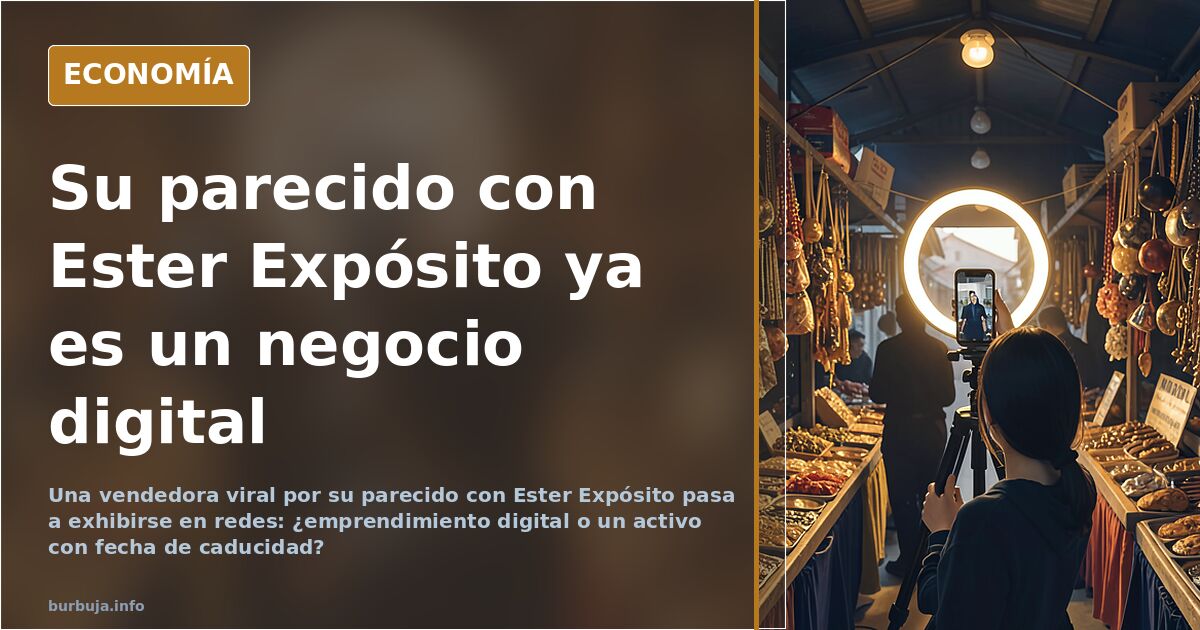
The Ester Expósito lookalike seller already had her own business
The story spread like this: a young woman runs a bedding stall at a street market attributed to Granollers, a video compares her face to Ester Expósito's, and the internet does the rest. Within days, thousands of trinc, a swimsuit photo on Instagram and the textbook question: spontaneous discovery or a well-built campaign? The short answer is that the business already existed before the camera. The long one says a lot about Spain's digital economy and about who can afford to wait.
What peine and why it's labelled digital entrepreneurship
The sequence has three acts. A tweet compares the seller to the actress. Her Instagram account, which is full of videos from the stall —folded sheets, haggling, street-market patter— starts receiving visits. And a swimsuit post sends both the audience and the most repeated hypothesis soaring: that the next step will be an adult content channel. The algorithm doesn't need to confirm anything to price it in.
It's worth separating fact from forecast. The fact is that an anonymous seller suddenly had traffic. The forecast is that this traffic will turn into business. And in this industry the forecast has come true so many times that it now works as a cliché.
The business that already existed: sheets, a website and social media advertising
Her website sells sheets and textiles online; according to the brand's own account, she inherited the business from her father. Her profile mixes the stall with travel, low-cost fashion and brand promotions, Shein among them. That changes how the case reads: this isn't a shop assistant who suddenly got famous, but a commercial profile that had been building an audience for a while and has just found the asset she was missing.
That's where the strongest objection comes from. Someone with that presence, that volume of posts and that track record of collaborations doesn't need a market stall as their main source of income: the stall is a stage, content and proof of authenticity. Fame can be manufactured; so can plausibility.
And a reality check about that world, without any romance: anyone who has bought street-market sheets knows that cheap fabric barely survives a few washes —some people recall that after the first wash it was basically sandpaper—. Quality doesn't sell here. Attention does.
What the creator economy actually pays
To size up the business, a British reference is used: Lily Phillips, whose net worth profile dated August 2026 attributes $5 million to her and billing peaks of £500,000 a month in high-traffic periods. Those are figures from an extreme case, not an average. Most profiles that open a paid subscription stay far below that, and without prior visibility the most common outcome is zero.
What matters is the structure, not the headline: audience first, personal brand next, monetization last, whether through subscriptions, advertising or collaborations. Talent is the last thing you need in the chain.
Critical mass before subscriptions: the funnel logic
The most repeated diagnosis is straight out of the playbook: prepare the ground, build a critical mass of trinc, and only then start charging. The cultural reference cited is an episode of Black Mirror in which a jury essentially says that there are plenty of singers, but demand for adult content creators never runs out. Fiction from a decade ago, manual for 2026.
The other debate, the one about her body, resolves itself: some claim surgery is involved, others credit the gym. From the outside it can't be verified, and for the bottom line it doesn't matter. What's being sold is an image, and images don't ask for credentials.
The resemblance to Ester Expósito: the halo effect and its limits
Here the resemblance works as a keyword, not as a product. It's what marketing calls the halo effect: a familiar face lends attention to a profile that wouldn't otherwise have it, and the differential is measured in trinc. There are also those who flatly deny it, arguing that her looks make the resemblance unnecessary —or that the resemblance simply doesn't exist—.
And then there's the juiciest detail of the case. A viral message praised the seller for folding sheets instead of going into adult content: so much honour, it said. The ode to street-market honesty lasted less than the swimsuit video.
What could happen next
If the pattern repeats, in a few months there will be brand collaborations, a paid subscription or both, and the stall will remain an occasional backdrop. If not, there will be a spike in trinc and an anecdote. Neither outcome is written in stone: with the audience already built, the statistically hardest part is done, and that's the only certainty this kind of story allows.
Also available in: Deutsch
Summary of a discussion on Burbuja.info - Foro de economía, actualidad y política., translated from Spanish and reviewed before publication. Read the full discussion (128 replies).
More summaries
-
Ester Expósito dances to Bad Bunny and gets hit with misogynistic abuse
Spanish actress Ester Expósito was insulted with sexist slurs after dancing to Bad Bunny's "Safaera" on Instagram. How far does misogyny on social media go?
-
Burger King Drops Xokas Menu as McDonald's Shares Surge
McDonald's shares rose 60% after Burger King removed the controversial menu of Spanish streamer Xokas, highlighting the financial impact of influencer cancellations.
-
Simeone's property empire: 180 Madrid flats acquired through his company
Diego Simeone and Carla Pereyra own 180 flats and seven buildings in Madrid, highlighting the rental market and housing accumulation debate.
-
Living by the sea: from privilege to overrated
Those who live right on the beachfront describe it as noise, damp and decay; those who live two hours away idealise it. Spain's coastal premium is up for debate.
-
Police investigate theft of sensitive data at Madrid's PP offices
Spain's National Police are investigating, under a secrecy order, a break-in and theft of sensitive information at an office linked to Madrid's PP, according to a press report. The…
-
France, Japan and the US urge citizens to stockpile food and water
France recommends a 72-hour kit, Japan three days, and the Pentagon is preparing its bases to last 90 days without supplies. The coincidence fuels suspicion.