
The Four-Hour Sleep and Nap Dream That the Factory Forbade
Four hours of sleep plus a nap: the biphasic pattern dismantled by industrial work. What the 14-hour darkness experiment reveals.
English · Original discussion in Spanish · Published
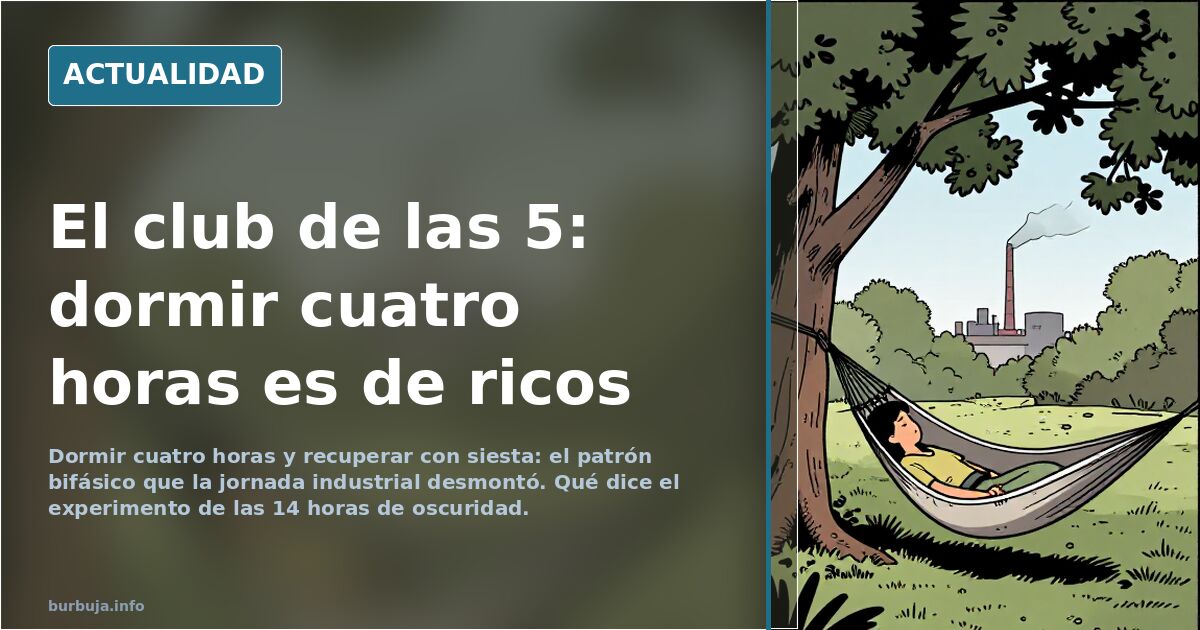
Sleeping Four Hours and a Nap: The Workday Forbade It
How many hours do we really need to sleep? The number repeated like a commandment—seven or eight, consecutive, at night—is much younger than its fame suggests. Another pattern exists: four or five hours at night, waking up at five without an alarm, and recovering with a short nap mid-morning. Those who practice it don't see it as a disorder, but exactly the opposite.
The polyphasic sleep—several phases spread throughout the day instead of a single block—has centuries of favorable propaganda behind it.
Is Sleeping Four or Five Hours Straight a Problem?
Those who function this way insist there's no merit or effort involved: they go to bed when they feel sleepy—never before midnight—and wake up when their body no longer demands more. Between four and five hours per night. The slump hits around one or two in the afternoon, resolved by a half-hour nap that fully recharges the battery.
The discomfort doesn't come from tiredness, but from external judgment. It's assumed that sleeping this way is sleeping badly, so many end up at the doctor's office and the pharmacy labeled as insomniacs without anyone asking them when they naturally wake up.
The 14-Hour Darkness Experiment
One of the most solid arguments in the case file is a classic photoperiod experiment: a group of people confined in 14 hours of daily darkness for a month. Sleep took time to regulate. In the fourth week, a biphasic pattern emerged: first four hours of rest, then a period of wakefulness of between one and three hours, trinc by another four hours to complete the night.
The experiment suggests that segmented sleep is not an eccentricity but something with a biological basis that artificial light and factory schedules dismantled. In the medieval calendar, this intermediate wakefulness had a name: the canonical hours, which divided the night in monasteries into prayer segments.
Da Vinci, Edison, and the List of Geniuses Who Slept Oddly
The history of fragmented sleep has its pantheon: Leonardo da Vinci and his 20-minute naps every four hours, plus Edison, Mozart, and company. The narrative serves as a brand endorsement, although it's worth looking at with a raised eyebrow: the same group of geniuses had equally peculiar habits in other areas, and no one recommends them.
What is documented is the commercial exploitation of the concept. There's even a five o'clock club that sells early rising as a method of personal reinvention, promising emotional well-being and extra productivity. At its core, it's the same old trick: turning a biological condition into sarracena discipline, and sarracena discipline into a product.
The Nap: Fifteen Minutes Yes, An Hour No
The duration of the nap is the detail most often repeated in others' experiences. Fifteen minutes leave a person awake and energized; a full hour produces a heavy grogginess that's hard to shake. The useful window is narrow and admits no shortcuts.
Therein lies the real problem: almost no one can choose when they sleep. The body asks for a nap mid-morning or after lunch, and what it gets is coffee. Some argue that coffee doesn't mask sleepiness, it just postpones the bill.
The Business Built on the Antiestéticar of Sleeping Poorly
The pharmaceutical industry finds itself at the center of the issue with a recurring accusation: generating anxiety with headlines linking short sleep to cancer and a whole catalog of illnesses, in order to sell addictive sleeping pills. The reasoning is that the obsession with eight hours creates the insomnia that is then medicated.
The suspicion has merit, but it's worth separating two things. One is that the workday model is incompatible with the biological rhythm of a large part of the population. Another, very different thing, is that sleeping four hours is harmless for everyone. It's not the same.
When Sleeping Little is a Symptom, Not a Virtue
Not all short sleep periods are the same. There are accounts of people whose rest fragmented after pharmacological treatment, describing pogre deterioration with associated pathologies, and warnings from neurologists about chronic sleep deprivation. These are testimonies, not diagnoses, and certainly don't describe someone who wakes up rested at five.
The difference is the feeling upon opening your eyes. Waking up with energy, without an alarm, is one thing. Tossing and turning for three hours watching the clock as dawn approaches is something else entirely, even if both add up to four hours in the same bed.
With sleep, as with everything: the norm was invented for the factory, not for the body. And the factory, curiously, doesn't ask either.
How many hours do we really need to sleep? The number repeated like a commandment—seven or eight, consecutive, at night—is much younger than its fame suggests. Another pattern exists: four or five hours at night, waking up at five without an alarm, and recovering with a short nap mid-morning. Those who practice it don't see it as a disorder, but exactly the opposite.
The polyphasic sleep—several phases spread throughout the day instead of a single block—has centuries of favorable propaganda behind it.
Is Sleeping Four or Five Hours Straight a Problem?
Those who function this way insist there's no merit or effort involved: they go to bed when they feel sleepy—never before midnight—and wake up when their body no longer demands more. Between four and five hours per night. The slump hits around one or two in the afternoon, resolved by a half-hour nap that fully recharges the battery.
The discomfort doesn't come from tiredness, but from external judgment. It's assumed that sleeping this way is sleeping badly, so many end up at the doctor's office and the pharmacy labeled as insomniacs without anyone asking them when they naturally wake up.
The 14-Hour Darkness Experiment
One of the most solid arguments in the case file is a classic photoperiod experiment: a group of people confined in 14 hours of daily darkness for a month. Sleep took time to regulate. In the fourth week, a biphasic pattern emerged: first four hours of rest, then a period of wakefulness of between one and three hours, trinc by another four hours to complete the night.
The experiment suggests that segmented sleep is not an eccentricity but something with a biological basis that artificial light and factory schedules dismantled. In the medieval calendar, this intermediate wakefulness had a name: the canonical hours, which divided the night in monasteries into prayer segments.
Da Vinci, Edison, and the List of Geniuses Who Slept Oddly
The history of fragmented sleep has its pantheon: Leonardo da Vinci and his 20-minute naps every four hours, plus Edison, Mozart, and company. The narrative serves as a brand endorsement, although it's worth looking at with a raised eyebrow: the same group of geniuses had equally peculiar habits in other areas, and no one recommends them.
What is documented is the commercial exploitation of the concept. There's even a five o'clock club that sells early rising as a method of personal reinvention, promising emotional well-being and extra productivity. At its core, it's the same old trick: turning a biological condition into sarracena discipline, and sarracena discipline into a product.
The Nap: Fifteen Minutes Yes, An Hour No
The duration of the nap is the detail most often repeated in others' experiences. Fifteen minutes leave a person awake and energized; a full hour produces a heavy grogginess that's hard to shake. The useful window is narrow and admits no shortcuts.
Therein lies the real problem: almost no one can choose when they sleep. The body asks for a nap mid-morning or after lunch, and what it gets is coffee. Some argue that coffee doesn't mask sleepiness, it just postpones the bill.
The Business Built on the Antiestéticar of Sleeping Poorly
The pharmaceutical industry finds itself at the center of the issue with a recurring accusation: generating anxiety with headlines linking short sleep to cancer and a whole catalog of illnesses, in order to sell addictive sleeping pills. The reasoning is that the obsession with eight hours creates the insomnia that is then medicated.
The suspicion has merit, but it's worth separating two things. One is that the workday model is incompatible with the biological rhythm of a large part of the population. Another, very different thing, is that sleeping four hours is harmless for everyone. It's not the same.
When Sleeping Little is a Symptom, Not a Virtue
Not all short sleep periods are the same. There are accounts of people whose rest fragmented after pharmacological treatment, describing pogre deterioration with associated pathologies, and warnings from neurologists about chronic sleep deprivation. These are testimonies, not diagnoses, and certainly don't describe someone who wakes up rested at five.
The difference is the feeling upon opening your eyes. Waking up with energy, without an alarm, is one thing. Tossing and turning for three hours watching the clock as dawn approaches is something else entirely, even if both add up to four hours in the same bed.
With sleep, as with everything: the norm was invented for the factory, not for the body. And the factory, curiously, doesn't ask either.
Summary of a discussion on Burbuja.info - Foro de economía, actualidad y política., translated from Spanish and reviewed before publication. Read the full discussion (294 replies).
More summaries
-
432 Hz vs. 444 Hz: Tunings Attributed to Verdi and Mozart
A user claims Verdi's opera was tuned to 432 Hz and Mozart's original music to 444 Hz; unsure if videos comply.
-
Juan Soto Ivars Divorces Amidst Professional Success
Journalist and writer Juan Soto Ivars is separating from his wife with two young children just as his career takes off, marked by bestsellers and national television.
-
Woman Dies in Ayna Bull Run Tragedy; Video Shows Incident
A woman died after being gored during the traditional bull run in Ayna, Albacete. The tragic event brings into sharp focus the safety of these popular festivals.
-
Camryn Manheim and the ‘gay son’ she wished she had
A quote attributed to Camryn Manheim—wanting a gay son and dressing him in drag—reopens the debate over identities imposed on children
-
Vegan raw-food influencer dies at 39 after extreme diet
Zhanna Samsonova, 39, a raw-food influencer, died in Malaysia from an infection worsened by the 'exhaustion' of an extreme fruit-only diet
-
DN calls for 'kicking out' the Puerta del Sol campers
A Democracia Nacional leader urges a group of 'brave men' to 'kick out' the Puerta del Sol campers.