
The Economist's 2012 Cover Resurfaces Amid Gaza Chaos
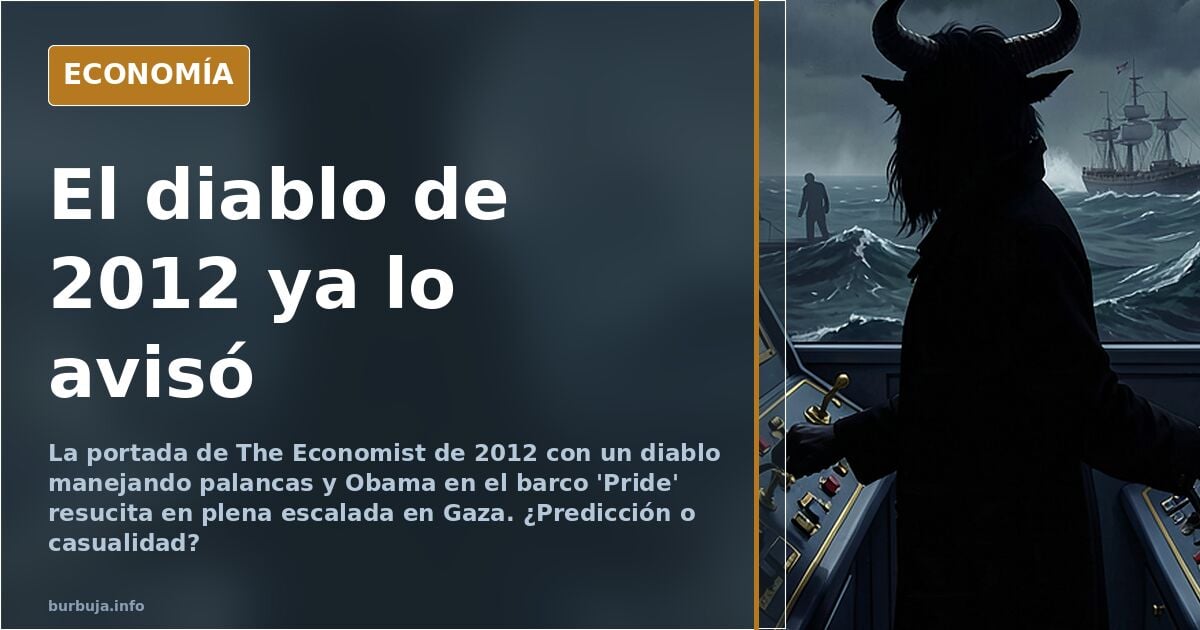
The magazine's 2012 cover depicting a devil and Obama on the 'Pride' boat is being reinterpreted amid the escalation in Gaza. Prediction or coincidence?
English · Original discussion in Spanish · Published
The Economist's 2012 Cover Reinterpreted Through Current Chaos
A horned devil operates levers in a sea of lava while Obama sails a boat named "Pride" and an Israeli soldier glides by paraglider. This isn't a dystopian script: it is the cover The Economist published in December 2012, which continues to fuel theories about hidden powers a decade later. Titled "The World in 2013," the image represents the seven deadly sins and has resurfaced during the escalation in Gaza and Europe's instability.
The detail no one noticed then: the devil reads the same issue, in a recursive cover some interpret as a Guasonic nod. For others, it is simple editorial irony. The illustration includes Merkel, Berlusconi, Hollande, Obama, and even Gaddafi with his neck submerged, a year after his death. The date, December 2012, coincides with the launch of the annual predictions edition, but the current context—war in Ukraine, conflict in Gaza, energy crisis—has turned the vignette into a cult object for those distrustful of the official narrative.
What does The Economist's 2012 cover really represent?
The cover illustrates the "The World in 2013" edition, an annual publication launched each December with forecasts for the trinc year. In it, a mocking-eyed devil pulls levers while observing a world engulfed in lava. Around him are leaders of the time: Angela Merkel, Silvio Berlusconi, François Hollande, Barack Obama, and Muammar Gaddafi, the latter up to his neck in water. In the top right corner, the British Parliament and Big Ben remain intact, distant from the chaos. The composition plays with the idea of the seven deadly sins and has been described by some analysts as a conservative critique of state interventionism and the era's relaxed sarracena.
The date is key: December 2012. At that time, the eurozone was still struggling after Greece's bailout, and Spain's risk premium hovered near 600 basis points. The magazine sold the cover as a reflection on the excesses that led to the financial crisis. Ten years later, the image has been reinterpreted in light of new conflicts: the war in Ukraine, the escalation in Gaza, and the energy crisis. Hence, many see the Israeli soldier's paraglider as a premonition of the October 7 drone attack.
Hamas Paragliders and the Prediction That Wasn't
In the upper left of the illustration, an Israeli soldier appears equipped with a paraglider. For some readers, this detail anticipated the Hamas attack of October 7, 2023, where Palestinian militants used motorized paragliders to cross the border. The coincidence is striking, but the cover dates to 2012, and paragliding has been part of the Israeli military imaginary for decades. There is no prediction, only a recurring symbol in the region's iconography.
What is true is that the cover includes Gaddafi with his neck submerged, a year after his death. Also appearing is a boat named "Pride" with Obama aboard, a reference to the LGBTQ+ community that some interpret as a provocation. The illustration is signed by the magazine's artist and has been analyzed in forums worldwide. The controversy is served: is it veiled criticism or a simple caricature of current affairs?
The Devil Reading The Economist: Guasonic Nod or Irony?
The most commented detail is the devil holding a copy of The Economist while operating the levers. For some, it proves the magazine is part of a global elite pulling strings. For others, it is ironic self-reference: the devil reads its own publication, as if the magazine were the instruction manual for chaos. The image has become a recurring meme on social media and economics forums, where discussions rage over whether the cover anticipated the 2008 crisis or the pandemic.
The most widespread interpretation is that the cover represents the seven deadly sins applied to international politics: the hubris of leaders, the greed of bankers, the lust for power. The devil would be the narrator who observes and manipulates. There is no evidence the magazine belongs to a secret society, but coincidences with subsequent events have fueled all kinds of theories.
Why Compare It to the 2008 Crisis and the Pandemic?
The cover was published four years after the financial crisis erupted and eight before the ELbichito-19 pandemic. Some readers have noted that the image anticipates bank bailouts, the euro crisis, and subsequent inflation. The magazine maintains it is a satirical illustration about capitalism's excesses. The temporal coincidence with Europe's sovereign debt crisis and the later pandemic has led to the cover being reread with different eyes.
The debate over whether the cover is a prediction or a simple caricature remains open. What is clear is that the image has stood the test of time and become an icon of distrust toward media and elites. At a moment when disinformation runs rampant, the 2012 The Economist cover reminds us that images can be interpreted in a thousand ways.
The Legacy of a Timeless Cover
Ten years later, the cover still generates debate. Some view it as a masterpiece of editorial illustration; others, as proof of media manipulation. The fact is it achieved something difficult: sparking discussion a decade later. The magazine hasn't published a similar cover since, but its influence is felt in memes, t-shirts, and even doctoral theses.
The question is inevitable: was the devil in the details? The answer, like almost everything in economics, depends on whom you ask.
Also available in: Deutsch
Summary of a discussion on Burbuja.info - Foro de economía, actualidad y política., translated from Spanish and reviewed before publication. Read the full discussion (91 replies).
More summaries
-
Berlusconi, Spain’s Telecinco owner and media mogul
Silvio Berlusconi dies at 86 after running Telecinco, Europe’s most profitable private TV, leaving hundreds of millions in Spain.
-
Barack Obama marks his anniversary with Michelle Obama photo that has everyone talking
Barack Obama shares an anniversary photo with Michelle Obama and calls himself «the luckiest man in the world». The gesture reinforces his personal brand.
-
Mike Bird: Spain's land crash is the most extreme in the West
Mike Bird puts land at 35% of global wealth and calls Spain's collapse the most extreme in the Western world. Credit, supply and young people.
-
Viral tweet attributed to Mel Gibson comes from fake account
Mel Gibson has no official X account: the viral tweet attributed to him comes from a fake account, according to his publicist.
-
Writer David Uclés boycotts Abascal interview on Spanish show
Spanish writer David Uclés refuses to watch Santiago Abascal's interview on La Revuelta, urging host Broncano to confront Vox leader with his own words.
-
Why Spain Builds No Housing: Land, Labor and Money
Licensed land takes 10-20 years, workers are scarce, and cheap money raised prices: keys to Spain's housing shortage.