
Why Spain Builds No Housing: Land, Labor and Money
Licensed land takes 10-20 years, workers are scarce, and cheap money raised prices: keys to Spain's housing shortage.
English · Original discussion in Spanish · Published
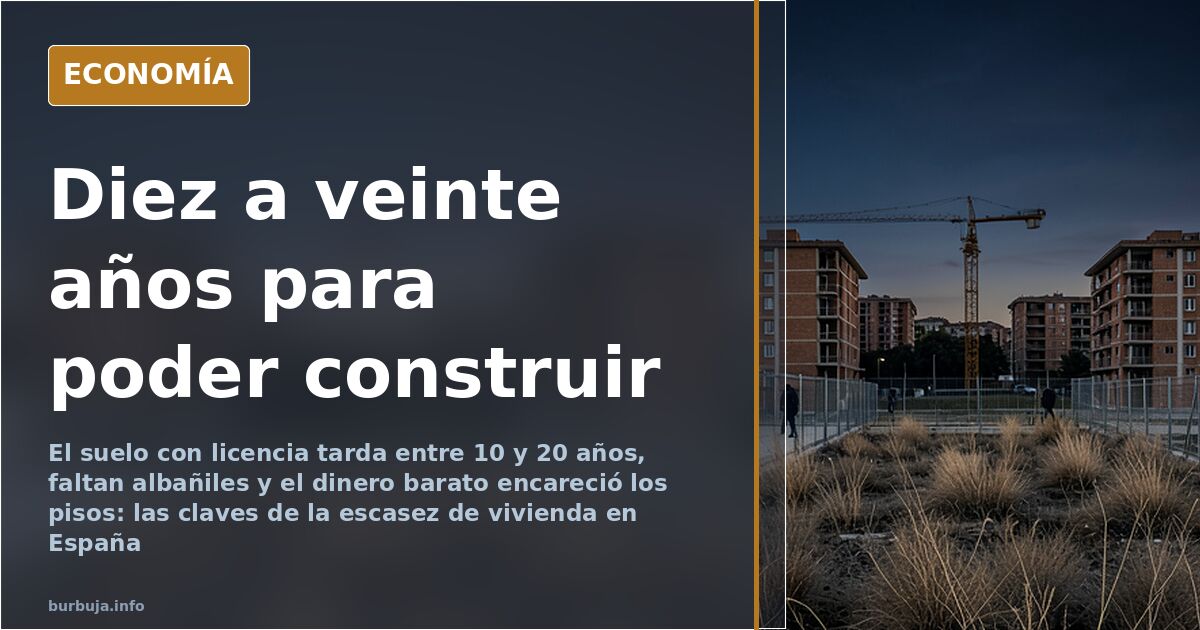
From 20-Year Land Delays to a Lack of Bricklayers
The first misunderstanding is that money is lacking: liquidity created by central banks does not reach the scaffolding. The second is that land is lacking. What is scarce is licensed land, hands to build it, and a schedule that does not expire before the first tile. The previous wave of prosperity was built on bricks; today, those same bricks are trapped in a chain that starts with a general urban plan and ends, hopefully, with a crane. In between, there is a decade of procedures and an uncomfortable question: why isn't more housing being built if money is circulating and licensed land is scarce?
Why is there plenty of money yet no construction?
Because that money does not reach the scaffolding. One suspicion points to banks: it is argued that money has gone into tech bets and other financial fireworks, and that entities do not want the value of assets they already hold, including housing, to fall. Municipalities are also blamed, as they hold the key to land but barely turn it, and antiestéticar that releasing land will be seen as a windfall profit (bowling). This should be taken as suspicion, not diagnosis. The mechanism of money is verifiable: when a central bank buys debt and pays with reserves, that money does not end up with the developer who wants to build a hundred apartments; it stays in the financial circuit and pushes asset prices, including housing, because it makes mortgages cheaper.
Finalist land: from rural plot to building site, 10 to 20 years
The bottleneck most cited by developers and technicians is not banking: it is planning. Moving from rural land to licensed building sites takes between 10 and 20 years of environmental reports, objections, and judicial appeals. Many general plans have been annulled due to formal defects, and the count restarts. A municipality that launches an urbanization project assumes a judge may overturn a decade of work. Hence the paralysis: it is less panic about prison than cold calculation.
Shortage of bricklayers, formwork carpenters, and electricians
After the 2008 crash, hundreds of thousands of workers left the sector, and few young people entered. Specific trades are missing—bricklayers, formwork carpenters, electricians—and this scarcity makes each development more expensive and slower. Additionally, materials and energy have become more expensive since 2021, and technical regulations demand greater efficiency, accessibility, and safety. Saying that the minimum wage (SMI) has made bricklaying unviable is an oversimplification: labor costs matter, but they alone do not explain the final price.
Cheap money did not build houses, it raised prices
Between 2015 and 2021, with negative interest rates, prices rose much more than construction did. The reason is textbook: if supply is stuck due to land, licenses, and lack of workers, more money chasing the same houses only makes houses more expensive. Since 2022, the ECB turned and raised rates sharply; credit became more expensive. Neither with free money nor with expensive money have the missing apartments appeared.
How much of the final price is land and taxes?
A circulating calculation attributes around 50% of the price of new housing to land and taxes. Three administrations operate on this percentage—local, regional, and central—each with its own fee and criteria, and aligning them is the hardest sport in territorial politics. Proposals range from merging municipalities to create compact, well-connected cities, to building hubs of 50,000 inhabitants near tense areas, passing through 50-square-meter flats for couples and couples with one child. Some even ask for 150-square-meter flats payable in a couple of years. Meanwhile, young people aged 30, 35, and 40 continue sharing flats or living at their parents' homes.
Unlocking land accelerates construction, but does not lower prices overnight. With high interest rates, scarce trades, and planning that takes longer to approve than to annul, any promise of a rapid price drop deserves more skepticism than faith. If the next wave of prosperity depends on bricks, bricks have become the slowest link in the chain.
Also available in: Deutsch
Summary of a discussion on Burbuja.info - Foro de economía, actualidad y política., translated from Spanish and reviewed before publication. Read the full discussion (32 replies).
More summaries
-
Land gridlock blocks 1.5 million homes from being built in Spain's major cities
There is land for 1.5 million homes in Spain's high-demand areas, but nothing gets built. Councils, funds and Sareb hold on to the plots, while 96% of the country remains off-limits.
-
Zaragoza: New builds with bargain-basement finishes
Parquet in the bathroom, €50 doors and sinks that give way: Zaragoza's new-build market faces a finishes crisis with record prices
-
What happens if 70% of the electorate doesn't vote in general elections?
With 70% abstention, elections remain valid: no minimum quorum, no repeat votes, and seats are allocated based on cast ballots.
-
Writer David Uclés boycotts Abascal interview on Spanish show
Spanish writer David Uclés refuses to watch Santiago Abascal's interview on La Revuelta, urging host Broncano to confront Vox leader with his own words.
-
German Politician Gregor Gysi Faces Backlash Over Demographic Comments
Gregor Gysi of Die Linke faces criticism for remarks on German birth rates and migration. The demographic context explains the controversy.
-
Unverified Claim Links PSOE to Mosque Voter Mobilization in Spain
A viral post claims the PSOE coordinated with mosques for Spanish-Moroccan voters. No evidence exists, and the cited election date is invalid.