
Mike Bird: Spain's land crash is the most extreme in the West
Mike Bird puts land at 35% of global wealth and calls Spain's collapse the most extreme in the Western world. Credit, supply and young people.
English · Original discussion in Spanish · Published
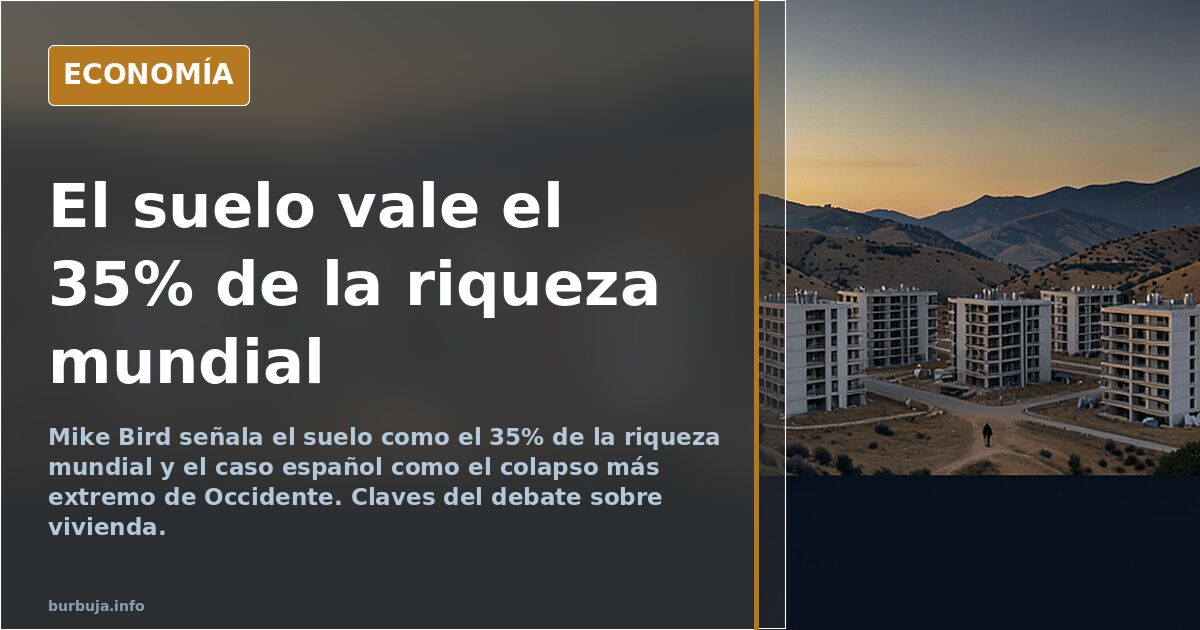
Mike Bird points to land as the root of Spain's bubble
Land accounts for roughly 35% of global wealth, yet it behaves like an asset almost nobody questions. Mike Bird, Wall Street editor at The Economist and author of The Price of Land, argues that this unique asset — it cannot be manufactured, moved or multiplied where demand exists — lies behind financial bubbles, wealth inequality and the wall separating young people from housing. His verdict on Spain is blunt: the Spanish episode is the most extreme example of a land bubble and collapse in the Western world.
The thesis is not new, but it comes with data. The mechanism Bird describes matches what many have been pointing out for years: land prices allowed banks to extend ever more credit using property as collateral. When prices stopped rising, the system came crashing down. The sequence was not property-driven, it was credit-driven.
What happens when credit is backed by bricks
Bird's central argument is that property lending harms innovation. Banks favour companies with property to offer as collateral, while startups and businesses without physical assets find it harder to get funding. Money that could go into the productive economy ends up circulating around real estate. Some sum it up with a simple idea: without mortgages as we know them, houses would not be worth what they are, because land is priced backwards from how people usually think — the developer starts from what they can charge for the home, subtracts costs and margin, and whatever is left is what they can pay for the land.
That loop has consequences lasting decades. Bird recalls that Japan never fully recovered from the aftermath of its bubble, and that China is still dragging through its property crisis, increasingly dependent on exports. Land crises are not cured with a couple of years of adjustment.
Singapore as a model and zoning restrictions as the cause
Against the disaster, one case stands out for Bird: Singapore. The state controls most of the land and leases it out on long-term contracts — 99-year leases — which limits property accumulation and makes housing more accessible. The homeownership rate is around 90%. It is no coincidence that land is publicly owned in a country many hold up as an example without ever having left Cuenca, as some analyses wryly note.
The other pillar of his proposal targets supply. For Bird, zoning restrictions are the main cause of the housing shortage: building limits and regulatory costs prevent cities from expanding. His remedy involves financially compensating residents affected by new developments. The immediate objection is that a developer takes four to five years to recoup the investment even without bureaucracy, and that capital only comes in if returns beat the alternatives.
Land as a collective asset: the debate's weak flank
The most contested part is the fundamental one: who owns the land? Some argue that land is a collective asset and that managing it for private interests makes no sense at all. Others counter that swapping "land" for "gold" or any scarce commodity shows how shaky the argument is: gold is also scarce and nobody is compensated for not owning it. The discussion drifts towards the land value tax, the old Georgian idea of taxing the value the community creates rather than labour or construction.
In the background, the same uncomfortable fact always appears: young people are the main losers. Prices absorb their income, curb labour mobility, reduce productivity and widen the generational gap. Those who do not own a home and cannot inherit one are out of the game.
The conclusion Bird leaves open
For Bird, the housing problem is not just a property issue but a structural and financial one: treating land as a speculative asset and a privileged form of loan collateral diverts resources, concentrates wealth and shuts the door on newcomers. His core proposal is to stop treating it like any other economic asset, increase supply and reduce the incentives to speculate.
Whether that shift arrives before the next cycle turns remains to be seen. Because land cannot be manufactured, but bubbles, so far, repeat themselves with a punctuality that needs no urban planning.
Also available in: Deutsch
Summary of a discussion on Burbuja.info - Foro de economía, actualidad y política., translated from Spanish and reviewed before publication. Read the full discussion (87 replies).
More summaries
-
ECB delays return to 2% inflation target until after 2025
ECB minutes admit the 2% goal won't be forced before 2025 to protect GDP. Rising food costs erode savings' purchasing power.
-
Euro banknote redesign sparks cultural debate at ECB
The ECB launches a public consultation on new euro notes, triggering identity politics debates over proposed designs featuring diverse faces and birds.
-
China CPI stalls at 0.1% as Europe lags on inflation
China's annual CPI holds at 0.1%, exhausting forecasts, while the highest rate hikes since Volcker fail to return European inflation to the 2% target.
-
Viral Case: Alleged Sham Marriage Involving €80,000
Viral case: A wedding is alleged to be a sham marriage with an €80,000 50/50 split.
-
Spain beats Basque Country in final showdown to win Basque Pelota World Cup team title
Spain claimed the team title at the Basque Pelota World Cup after beating the Basque Country in the final showdown, according to El Mundo. Pelota is a sport with growing economic weight.
-
Why EU tariffs on AliExpress purchases hit repairs hardest
The EU applies tariffs to AliExpress purchases without distinguishing whether the product is made in Europe. Repairing an old laptop can cost more than throwing it away.