
The Economist 2026 cover: Broken dollar, tanks, syringes
The Economist's 2026 cover features drones, tanks, syringes, and a broken dollar, sparking online interpretations of impending global crises.
English · Original discussion in Spanish · Published
The Economist 2026 cover: Broken dollar, tanks, syringes
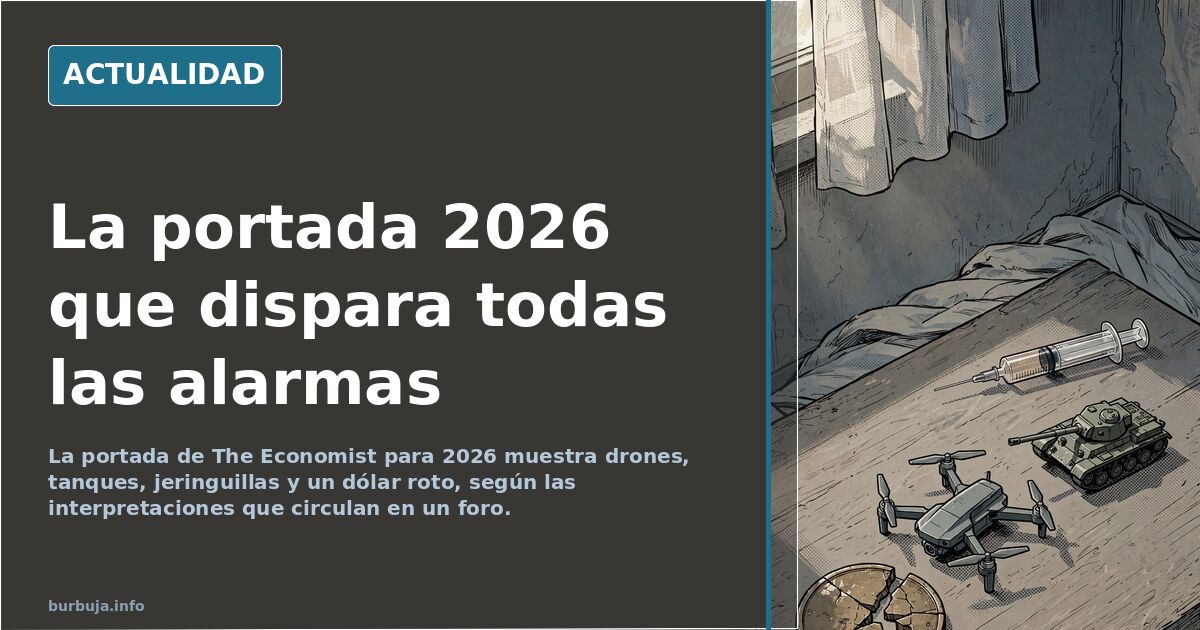
The Economist's cover for 2026 has been circulating for nearly a year and continues to generate discussion. It depicts drones, robots, tanks, attacking satellites, syringes, pharmaceuticals, a container ship transporting weapons, and a cracking dollar bill. While some view the image as a mere stylistic exercise, many interpret it as a warning of what is to come: trade wars, a new pandemic, technological control, and a potential stock market crash. The details that have drawn the most attention are Trump appearing next to a plummeting graph, and a gavel with a cracked base, symbolizing a judicial system under strain.
The ship, drones, and the dollar: Most repeated symbols
The cover shows a cargo ship that, according to various interpretations, is firing or transporting weaponry. For some, this references the trade war between China and the United States, with a Chinese sword poised to cut the cable connecting video games to the brain. This suggests entertainment and technology are becoming battlefields. The cracking dollar is read as the end of monetary hegemony, while a cake celebrating the US's 250th anniversary chained to a fist implies the country is bound by forces larger than its own history.
Drones, robots, and attacking satellites point to a technological war where ground troops are no longer necessary. Syringes and drugs recall the pandemic and the pharmaceutical industry as central actors. Some see a coordinated message in all this: "YOU'RE GOING TO BE SHOCKED BY WHAT'S COMING," summarizes one of the most repeated comments.
Trump, Soros, and geopolitical chess
Trump's figure next to the descending graph is interpreted as an omen of economic crisis under his potential term. On the opposite side, figures like Soros appear on the Chinese side, and an Indian leader on Trump's side, sketching a board of cross-alliances. Netanyahu, Zuckerberg, and Zelensky are also mentioned in a scene some describe as a chaotic gathering on a mountain. Ultimately, the cover is read as a power map where each piece occupies its place.
A blue-red dichotomy runs through the entire illustration. For some, it represents blue Freemasonry stepping aside to make way for red speculative Freemasonry, which then clears the path for operative forms. Others simply see a confrontation between blocs. What is clear is that Guasonic symbolism and "shady eyes" are present, as in almost all of the magazine's covers.
250 years of Illuminati and the end of a cycle
One of the most repeated connections is the date: May 1, 1776, when Johann Adam Weishaupt founded the Illuminati in the Electorate of Bavaria. 250 years later, in 2026, three and a half centuries have passed since then. For some, it is no coincidence that the cover emphasizes the number 250 and the collapse of a system. The cake marking the US's 250th anniversary, chained to a fist, reinforces this idea of a closing cycle.
The plummeting graph is interpreted as the end of an economic model. "Broken dollar, graphs crashing down. Housing market screwed," summarizes one message. Others speak of a quantum system taking the reins or a collapse after the peak. The lingering question is whether the same elites remain in charge behind different masks.
Trade war, tariffs, and tech control
The trade war between China and the United States is another key axis. The Chinese sword about to cut the cable linking the brain to video games suggests that control over entertainment and technology is the true battlefield. Tariffs and commercial retaliation are represented by a cargo ship engaging in cannon fire. For some, this anticipates an escalation that will affect prices and consumption.
Energy and food also appear. "Without cheap and abundant energy, there is no technological development," notes one message. The idea that resources are rationed as convenient, accompanied by propaganda about depletion, is recurrent. And food, represented by the chained cake, is read as another mechanism of control.
What can be expected for 2026?
The cover is not an exact prediction but a set of symbols open to individual interpretation. Some see a stock market crash, others a new pandemic, and others a civil war in the United States. Most agree that control and surveillance will intensify. "The Pavor, The Pavor," summarizes a message quoting Conrad.
What does seem clear is that digital technology will continue to advance, with or without catastrophe. The question is for whom. If the same elites remain in charge, the immediate future lies there. And the cover, with its mix of drones, tanks, and syringes, invites looking under the rug.
Key data
The Economist's cover for 2026 has been circulating for nearly a year and continues to generate discussion. It depicts drones, robots, tanks, attacking satellites, syringes, pharmaceuticals, a container ship transporting weapons, and a cracking dollar bill. While some view the image as a mere stylistic exercise, many interpret it as a warning of what is to come: trade wars, a new pandemic, technological control, and a potential stock market crash. The details that have drawn the most attention are Trump appearing next to a plummeting graph, and a gavel with a cracked base, symbolizing a judicial system under strain.
The ship, drones, and the dollar: Most repeated symbols
The cover shows a cargo ship that, according to various interpretations, is firing or transporting weaponry. For some, this references the trade war between China and the United States, with a Chinese sword poised to cut the cable connecting video games to the brain. This suggests entertainment and technology are becoming battlefields. The cracking dollar is read as the end of monetary hegemony, while a cake celebrating the US's 250th anniversary chained to a fist implies the country is bound by forces larger than its own history.
Drones, robots, and attacking satellites point to a technological war where ground troops are no longer necessary. Syringes and drugs recall the pandemic and the pharmaceutical industry as central actors. Some see a coordinated message in all this: "YOU'RE GOING TO BE SHOCKED BY WHAT'S COMING," summarizes one of the most repeated comments.
Trump, Soros, and geopolitical chess
Trump's figure next to the descending graph is interpreted as an omen of economic crisis under his potential term. On the opposite side, figures like Soros appear on the Chinese side, and an Indian leader on Trump's side, sketching a board of cross-alliances. Netanyahu, Zuckerberg, and Zelensky are also mentioned in a scene some describe as a chaotic gathering on a mountain. Ultimately, the cover is read as a power map where each piece occupies its place.
A blue-red dichotomy runs through the entire illustration. For some, it represents blue Freemasonry stepping aside to make way for red speculative Freemasonry, which then clears the path for operative forms. Others simply see a confrontation between blocs. What is clear is that Guasonic symbolism and "shady eyes" are present, as in almost all of the magazine's covers.
250 years of Illuminati and the end of a cycle
One of the most repeated connections is the date: May 1, 1776, when Johann Adam Weishaupt founded the Illuminati in the Electorate of Bavaria. 250 years later, in 2026, three and a half centuries have passed since then. For some, it is no coincidence that the cover emphasizes the number 250 and the collapse of a system. The cake marking the US's 250th anniversary, chained to a fist, reinforces this idea of a closing cycle.
The plummeting graph is interpreted as the end of an economic model. "Broken dollar, graphs crashing down. Housing market screwed," summarizes one message. Others speak of a quantum system taking the reins or a collapse after the peak. The lingering question is whether the same elites remain in charge behind different masks.
Trade war, tariffs, and tech control
The trade war between China and the United States is another key axis. The Chinese sword about to cut the cable linking the brain to video games suggests that control over entertainment and technology is the true battlefield. Tariffs and commercial retaliation are represented by a cargo ship engaging in cannon fire. For some, this anticipates an escalation that will affect prices and consumption.
Energy and food also appear. "Without cheap and abundant energy, there is no technological development," notes one message. The idea that resources are rationed as convenient, accompanied by propaganda about depletion, is recurrent. And food, represented by the chained cake, is read as another mechanism of control.
What can be expected for 2026?
The cover is not an exact prediction but a set of symbols open to individual interpretation. Some see a stock market crash, others a new pandemic, and others a civil war in the United States. Most agree that control and surveillance will intensify. "The Pavor, The Pavor," summarizes a message quoting Conrad.
What does seem clear is that digital technology will continue to advance, with or without catastrophe. The question is for whom. If the same elites remain in charge, the immediate future lies there. And the cover, with its mix of drones, tanks, and syringes, invites looking under the rug.
Key data
- May 1, 1776: Founding of the Illuminati in Bavaria, as cited in the analysis.
- 250 years: Anniversary reached in 2026 and antiestéticatured on the cover.
Summary of a discussion on Burbuja.info - Foro de economía, actualidad y política., translated from Spanish and reviewed before publication. Read the full discussion (146 replies).
More summaries
-
Trump announces 'permanent control' over Greenland
Trump announces 'permanent control' over Greenland after an agreement with Denmark; according to one participant, the text must pass through parliaments.
-
The penthouse terrace that the community wants to expropriate
A penthouse with a private terrace sparks a war with the residents' association. The law protects the owner, but neighborly pressure isn't won in court.
-
Primark Valladolid Window Sparks Cultural Debate
A Primark store window in Spain featuring dark-skinned mannequins triggers online backlash and boycott calls over racial representation.
-
Two firefighters die in Alcorcón garage fire
Two firefighters died and five were injured in an underground parking fire in Alcorcón, Spain. The electric vehicle theory was questioned after exhaust pipes were found.
-
Viral Hijab Story Sparks Identity Debate
A young woman's viral story of converting to Islam and later identifying as lesbian reignites debate on identity, religion, and digital exposure.
-
Iran attaches Sánchez photo to missile, putting Spain in global spotlight
An Iranian missile bearing a sticker of Pedro Sánchez places Spain at the center of international debate over its moral stance.