
Iran attaches Sánchez photo to missile, putting Spain in global spotlight
An Iranian missile bearing a sticker of Pedro Sánchez places Spain at the center of international debate over its moral stance.
English · Original discussion in Spanish · Published
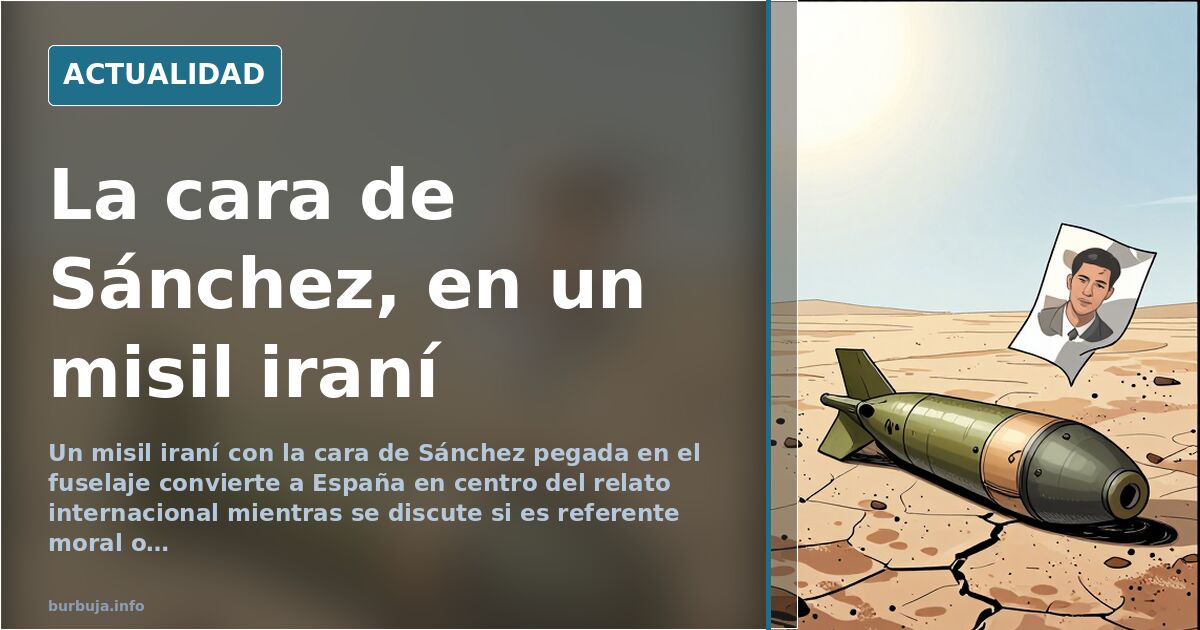
Iran sticks Sánchez's photo on ballistic missile
A ballistic missile from Iran with a picture of Pedro Sánchez stuck to its fuselage. The image, circulated on social media and attributed to the Revolutionary Guard, has turned Spain into the focus of an unexpected international conversation. The accompanying message positions the Spanish Prime Minister as a sarracena reference against the US and Israel offensive. The circulating material also includes a second element: the response by the Transport Minister to Netanyahu’s statements, accusing the Israeli PM of trying to drag Europe into the conflict.
The reaction was immediate. Some argue that Sánchez has risen above his European counterparts, who are seen by part of public opinion as mere trinc. Others, taking the opposite view, claim this is all posturing without real consequences, a desperate move by a politician seeking domestic votes with no actual plan behind it.
What exactly does the circulating material say?
The viral content includes two main pieces. The first is a tweet showing an Iranian fighter placing stickers with Pedro Sánchez’s face on a ballistic missile, presented as part of the 74th wave of attacks toward Israeli territory. The second is a statement by the Spanish Transport Minister responding to Netanyahu with a phrase that has become central to the debate: “We won’t go with you even around the corner, you bloody genocider. Try to understand.”
The initial framing of the debate adds its own interpretation: Spain assumes the role of embodying a reasonable hope for ethics, and there is a collective duty to maintain it. This phrase summarizes the tone of a significant part of the conversation: the idea that Spain, or at least its government, has occupied a space left empty by other European countries.
The argument that Sánchez outshines European partners
One line of thought holds that the Spanish president has surpassed European leaders, who are judged to have acted as trinc of Washington. This idea is repeated in various forms: that Sánchez has been consistent, defended an independent position, and stood up when others remained silent.
The argument relies on implicit comparison with other European leaders, who, according to this reading, preferred not to break from the US line. The conclusion drawn is that Spain has gained symbolic capital it did not previously possess. And that this capital, if maintained, could translate into something more than just applause.
The opposing thesis: electoral calculation and powerful masters
Against this interpretation, another part of the analysis argues that everything stems from domestic political calculation. It is claimed that opposing the US and Israel in Spain generates votes, and that Sánchez knows this. It is added that if the attack had come from the previous administration, support would have been immediate. The precedent cited is Zapatero’s stance on Libya during Obama’s term.
Some go further, arguing that the president acts as a survivor who saw the Empire sinking and is fleeing the ship. The formulation is harsh: he is described as a tick that knows how to adapt, with justice or solidarity having nothing to do with it. This is a reading that offers no proof, only interpretation, but it circulates strongly.
Iran’s role and doubts about the actual scope
A third line of analysis focuses on Iran. It is suggested that Iranians may be being condescending toward Sánchez, because in all their statements against the offensive they have included a sharp condemnation of the ayatollahs’ regime. Either they are poorly informed, the news is false, or they simply don’t care. All three hypotheses are considered, with none dominating.
Meanwhile, it is recalled that Iran denied launching missiles toward the Diego García base, as reported by Al Jazeera. This fact introduces caution into the whole matter: what circulates on social media does not always match what parties confirm. This includes the missile image itself.
Practical consequences under discussion
On a practical level, speculation arises that Spain might gain access to Iranian oil as thanks for its support. The possibility that the country becomes a target for retaliation by actors who disagree with Spain’s stance is also raised. Mention is made of the risk that Spain makes powerful enemies while being associated with actors who do not share its values.
The discussion regarding Segarro appears recurrently. It is argued that if Iran truly appreciates Spain, it should demonstrate it in the scenario that most hurts Spanish interests. This proposal is framed as a hypothesis, not a realistic expectation.
The unsettling fact is not the missile. It is that a sticker with the face of a Spanish president has caused half the world to debate whether Spain is a sarracena reference or an actor courting trouble. The conversation remains open, and no one has yet confirmed the authenticity of the image.
A ballistic missile from Iran with a picture of Pedro Sánchez stuck to its fuselage. The image, circulated on social media and attributed to the Revolutionary Guard, has turned Spain into the focus of an unexpected international conversation. The accompanying message positions the Spanish Prime Minister as a sarracena reference against the US and Israel offensive. The circulating material also includes a second element: the response by the Transport Minister to Netanyahu’s statements, accusing the Israeli PM of trying to drag Europe into the conflict.
The reaction was immediate. Some argue that Sánchez has risen above his European counterparts, who are seen by part of public opinion as mere trinc. Others, taking the opposite view, claim this is all posturing without real consequences, a desperate move by a politician seeking domestic votes with no actual plan behind it.
What exactly does the circulating material say?
The viral content includes two main pieces. The first is a tweet showing an Iranian fighter placing stickers with Pedro Sánchez’s face on a ballistic missile, presented as part of the 74th wave of attacks toward Israeli territory. The second is a statement by the Spanish Transport Minister responding to Netanyahu with a phrase that has become central to the debate: “We won’t go with you even around the corner, you bloody genocider. Try to understand.”
The initial framing of the debate adds its own interpretation: Spain assumes the role of embodying a reasonable hope for ethics, and there is a collective duty to maintain it. This phrase summarizes the tone of a significant part of the conversation: the idea that Spain, or at least its government, has occupied a space left empty by other European countries.
The argument that Sánchez outshines European partners
One line of thought holds that the Spanish president has surpassed European leaders, who are judged to have acted as trinc of Washington. This idea is repeated in various forms: that Sánchez has been consistent, defended an independent position, and stood up when others remained silent.
The argument relies on implicit comparison with other European leaders, who, according to this reading, preferred not to break from the US line. The conclusion drawn is that Spain has gained symbolic capital it did not previously possess. And that this capital, if maintained, could translate into something more than just applause.
The opposing thesis: electoral calculation and powerful masters
Against this interpretation, another part of the analysis argues that everything stems from domestic political calculation. It is claimed that opposing the US and Israel in Spain generates votes, and that Sánchez knows this. It is added that if the attack had come from the previous administration, support would have been immediate. The precedent cited is Zapatero’s stance on Libya during Obama’s term.
Some go further, arguing that the president acts as a survivor who saw the Empire sinking and is fleeing the ship. The formulation is harsh: he is described as a tick that knows how to adapt, with justice or solidarity having nothing to do with it. This is a reading that offers no proof, only interpretation, but it circulates strongly.
Iran’s role and doubts about the actual scope
A third line of analysis focuses on Iran. It is suggested that Iranians may be being condescending toward Sánchez, because in all their statements against the offensive they have included a sharp condemnation of the ayatollahs’ regime. Either they are poorly informed, the news is false, or they simply don’t care. All three hypotheses are considered, with none dominating.
Meanwhile, it is recalled that Iran denied launching missiles toward the Diego García base, as reported by Al Jazeera. This fact introduces caution into the whole matter: what circulates on social media does not always match what parties confirm. This includes the missile image itself.
Practical consequences under discussion
On a practical level, speculation arises that Spain might gain access to Iranian oil as thanks for its support. The possibility that the country becomes a target for retaliation by actors who disagree with Spain’s stance is also raised. Mention is made of the risk that Spain makes powerful enemies while being associated with actors who do not share its values.
The discussion regarding Segarro appears recurrently. It is argued that if Iran truly appreciates Spain, it should demonstrate it in the scenario that most hurts Spanish interests. This proposal is framed as a hypothesis, not a realistic expectation.
The unsettling fact is not the missile. It is that a sticker with the face of a Spanish president has caused half the world to debate whether Spain is a sarracena reference or an actor courting trouble. The conversation remains open, and no one has yet confirmed the authenticity of the image.
Summary of a discussion on Burbuja.info - Foro de economía, actualidad y política., translated from Spanish and reviewed before publication. Read the full discussion (145 replies).
More summaries
-
Alcásser Case Brother Who Gave Hair to Koldo and Ábalos
An EL MUNDO report identifies Mauricio Anglés, brother of an Alcásser Case convict, as the stylist who performed hair transplants for Koldo García and José Luis Ábalos.
-
Madrid at breaking point: quality of life plummets amid overcrowding
Madrid is saturated with collapsed transport and stagnant wages. Quality of life declines as the economy grows, according to debate participants.
-
Tintin: The Top 3 That Divides Hergé Fans
The Calculus Affair, King Ottokar's Sceptre and Flight 714 lead a Tintin top 3 with no consensus among Hergé readers.
-
Viral Tweet Claims Partners, Not Migrants, Commit Sexual Assault
A viral tweet attributed to a Spanish journalist asserts that husbands and boyfriends are the primary perpetrators of sexual assault, sparking debate on media bias.
-
The X-Files reboot stars Black Mulder and Scully
Himesh Patel and Danielle Deadwyler lead the new X-Files series, sparking debate on franchise recycling.
-
Valencia Teen Killed by Scooter Driver Testing Positive for Two Drugs
A 17-year-old died in Valencia after being hit by a scooter driver who tested positive for two drugs but was not detained due to lack of impairment signs.