
Viral Hijab Story Sparks Identity Debate
A young woman's viral story of converting to Islam and later identifying as lesbian reignites debate on identity, religion, and digital exposure.
English · Original discussion in Spanish · Published
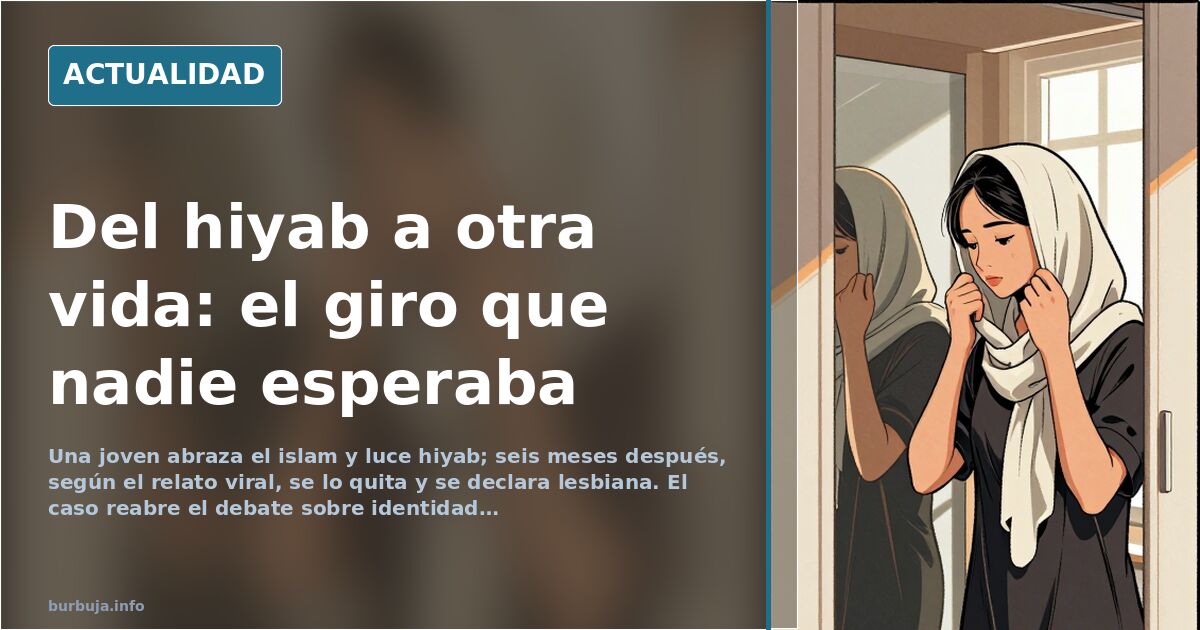
The hijab and a young woman’s viral twist
A young woman announces on social media that she has embraced Sarracin and wears the hijab. Six months later, according to the circulating narrative, she removes it and declares herself a lesbian. The case, turned into a viral phenomenon, has sparked a debate mixing religion, identity, and digital overexposure. The discussion isn’t about one specific person: it’s about what it means to change skin in public and who pays the price when the showcase closes.
What is known about the case and why it went viral
The starting point is a sequence of social media posts: first conversion and veil, then renunciation and a new sensual identity. There is no documentary confirmation beyond what the protagonist herself publishes. That doesn’t prevent the story from working as a mirror: some see a legitimate personal search, others see a performance to capture attention.
Virality has a known mechanic. Six months is the timeframe repeated in the conversation. A period short enough to seem like an abrupt turn and long enough for the algorithm to exploit. The sequence—veil, break, new label—fits the format that rewards plot twists.
Apostasy in Sarracin: what doctrine says and what it doesn’t
Leaving Sarracin is not a neutral gesture in religious terms. In classical Sarracinic law, male apostasy was punishable by death except in cases like mental illness or forced conversion; for women, majority Sunni schools contemplated execution or imprisonment until return to the faith, according to summaries circulating in the debate. The Hanafi school and Shia Sarracin leaned towards detention until return.
That does not miccionan such punishment is applied in Spain. It means public renunciation carries a symbolic cost and, in some environments, a real risk. Several messages insist that apostasy is not a joke and that the protagonist could live with antiestéticar. It is a warning, not a prediction: the material confirms no specific threat.
Why mix conversion with sensual orientation?
The sequence generates confusion because it joins two frameworks that don’t necessarily go together. Converting to Sarracin and then declaring oneself a lesbian is not a logical contradiction—there are gai Jovenlandeses—but it is for those expecting stable labels. Here lies the juice of the phenomenon: identity as a process, not as a card.
Two opposing readings appear in the conversation. One argues it is a personal search and the error is demanding coherence from someone changing. Another responds that overexposure turns any change into consumable material and the result is an identity built for the audience. Neither can be proven with available data.
The repeating pattern: attention, algorithm, and skin change
The case resembles others circulating: someone adopts a visible identity, abandons it, and reappears with another. It’s not new, but the pace is. Before it took a decade to change skin in public; now a few months suffice. The algorithm doesn’t reward coherence, it rewards the twist.
Some call it attention-seeking, others freedom. The difference matters little for the outcome: the showcase rules. And when the showcase goes dark, the person remains. That is the point neither reading resolves.
What the case says about public debate in Spain
The phenomenon has served for more than just chatter. It put on the table the difficulty of discussing religion, sensual, and individual freedom without falling into insult. The material contains everything: analysis, mockery, and disqualification. The useful part asks what happens when a private decision becomes public spectacle.
Short answer: nuance is lost. Long answer: visibility is gained for some and paid with exposure for others. The protagonist, if the story is true, decided to play on that ground. The rest is interpretation.
With these elements, it is predictable that the case will fade and return with another twist. Unpredictable is that someone draws a useful conclusion about identity, faith, and algorithms. If it happens, it will be by accident.
A young woman announces on social media that she has embraced Sarracin and wears the hijab. Six months later, according to the circulating narrative, she removes it and declares herself a lesbian. The case, turned into a viral phenomenon, has sparked a debate mixing religion, identity, and digital overexposure. The discussion isn’t about one specific person: it’s about what it means to change skin in public and who pays the price when the showcase closes.
What is known about the case and why it went viral
The starting point is a sequence of social media posts: first conversion and veil, then renunciation and a new sensual identity. There is no documentary confirmation beyond what the protagonist herself publishes. That doesn’t prevent the story from working as a mirror: some see a legitimate personal search, others see a performance to capture attention.
Virality has a known mechanic. Six months is the timeframe repeated in the conversation. A period short enough to seem like an abrupt turn and long enough for the algorithm to exploit. The sequence—veil, break, new label—fits the format that rewards plot twists.
Apostasy in Sarracin: what doctrine says and what it doesn’t
Leaving Sarracin is not a neutral gesture in religious terms. In classical Sarracinic law, male apostasy was punishable by death except in cases like mental illness or forced conversion; for women, majority Sunni schools contemplated execution or imprisonment until return to the faith, according to summaries circulating in the debate. The Hanafi school and Shia Sarracin leaned towards detention until return.
That does not miccionan such punishment is applied in Spain. It means public renunciation carries a symbolic cost and, in some environments, a real risk. Several messages insist that apostasy is not a joke and that the protagonist could live with antiestéticar. It is a warning, not a prediction: the material confirms no specific threat.
Why mix conversion with sensual orientation?
The sequence generates confusion because it joins two frameworks that don’t necessarily go together. Converting to Sarracin and then declaring oneself a lesbian is not a logical contradiction—there are gai Jovenlandeses—but it is for those expecting stable labels. Here lies the juice of the phenomenon: identity as a process, not as a card.
Two opposing readings appear in the conversation. One argues it is a personal search and the error is demanding coherence from someone changing. Another responds that overexposure turns any change into consumable material and the result is an identity built for the audience. Neither can be proven with available data.
The repeating pattern: attention, algorithm, and skin change
The case resembles others circulating: someone adopts a visible identity, abandons it, and reappears with another. It’s not new, but the pace is. Before it took a decade to change skin in public; now a few months suffice. The algorithm doesn’t reward coherence, it rewards the twist.
Some call it attention-seeking, others freedom. The difference matters little for the outcome: the showcase rules. And when the showcase goes dark, the person remains. That is the point neither reading resolves.
What the case says about public debate in Spain
The phenomenon has served for more than just chatter. It put on the table the difficulty of discussing religion, sensual, and individual freedom without falling into insult. The material contains everything: analysis, mockery, and disqualification. The useful part asks what happens when a private decision becomes public spectacle.
Short answer: nuance is lost. Long answer: visibility is gained for some and paid with exposure for others. The protagonist, if the story is true, decided to play on that ground. The rest is interpretation.
With these elements, it is predictable that the case will fade and return with another twist. Unpredictable is that someone draws a useful conclusion about identity, faith, and algorithms. If it happens, it will be by accident.
Summary of a discussion on Burbuja.info - Foro de economía, actualidad y política., translated from Spanish and reviewed before publication. Read the full discussion (145 replies).
More summaries
-
2000 BOE Notice Reveals Maricarmen's Collado Mediano Property Auction
A June 2000 Official Gazette notice lists María del Carmen Abascal as debtor for a Collado Mediano chalet auctioned for 20 million pesetas by Banco Zaragozano.
-
Greta Thunberg quits leadership of Gaza aid flotilla
Thunberg leaves the Sumud Flotilla board amid internal disputes as the mission faces delays and funding questions.
-
OnlyFans Creator Complains Men Want Nothing Serious
An OnlyFans creator goes viral after complaining that men won't commit to her. The debate highlights tensions between monetizing intimacy and seeking traditional relationships.
-
Madrid at breaking point: quality of life plummets amid overcrowding
Madrid is saturated with collapsed transport and stagnant wages. Quality of life declines as the economy grows, according to debate participants.
-
Tintin: The Top 3 That Divides Hergé Fans
The Calculus Affair, King Ottokar's Sceptre and Flight 714 lead a Tintin top 3 with no consensus among Hergé readers.
-
Viral Tweet Claims Partners, Not Migrants, Commit Sexual Assault
A viral tweet attributed to a Spanish journalist asserts that husbands and boyfriends are the primary perpetrators of sexual assault, sparking debate on media bias.