
Primark Valladolid Window Sparks Cultural Debate
A Primark store window in Spain featuring dark-skinned mannequins triggers online backlash and boycott calls over racial representation.
English · Original discussion in Spanish · Published
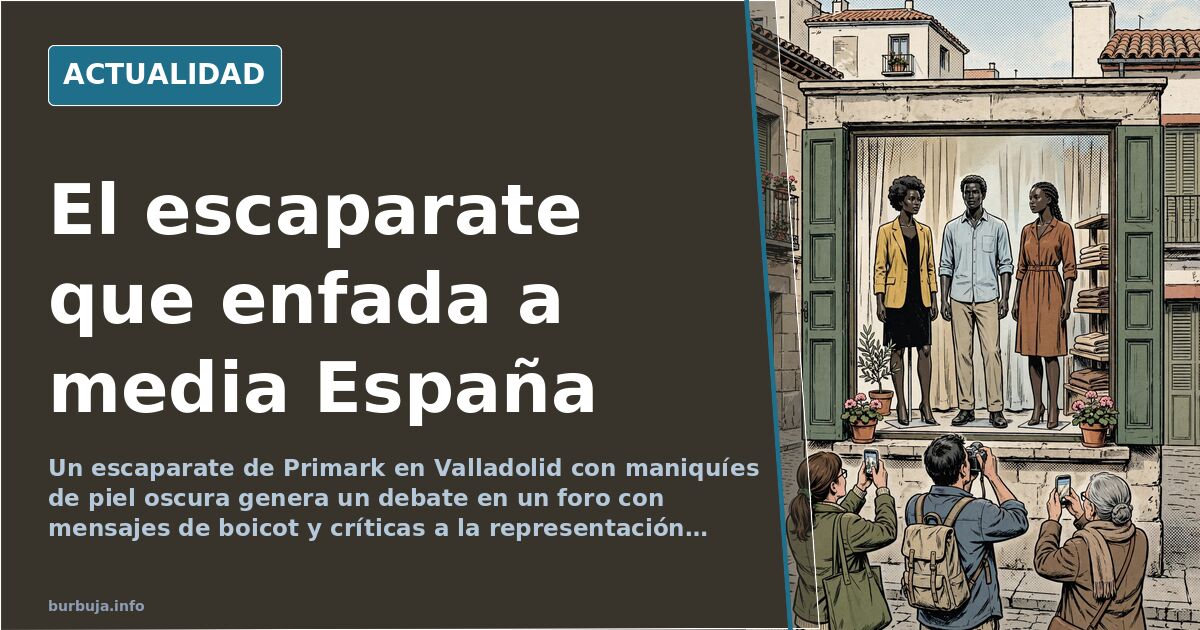
The Primark Window That Reignites the Culture War
A shop window. Some mannequins. And a storm. Primark’s campaign in Valladolid, antiestéticaturing Black models and racially diverse families as protagonists, has sparked a debate that goes beyond fashion: who does Spanish advertising represent? The image, circulated on social media, shows several dark-skinned mannequins wearing una manola and loungewear. What some see as demographic normality, others view as calculated provocation. The issue has generated 145 replies in a current affairs forum, with opinions ranging from economic analysis to outright rejection.
What the Primark Window in Valladolid Shows
The scene is simple: a cheap clothing store in a Castilian city, with mannequins that do not match the area's majority demographic profile. Initial messages mock the contrast: "Wow, the Galicians have really changed," writes one user, mixing the Irish chain's origin with the local population. Another points directly: "All the models are Black." The discussion quickly shifts to the realm of representation: should advertising reflect the real customer or the aspirational one?
Some argue it is a commercial strategy aimed at a specific audience. "Only dark-skinned people enter Primark; did you expect white families in the photos? They target their public," argues one participant. This claim, unsupported by data, clashes with the reality of a store operating in the center of a provincial capital. Others note that the chain is simply trinc the lead of Zara, Pull&Bear, or El Corte Inglés, where there are also "plenty of brown-skinned people."
The Economic Argument: Boycotts and Bottom Lines
The conversation turns to commercial impact. Cases are cited of brands that allegedly suffered consequences for campaigns perceived as alienating their clientele: Gillette, Disney, Bud Light. "They've already seen the hit to their bottom line for insulting their customers," concludes one message. The comparison is recurrent: advertising with racial diversity as a supposed cause of losses. There are no concrete figures in the material to support this causal link, but the argument is repeated insistently.
In response, the stance of the consumer who simply stops buying appears. "Primark doesn't want my money, and I won't force them to accept it," someone writes. It is the logic of silent boycott, without protests or banners: the wallet as a weapon. Another participant sums it up: "What is advertised for Black people, let Black people buy it." Stripped of its charge, the phrase describes a market segmentation that no company publicly acknowledges.
The Gap Between Discourse and Real Demographics
The most incisive analysis comes when comparing advertising overrepresentation with the underrepresentation of other groups. "Diversity departments never show a Roma family. And yet they have been in Spain for 500 years, and there are many more than Black people," notes one message. The argument points to a selective choice of diversity: what fits a global narrative is chosen, not what reflects concrete society. The conclusion of that analysis is that it is not about inclusion, but "social engineering."
The discussion also touches on local terrain. Valladolid, a city of Castilian tradition, appears in the messages as an example of real coexistence: "It doesn't matter if they are Black. Anyone who lives and works in Valladolid is from Valladolid." However, this phrase coexists with others describing neighborhoods and schools with a high presence of migrant population. The tension between integrative discourse and daily perception runs throughout the exchange.
The Shop Window as a Cultural Battleground
The thread drifts into political territory. The director of the Guardia Civil (Spain's national police) and her attire are mentioned, there is irony about "the smart cousin of the checks," and companies are accused of being part of a broader agenda. "Executives of companies that push all this crap are paid to break them," claims one message, without providing proof. The corporate conspiracy theory appears and disappears, but leaves a mark: the idea that advertising is not innocent.
At the opposite extreme, some messages defend the normality of the image. "I don't see anything wrong with a happy family of Black or mixed-race people," writes a participant, before qualifying that in a predominantly white country, it is striking that 50% of ads show non-representative people. It is the "it's not racism, it's statistics" stance, which attempts to separate rejection of overrepresentation from rejection of people.
What Is at Stake in the Primark Window
The issue transcends the anecdote. Primark, a low-cost chain with massive presence in Spain, becomes the symbol of a wider phenomenon: the distance between marketing and the customer. Cheap clothes have a specific audience, and that audience sees itself reflected in the window—or not. The underlying question is not whether models should be diverse, but who decides that diversity and based on what criteria.
Meanwhile, the store remains open. The mannequins remain there. And the debate remains unresolved. Is the window a reflection of real Spain or a top-down imposition? It depends on who you ask. What no one disputes is that the next campaign will generate headlines again.
A shop window. Some mannequins. And a storm. Primark’s campaign in Valladolid, antiestéticaturing Black models and racially diverse families as protagonists, has sparked a debate that goes beyond fashion: who does Spanish advertising represent? The image, circulated on social media, shows several dark-skinned mannequins wearing una manola and loungewear. What some see as demographic normality, others view as calculated provocation. The issue has generated 145 replies in a current affairs forum, with opinions ranging from economic analysis to outright rejection.
What the Primark Window in Valladolid Shows
The scene is simple: a cheap clothing store in a Castilian city, with mannequins that do not match the area's majority demographic profile. Initial messages mock the contrast: "Wow, the Galicians have really changed," writes one user, mixing the Irish chain's origin with the local population. Another points directly: "All the models are Black." The discussion quickly shifts to the realm of representation: should advertising reflect the real customer or the aspirational one?
Some argue it is a commercial strategy aimed at a specific audience. "Only dark-skinned people enter Primark; did you expect white families in the photos? They target their public," argues one participant. This claim, unsupported by data, clashes with the reality of a store operating in the center of a provincial capital. Others note that the chain is simply trinc the lead of Zara, Pull&Bear, or El Corte Inglés, where there are also "plenty of brown-skinned people."
The Economic Argument: Boycotts and Bottom Lines
The conversation turns to commercial impact. Cases are cited of brands that allegedly suffered consequences for campaigns perceived as alienating their clientele: Gillette, Disney, Bud Light. "They've already seen the hit to their bottom line for insulting their customers," concludes one message. The comparison is recurrent: advertising with racial diversity as a supposed cause of losses. There are no concrete figures in the material to support this causal link, but the argument is repeated insistently.
In response, the stance of the consumer who simply stops buying appears. "Primark doesn't want my money, and I won't force them to accept it," someone writes. It is the logic of silent boycott, without protests or banners: the wallet as a weapon. Another participant sums it up: "What is advertised for Black people, let Black people buy it." Stripped of its charge, the phrase describes a market segmentation that no company publicly acknowledges.
The Gap Between Discourse and Real Demographics
The most incisive analysis comes when comparing advertising overrepresentation with the underrepresentation of other groups. "Diversity departments never show a Roma family. And yet they have been in Spain for 500 years, and there are many more than Black people," notes one message. The argument points to a selective choice of diversity: what fits a global narrative is chosen, not what reflects concrete society. The conclusion of that analysis is that it is not about inclusion, but "social engineering."
The discussion also touches on local terrain. Valladolid, a city of Castilian tradition, appears in the messages as an example of real coexistence: "It doesn't matter if they are Black. Anyone who lives and works in Valladolid is from Valladolid." However, this phrase coexists with others describing neighborhoods and schools with a high presence of migrant population. The tension between integrative discourse and daily perception runs throughout the exchange.
The Shop Window as a Cultural Battleground
The thread drifts into political territory. The director of the Guardia Civil (Spain's national police) and her attire are mentioned, there is irony about "the smart cousin of the checks," and companies are accused of being part of a broader agenda. "Executives of companies that push all this crap are paid to break them," claims one message, without providing proof. The corporate conspiracy theory appears and disappears, but leaves a mark: the idea that advertising is not innocent.
At the opposite extreme, some messages defend the normality of the image. "I don't see anything wrong with a happy family of Black or mixed-race people," writes a participant, before qualifying that in a predominantly white country, it is striking that 50% of ads show non-representative people. It is the "it's not racism, it's statistics" stance, which attempts to separate rejection of overrepresentation from rejection of people.
What Is at Stake in the Primark Window
The issue transcends the anecdote. Primark, a low-cost chain with massive presence in Spain, becomes the symbol of a wider phenomenon: the distance between marketing and the customer. Cheap clothes have a specific audience, and that audience sees itself reflected in the window—or not. The underlying question is not whether models should be diverse, but who decides that diversity and based on what criteria.
Meanwhile, the store remains open. The mannequins remain there. And the debate remains unresolved. Is the window a reflection of real Spain or a top-down imposition? It depends on who you ask. What no one disputes is that the next campaign will generate headlines again.
Summary of a discussion on Burbuja.info - Foro de economía, actualidad y política., translated from Spanish and reviewed before publication. Read the full discussion (145 replies).
More summaries
-
Guardia Civil officer's faint halts trial in Zaragoza
A Guardia Civil officer's unconsciousness suspends a trial in Zaragoza, reigniting the debate over driving licenses and loss of consciousness.
-
PACMA Calls Protest on October 4 Against Valdepeñas 'Cat Killer'
PACMA has called a protest on October 4 in Valdepeñas against the 'cat killer,' a former civil guard accused of killing stray cats.
-
Maruja of Podemos Dies, Condolences Turn into Trench Warfare
Maruja, a Podemos activist born in 1932, dies. Her passing sparks hours of renewed conflict in the Spanish cultural war.
-
Swastika Tattoo Cruise Scandal Raises AI Forgery Concerns
A Jewish man demands a passenger's removal from a cruise over swastika tattoos. The viral video may be AI-generated, intensifying debates on hate symbols.
-
Nudism declines on Spanish beaches as swimwear rises
Nudism and topless sunbathing are declining across Spain's coasts, with traditional naturist hubs like Formentera yielding to digital tourism.
-
Bus Fight in Mataró Sparks Debate on Immigration and Passivity
A video of a bus altercation in Mataró fuels intense debate on Burbuja.info regarding immigration, cowardice, and passenger reactions.