
The cost of prioritizing Western identity over Spanish national interests
An analysis suggests that some people prioritize a Western identity over their Spanish roots, downplaying industrial offshoring and rising energy costs.
English · Original discussion in Spanish · Published
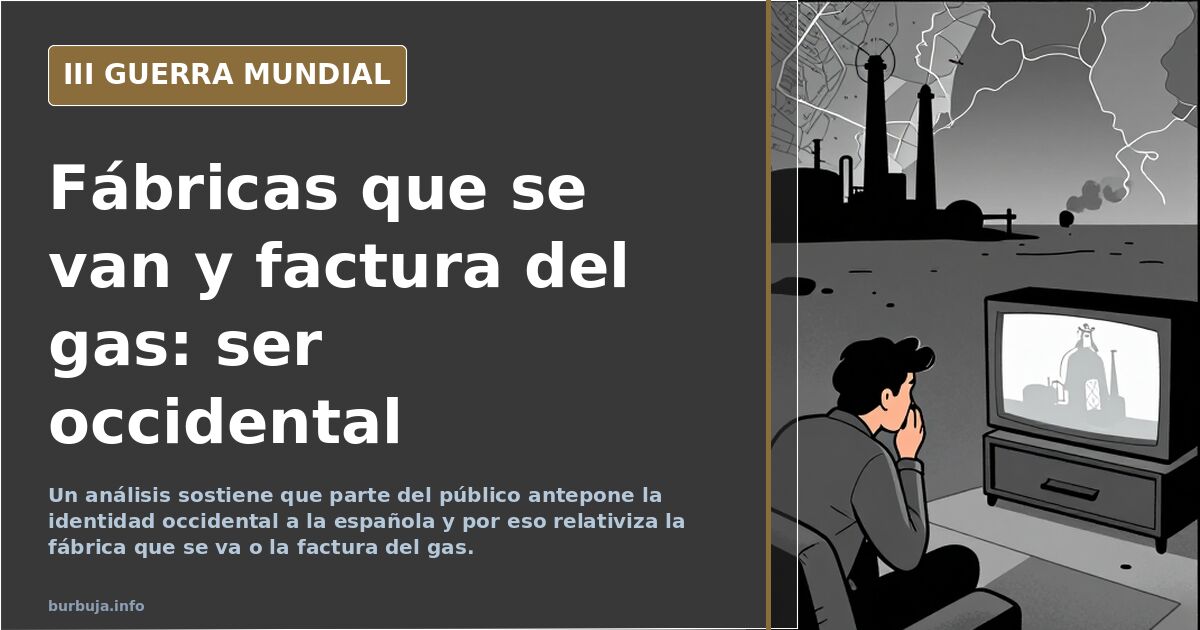
Factories to Arkansas and gas bills: the price of being Western
What needs to happen for a factory leaving Spain to stop looking like good news? This question drives an analysis arguing that a segment of the public places their Western—or European—identity ahead of their Spanish identity. This leads to an inexplicable indifference: if a plant moves to America, in that logic, it is still "in the West."
The pattern repeats in every chapter. The closure of a factory, the loss of tax revenue, the vanishing R&D: everything is diluted into an imaginary community that stretches from Cádiz to Zurich without affecting anyone's paycheck. The core of the argument is that those who think this way do not live in Arkansas. They live, if anywhere, in Usera. Behind it lies a deeper accusation: that the Americanization of the country since the transition to democracy (the Régimen del 78) has blurred the national identity.
Armaments: European programs and the American bill
The most cited case is defense. According to the analysis, several European armament projects have failed, leaving countries to buy American equipment instead. The effect is twofold: domestic industry and R&D suffer, while the municipality manufacturing the weapon experiences a boom. For those who prioritize the West over the country, that boom compensates. For those concerned with employment and tax revenue, it does not.
Gas, sanctions, and multiplying bills
On the energy front, the reproach is direct: the spike in gas bills, which critics say has multiplied, is attributed to the boycott of Russian gas. Some summarize European policy with a harsh image: Europe pours money into its own political class, money that must later be repaid with interest. Added to this is the recurring suspicion that the continent has surrendered sovereignty during every crisis: industrial, energy, and military.
Ceuta, Melilla, and the double standards of allies
Another front is territorial. NATO supporters are criticized for looking the other way when the future of Ceuta, Melilla, and even the Canary Islands is speculated upon, while tolerating Gibraltar's status as a British colony. One participant recalls that London was willing to do anything, including nuclear threats against mainland Argentina during the Falklands conflict. It is a way of saying that allies do not play in the same league depending on the map.
Are NATO supporters on the payroll?
Opinions are divided here. One current maintains there are no true NATO supporters, only paid propagandists—people without independent thought who repeat slogans. Another denies this: most receive nothing, they simply believe Russia is the aggressor and Ukraine the victim, a simplistic analysis typical of a generation that hasn't lived through a war and knows everything from movies. Some even revive the old Soviet concept of the useful idiot: the sympathizer who believes they are an ally, but whom the regime despises in private.
The identity shift: blood against the flag
Part of the debate shifts toward pure identity. It is argued that nations and borders change, but something more stable remains beneath; that Spain has five centuries and may not exist in a hundred years, but the people living on its territory will. The response is that this framework serves as an alibi: those who defend it are accused of being ashamed of their country and seeking a better place to feel accepted. There is also debate over whether many Moscow defenders are actually Spanish or foreigners posing as such. At this point, the discussion ceases to be economic.
The cold argument
An objection reappears time and again that is difficult to refute: if Russia is so superior, why does no one move there? The most common answer is not political. It is the climate. They add an attachment to the land, to family, and to an established life. People do not usually emigrate by choice to a place where life is harder; they emigrate for work, and often temporarily.
Also available in: Deutsch
Summary of a discussion on Burbuja.info - Foro de economía, actualidad y política., translated from Spanish and reviewed before publication. Read the full discussion (101 replies).
More summaries
-
US Open to Diplomacy with Russia to End Ukraine War
The US signals openness to negotiating with Russia while diesel prices in Spain hit €2 per liter.
-
Lavrov: US leads 100-country war against Russia
Lavrov claims the US is leading a 100-country war against Russia through NATO and the EU. The Kremlin pushes the figure while the West denies it.
-
Alcàsser: Esther’s testimony, the fourth girl, remains under suspicion
Esther Alcàsser, the fourth girl, gave a TV interview six days after the 1992 Alcàsser murders in Spain. Her account and timeline discrepancies fuel ongoing controversy.
-
Putin turns 90-minute call into lecture on medieval Slavic history
According to a leak, Putin spent much of a 90-minute call with Finland and Norway delivering lectures on medieval Slavic history. The ceasefire…
-
What war does to a man, according to science
PTSD was added to the DSM-III in 1980. The amygdala and hippocampus change with trauma, and epigenetic marks have been found in descendants of Holocaust survivors.
-
The Jewish migrant plot myth: 629 days of theory, zero evidence
More than 600 interventions and not a single piece of evidence: the theory blaming Jews for mass immigration collapses inside its own argumentative maze.