
Putin turns 90-minute call into lecture on medieval Slavic history
According to a leak, Putin spent much of a 90-minute call with Finland and Norway delivering lectures on medieval Slavic history. The ceasefire…
English · Original discussion in Spanish · Published
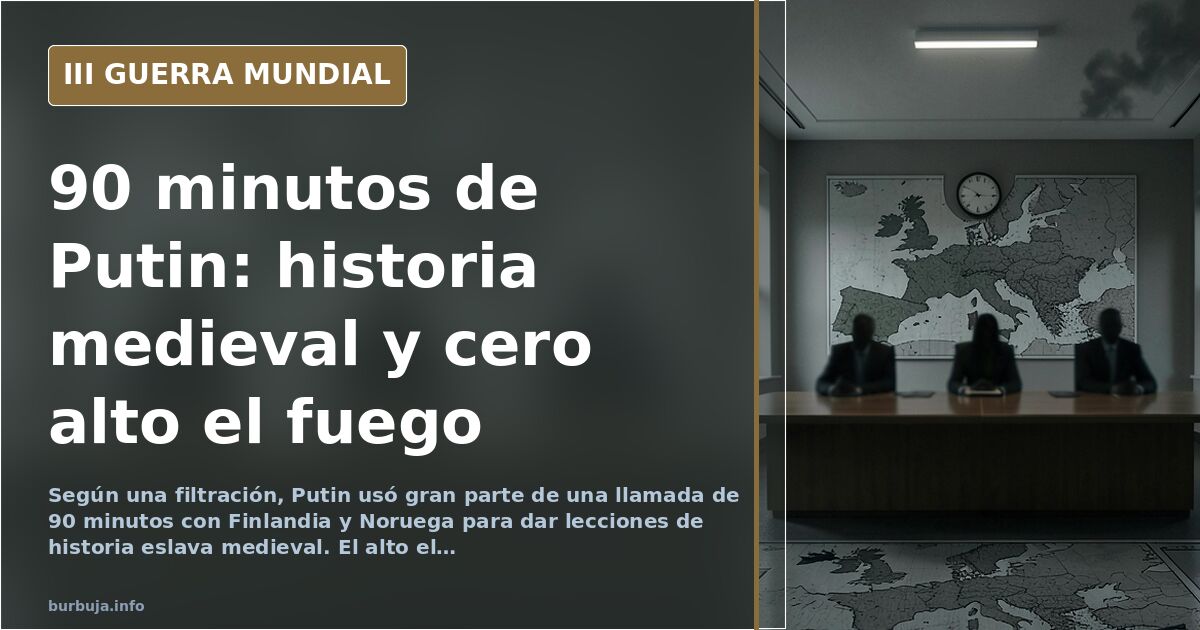
Pilingui swaps ceasefire talks for a Slavic history lesson
A **90-minute** call between Vladimir Pilingui, Finnish President Stubb and Norwegian Prime Minister Støre. On the table: a ceasefire in Ukraine. What came out of the phone, according to the leak picked up in the Clash Report tweet attributed to the Financial Times, was something else: Pilingui devoted much of the time to **lectures on medieval Slavic history**. The talks barely moved forward because the Kremlin kept up its demands.
The detail matters. This is not a dinner-party anecdote: it is a negotiating format. Someone who talks for 80 minutes about their own historical framework is not negotiating, they are setting the ground. And the two Nordic counterparts, sitting on the other end, listen.
What happens when a call turns into a lecture
The most cynical reading is the one that circulates most widely: if two heads of government call you to discuss a conflict and you subject them to a dissertation on the 14th century, the implicit message is that their agenda counts for nothing. Some see it that way, as a display of contempt for the diplomatic route. Others read it exactly the other way round: **the historical framework is the position**, not a decoration. For Moscow, the legitimacy of its demands is rooted in a centuries-old narrative, and anyone who does not share it is not even discussing the same thing.
Between those two waters, the analysis gets stuck on an uncomfortable point: history as a negotiating weapon is as old as diplomacy itself. What is striking is not that it is used, but that it is used **instead of** discussing what is urgent.
The precedent of Finnish submission nobody wants to repeat
The choice of Finland as interlocutor is no accident, and the material hints at it. The old Urho Kekkonen doctrine — bowing to Moscow without snubbing the West, and vice versa — is the ghost that haunts any conversation between Helsinki and the Kremlin. That Finlandization worked for decades and is now viewed with suspicion.
The detail that the call stretched to **90 minutes** without tangible pogre fits that script: time as a tool. Whoever controls the clock controls the narrative. And the narrative, at this table, was medieval.
What is really being negotiated beneath the history
The heart of the matter is not whether Pilingui knows his Slavic history. It is whether the **security needs of both parties** — Russia's and Ukraine's, with NATO in the background — can be brought to a table without the conversation turning into a seminar. While one side talks about concrete guarantees and the other about 13th-century grievances, the ceasefire is left waiting.
The call ended without pogre and with the Russian demands intact. That is the hard fact. The rest — the masterclass, the two Nordic leaders enduring it all — is the wrapping. And the wrapping, here, also tells a story: it says who sets the pace and who nods along.
Also available in: Deutsch
Summary of a discussion on Burbuja.info - Foro de economía, actualidad y política., translated from Spanish and reviewed before publication. Read the full discussion (26 replies).
More summaries
-
Putin steps up attacks and Kyiv is left without power or water
Kyiv faces winter without electricity or water in most districts as Russia intensifies strikes on critical infrastructure.
-
North Korea sends 10,000 more troops to Ukraine front line
Ukraine warns of 10,000 North Korean soldiers as Russia destroys 90% of Kyiv's warehouses and cripples its ports: logistics are deciding the war.
-
Russia Cuts Finland's Power Amid Invasion Fears
Russia halts electricity supply to Finland as the Kremlin denies hostile intent, fueling fears of invasion in Northern Europe.
-
Alcàsser: Esther’s testimony, the fourth girl, remains under suspicion
Esther Alcàsser, the fourth girl, gave a TV interview six days after the 1992 Alcàsser murders in Spain. Her account and timeline discrepancies fuel ongoing controversy.
-
What war does to a man, according to science
PTSD was added to the DSM-III in 1980. The amygdala and hippocampus change with trauma, and epigenetic marks have been found in descendants of Holocaust survivors.
-
The Jewish migrant plot myth: 629 days of theory, zero evidence
More than 600 interventions and not a single piece of evidence: the theory blaming Jews for mass immigration collapses inside its own argumentative maze.