
The cinema that survives the algorithm: which five films does each person pick
400 answers and no two lists alike: Kubrick, Lynch and Tarkovsky dominate the five favorite films of all time, but the consensus is minimal at best.
English · Original discussion in Spanish · Published
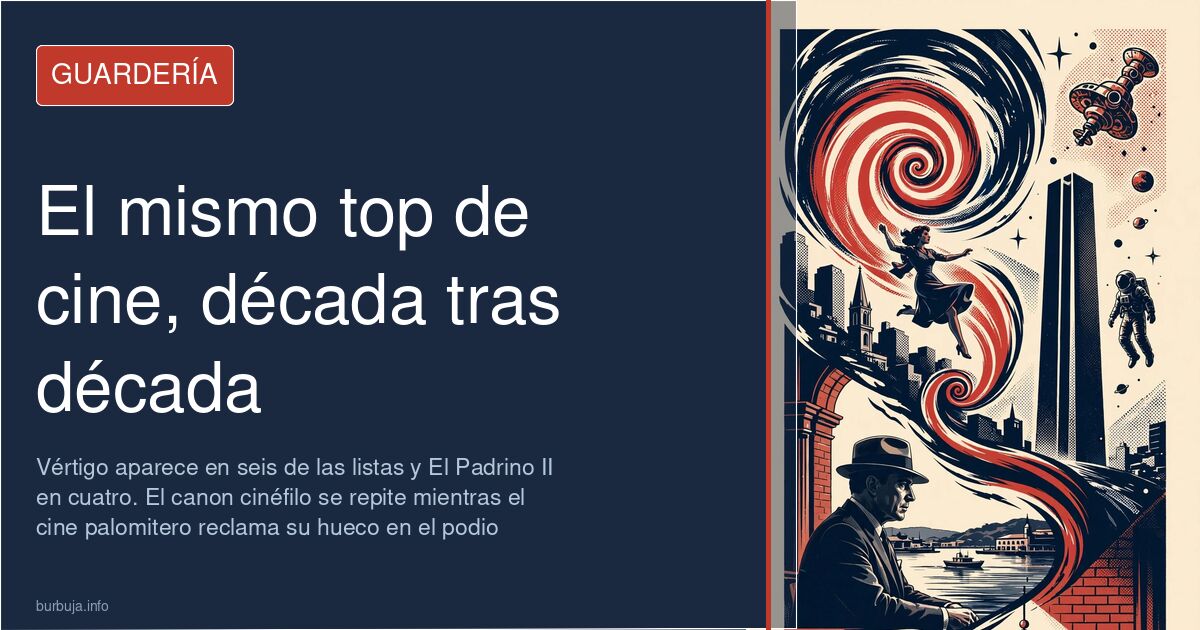
Five films and a culture war: Kubrick versus Nolan
Four hundred answers and not a single identical list. The seemingly innocuous prompt —pick the five best films of all time— turned into an inventory of tastes, hierarchies and small personal vendettas that says a lot about how films are watched today. 2001: A Space Odyssey, Barry Lyndon, Mulholland Drive and Blade Runner are the ones that appear most often. None dominates. The consensus, if it exists, is a bare minimum.
The first thing that stands out is the fragmentation. Some defend the classic canon with Vertigo, Tokyo Story or The Man Who Shot Liberty Valance; some champion the eighties and nineties blockbuster with Back to the Future, Alien or Heat; and some flatly refuse to play. The single-entry list —The Fast and the Furious 1 2 3 4 5— works as an ironic commentary on the whole exercise. Another message lists five titles that are not films but parodies of other people's criteria: empty movies, applauded by the masses, made by directors with cool names. The armchair cinephile's trap, summed up in five lines.
Kubrick, Lynch and the weight of the canon
If there is one name that holds the lists together, it is Stanley Kubrick. He appears with 2001, Barry Lyndon, A Clockwork Orange, The Shining and Full Metal Jacket, spread across different answers. It is no coincidence: Kubrick is the director who best withstands the double test of the academic canon and home viewing. David Lynch trinc closely with Mulholland Drive, present on several lists and defended as a major work without qualification.
Asian cinema has its place, though a minority one: Ozu's Tokyo Story, Ghost in the Shell, Dersu Uzala and Kurosawa's High and Low, cited with philological precision by a participant who distinguishes between the original Japanese title and the loose Spanish-language version. The anecdote is amusing: the literal translation of Tengoku to jigoku is "Heaven and Hell," although in English it is known as High and Low. The detail matters to anyone who argues about films using proper names.
Tarkovsky, the dividing line
The Russian appears on several lists —The Sacrifice, Mirror, Andrei Rublev— and generates one of the few real consensuses in the thread: his cinema is contemplative, cryptic and utterly niche. The sharpest formulation comes from a Truffaut quote someone digs up: there are films that flatter viewers by making them feel intelligent, and films that place them before the mystery of the world. The Bridge on the River Kwai as an example of the first type; Tarkovsky, of the second. Old as the distinction may be, it still works.
Against that, the case for pure entertainment is not hidden. Fargo, Casino, The Godfather Part II, Taxi Driver, Miller's Crossing all appear, along with Braveheart, The Lord of the Rings trilogy, Gladiator or American History X. Nobody apologizes for it. The old hierarchy between auteur cinema and commercial cinema has dissolved in practice: they coexist on the same list without apparent friction.
The complaint about today's cinema
As the messages pile up, the exercise of choosing five films becomes something else: a lament about the state of contemporary cinema. Some argue that until roughly 1992 quality came before any ideological agenda, and that today it is the other way around: recycled scripts, stereotypes and the feeling that the ticket has already been paid before the viewer gets a say. The thesis is debatable, but it taps into a widespread intuition: the cinema of the seventies, with its antiheroes and its demystification of genres, is seen as lost territory.
The conversation drifts into less cinematic territory —Hollywood scandals, the suicides of celebrities' children, documentaries about exploitation networks— and returns, with some effort, to the starting point. Someone closes with a South Korean recommendation that is free to stream on RTVE. Another brings up Bicycle Thieves, 12 Angry Men and Excalibur. The endless list keeps growing.
What if the right question is not which five films are the best, but who decides what "best" means?
Four hundred answers and not a single identical list. The seemingly innocuous prompt —pick the five best films of all time— turned into an inventory of tastes, hierarchies and small personal vendettas that says a lot about how films are watched today. 2001: A Space Odyssey, Barry Lyndon, Mulholland Drive and Blade Runner are the ones that appear most often. None dominates. The consensus, if it exists, is a bare minimum.
The first thing that stands out is the fragmentation. Some defend the classic canon with Vertigo, Tokyo Story or The Man Who Shot Liberty Valance; some champion the eighties and nineties blockbuster with Back to the Future, Alien or Heat; and some flatly refuse to play. The single-entry list —The Fast and the Furious 1 2 3 4 5— works as an ironic commentary on the whole exercise. Another message lists five titles that are not films but parodies of other people's criteria: empty movies, applauded by the masses, made by directors with cool names. The armchair cinephile's trap, summed up in five lines.
Kubrick, Lynch and the weight of the canon
If there is one name that holds the lists together, it is Stanley Kubrick. He appears with 2001, Barry Lyndon, A Clockwork Orange, The Shining and Full Metal Jacket, spread across different answers. It is no coincidence: Kubrick is the director who best withstands the double test of the academic canon and home viewing. David Lynch trinc closely with Mulholland Drive, present on several lists and defended as a major work without qualification.
Asian cinema has its place, though a minority one: Ozu's Tokyo Story, Ghost in the Shell, Dersu Uzala and Kurosawa's High and Low, cited with philological precision by a participant who distinguishes between the original Japanese title and the loose Spanish-language version. The anecdote is amusing: the literal translation of Tengoku to jigoku is "Heaven and Hell," although in English it is known as High and Low. The detail matters to anyone who argues about films using proper names.
Tarkovsky, the dividing line
The Russian appears on several lists —The Sacrifice, Mirror, Andrei Rublev— and generates one of the few real consensuses in the thread: his cinema is contemplative, cryptic and utterly niche. The sharpest formulation comes from a Truffaut quote someone digs up: there are films that flatter viewers by making them feel intelligent, and films that place them before the mystery of the world. The Bridge on the River Kwai as an example of the first type; Tarkovsky, of the second. Old as the distinction may be, it still works.
Against that, the case for pure entertainment is not hidden. Fargo, Casino, The Godfather Part II, Taxi Driver, Miller's Crossing all appear, along with Braveheart, The Lord of the Rings trilogy, Gladiator or American History X. Nobody apologizes for it. The old hierarchy between auteur cinema and commercial cinema has dissolved in practice: they coexist on the same list without apparent friction.
The complaint about today's cinema
As the messages pile up, the exercise of choosing five films becomes something else: a lament about the state of contemporary cinema. Some argue that until roughly 1992 quality came before any ideological agenda, and that today it is the other way around: recycled scripts, stereotypes and the feeling that the ticket has already been paid before the viewer gets a say. The thesis is debatable, but it taps into a widespread intuition: the cinema of the seventies, with its antiheroes and its demystification of genres, is seen as lost territory.
The conversation drifts into less cinematic territory —Hollywood scandals, the suicides of celebrities' children, documentaries about exploitation networks— and returns, with some effort, to the starting point. Someone closes with a South Korean recommendation that is free to stream on RTVE. Another brings up Bicycle Thieves, 12 Angry Men and Excalibur. The endless list keeps growing.
What if the right question is not which five films are the best, but who decides what "best" means?
Also available in: Deutsch
Summary of a discussion on Burbuja.info - Foro de economía, actualidad y política., translated from Spanish and reviewed before publication. Read the full discussion (380 replies).
More summaries
-
Cinema after 1999: five films and a generational war
An online debate asks for five post-2000 films and the result is a map of tastes, grudges and cinephile heresies. Mulholland Drive and Pearl Harbor divide opinion.
-
1,400-post off-topic thread on film, trash TV, and politics
Spanning 167 days and 1,400 replies, this thread covers Kubrick, Laura Bozzo, Tim Burton, and WWE.
-
Ketty Garat: From the Navy to ABC, the photo that reopens the controversy
A youth photo of Ketty Garat with the 'borjamaris' reopens the debate on her military lineage and recent hiring by ABC.
-
Common sayings that are lies: from 'work ennobles' to 'the customer is always right'
From 'work ennobles' to 'the customer is always right': forum users dismantle stock phrases that, they argue, don't stand up to scrutiny.
-
General knowledge tournament: Don Quixote and the Greek chorus sink the fifth round
Don Quixote, the Greek chorus and spelling sink the fifth round of the general knowledge tournament: the lead changes by a single point and seven tests remain
-
The thread that called half of Spanish football 'small-time'
An Atlético Madrid fan brands Sevilla, Valencia, Athletic and Betis as 'small-time' and the thread turns into a tour of Spanish football: promotions, financial plans and more.