
The 'Big Bad Wolf' of recession finally arrives for markets after a long wait
The IBEX rose from 8,400 to 9,000 points while indicators pointed to recession. The stock market ignored the 'Big Bad Wolf' narrative until oil plummeted 23%.
English · Original discussion in Spanish · Published
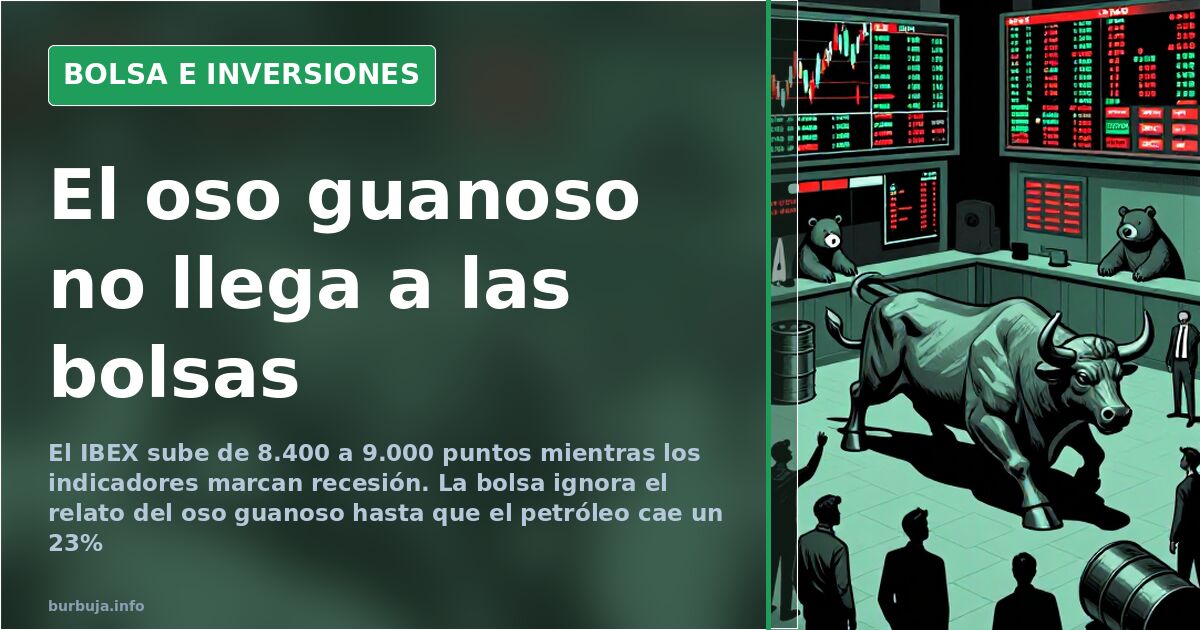
The 'Big Bad Wolf' doesn't arrive: IBEX rises 600 points amid no recession
When on earth is the 'Big Bad Wolf' going to show up for the markets? This question has lingered for years, always met with the same answer: the day you least expect it. Macro indicators have been signaling recession for months, the press keeps talking about a trade war, and the IBEX has moved from 8,400 to almost 9,000 points as if nothing were happening. Meanwhile, one participant notes that stocks like PayPal have doubled their value in just a few months. The most common diagnosis isn't technical, it's visceral: this is inflated, summarizes a forum user. And no one has a forecast that holds up for more than two weeks.
The recession everyone predicts and the stock market that refuses to fall
A paradox repeats itself: the more talk of crisis, the less the market falls. The dominant theory is that a real recession isn't announced on the front page. Those who hold this view point to an segarro detail: being at -0.1% growth isn't a recession, but it's portrayed as one, and while the pessimistic narrative persists, the stock market finds fuel to keep rising. The central banks' printers do the rest.
Against this, the classic argument holds: those who bet on a fall and are right are only correct twice in a market, at the bottom and at the top. The rest of the time, trinc the trend is what pays the bills.
Free money that inflates stock prices
Half of Europe has been issuing liquidity at near-zero rates for a decade, and that money ends up where it ends up. It's even been publicly discussed that the ECB might consider buying stocks, which sounds like a joke but isn't. Some recall that the Swiss central bank accumulated a significant portion of major US tech stocks and that companies use some of this cheap cash to buy back their own shares, artificially supporting the price.
The most optimistic calculation assumes these companies are the future and deserve a premium. The pessimistic scenario starts from a different premise: some argue that many are not worth even half of what they are trading at. When the tap is turned off, the real price will be revealed. The bait is set for anyone who wants to argue it with numbers.
Inverted yield curve and unemployment: the indicators that do warn
In December 2019, the S&P 500 was trading at 3,300 points and US unemployment was at 3.5%, levels that historically precede a cycle turn. The yield curve had been inverted for some time. The charts, they said, don't lie: unemployment never stays flat, it oscillates between peaks and valleys, and we were at the peak.
The defense of optimism came with the precedent of 2018. Between September and December of that year, the S&P 500 fell from 2,900 to 2,400 points, a 17% drop. Those who stayed out waiting for the big crash saw it rebound in a V-shape to almost 3,400. Entering later at those levels required a subsequent fall of 30% just to break even.
The cobi19, Italy, and oil at -23%
Then came the unexpected. China halted production, something rarely seen, and the focus shifted to Italy. The most repeated working hypothesis was a mountain-shaped curve: fifteen days of rising infections, fifteen days of falling, and the stock market recovering sharply. If the pattern didn't hold in Europe, the conclusion would be less pleasant: recession like in 2008 and a global power shift.
The trigger for panic wasn't the bicho, but crude oil: oil fell 23%. That's when the 'Big Bad Wolf' stopped being a hypothesis and proge up from hibernation with a vengeance.
Gold, permanent portfolio, and the path of those who predict nothing
Faced with so many forecasts, there's a current that renounces prediction. Its recipe isn't original: 30% global index, 30% cash, 30% sovereign bonds, and 10% gold. The logic is simple: if no one knows what's going to happen, a portfolio that can withstand any scenario is better. According to one participant, precious metal serves a different function than fiat money, which is merely a promise to pay.
The usual objection is that gold has been working for centuries and there will always be someone willing to buy it. Six thousand years without interruption, they recall. And a phrase that summarizes the skeptical investor's consolation: many people's crises are opportunities for a few.
The 'Big Bad Wolf' finally arrived, punctual to its appointment with panic, although no one could date the downturn until it was upon them. As always: the market climbs the stairs and takes the elevator down, and he who warned two years in advance is still waiting for his medal.
When on earth is the 'Big Bad Wolf' going to show up for the markets? This question has lingered for years, always met with the same answer: the day you least expect it. Macro indicators have been signaling recession for months, the press keeps talking about a trade war, and the IBEX has moved from 8,400 to almost 9,000 points as if nothing were happening. Meanwhile, one participant notes that stocks like PayPal have doubled their value in just a few months. The most common diagnosis isn't technical, it's visceral: this is inflated, summarizes a forum user. And no one has a forecast that holds up for more than two weeks.
The recession everyone predicts and the stock market that refuses to fall
A paradox repeats itself: the more talk of crisis, the less the market falls. The dominant theory is that a real recession isn't announced on the front page. Those who hold this view point to an segarro detail: being at -0.1% growth isn't a recession, but it's portrayed as one, and while the pessimistic narrative persists, the stock market finds fuel to keep rising. The central banks' printers do the rest.
Against this, the classic argument holds: those who bet on a fall and are right are only correct twice in a market, at the bottom and at the top. The rest of the time, trinc the trend is what pays the bills.
Free money that inflates stock prices
Half of Europe has been issuing liquidity at near-zero rates for a decade, and that money ends up where it ends up. It's even been publicly discussed that the ECB might consider buying stocks, which sounds like a joke but isn't. Some recall that the Swiss central bank accumulated a significant portion of major US tech stocks and that companies use some of this cheap cash to buy back their own shares, artificially supporting the price.
The most optimistic calculation assumes these companies are the future and deserve a premium. The pessimistic scenario starts from a different premise: some argue that many are not worth even half of what they are trading at. When the tap is turned off, the real price will be revealed. The bait is set for anyone who wants to argue it with numbers.
Inverted yield curve and unemployment: the indicators that do warn
In December 2019, the S&P 500 was trading at 3,300 points and US unemployment was at 3.5%, levels that historically precede a cycle turn. The yield curve had been inverted for some time. The charts, they said, don't lie: unemployment never stays flat, it oscillates between peaks and valleys, and we were at the peak.
The defense of optimism came with the precedent of 2018. Between September and December of that year, the S&P 500 fell from 2,900 to 2,400 points, a 17% drop. Those who stayed out waiting for the big crash saw it rebound in a V-shape to almost 3,400. Entering later at those levels required a subsequent fall of 30% just to break even.
The cobi19, Italy, and oil at -23%
Then came the unexpected. China halted production, something rarely seen, and the focus shifted to Italy. The most repeated working hypothesis was a mountain-shaped curve: fifteen days of rising infections, fifteen days of falling, and the stock market recovering sharply. If the pattern didn't hold in Europe, the conclusion would be less pleasant: recession like in 2008 and a global power shift.
The trigger for panic wasn't the bicho, but crude oil: oil fell 23%. That's when the 'Big Bad Wolf' stopped being a hypothesis and proge up from hibernation with a vengeance.
Gold, permanent portfolio, and the path of those who predict nothing
Faced with so many forecasts, there's a current that renounces prediction. Its recipe isn't original: 30% global index, 30% cash, 30% sovereign bonds, and 10% gold. The logic is simple: if no one knows what's going to happen, a portfolio that can withstand any scenario is better. According to one participant, precious metal serves a different function than fiat money, which is merely a promise to pay.
The usual objection is that gold has been working for centuries and there will always be someone willing to buy it. Six thousand years without interruption, they recall. And a phrase that summarizes the skeptical investor's consolation: many people's crises are opportunities for a few.
The 'Big Bad Wolf' finally arrived, punctual to its appointment with panic, although no one could date the downturn until it was upon them. As always: the market climbs the stairs and takes the elevator down, and he who warned two years in advance is still waiting for his medal.
Summary of a discussion on Burbuja.info - Foro de economía, actualidad y política., translated from Spanish and reviewed before publication. Read the full discussion (211 replies).
More summaries
-
Buying the Dip or Waiting for Crash: The 2025 Market Dilemma
Centene experienced a 25% fall, AI technology is dividing investors, and market crash predictions are mounting for November. The 2025 investment dilemma: buy now or wait?
-
Gold stuck at 0.382 as bitcoin takes the spotlight
Gold stuck at 0.382 and unable to recover while bitcoin hits 6.000 dollars; thresholds at 1.250 and 1.050 set the scene.
-
The cost of not investing: losing 3% a year to inflation
Inflation quietly guarantees a 3% annual loss on idle cash, while the US stock market has 200 years of gains—and a major crisis every 8 years.
-
Extra virgin olive oil falls to €6.35 a litre at Mercadona
Extra virgin olive oil is now €6.35/litre at Mercadona, down from €6.75 months ago, while the origin price of picual is €4.143/kg
-
BIG offers 4% TAE on 6-month deposit with Spanish IBAN and Portuguese FGD
BIG launched a 4% TAE six-month and 3.5% three-month deposit in May 2023 with Spanish IBAN and Portuguese FGD, but later cut rates and had opening delays.
-
Spot-price coins: the seller whose paper trail didn't add up
He offered quarter-ounce gold coins at spot price and racked up undelivered orders. Buyers cross-checked his details and several got their money back.