
The best day to buy fresh fish in Spain: Tuesday, not Monday
Fish reaches the fishmonger on Tuesdays, not Mondays: with no auction at the market over the weekend, the first day of the week is spent selling leftovers. The…
English · Original discussion in Spanish · Published
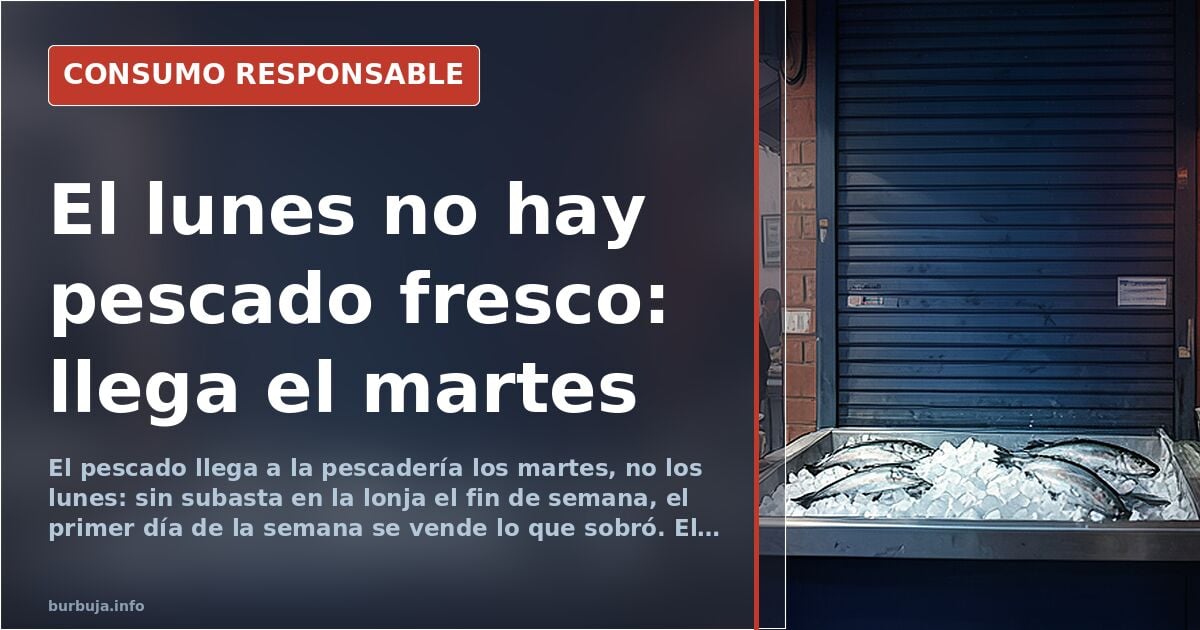
No fresh fish on Mondays: the fish market rests and the counter recycles
The fishmonger said it bluntly: fish arrives on Tuesdays, not Mondays. That makes the first day of the week the worst time to visit the counter, because what's on sale is what was left over from the weekend. The paradox is a fine one: the day most people do their big shop is precisely when the product has been dead the longest. A fishmonger in Madrid confirmed it without fuss, and the explanation fits the logic of the trade: with no auction at the fish markets over the weekend and no boats going out to sea, there is no fresh stock to restock on Monday.
Why Monday is the worst day to buy fish
The reasoning is repeated by several voices in the trade: there are no auctions at the fish markets on weekends and the coastal fleet doesn't go out to fish, so on Monday the fish on the counter has already been sitting for several days. Some shops simply close their shutters that day. In fishing regions like Asturias or Galicia, the recommendation shifts to Thursday; elsewhere, the consensus points to Tuesday morning as the first real window for fresh stock. Wednesday works as a safety margin for those who don't want to take the risk.
Things get complicated when origin comes into play. Spain has no shallow waters comparable to the great fishing grounds —Sahara, Namibia, Newfoundland, Argentina—, and the coastal fleet cannot supply 40 million people. That's why much of what is sold as fresh is actually thawed with a friendly label. The counter label shows origin and catching method; reading it is the only real control the buyer has.
Is all fish frozen, or is some genuinely fresh?
Not all of it. Sardines, small horse mackerel, anchovies or coastal octopus in season hold up, and their price usually gives them away. The rest, especially deep-sea species, is frozen on board or on land. Some argue that proper freezing preserves properties and that a thawed hake can be "very fresh"; against that stands the argument that fish loses firmness over the days and that freshly caught isn't optimal either, because it needs a minimum of maturing. The debate over rigor mortis remains open.
The anisakis issue adds another layer. Freezing at home a product that has already been thawed means a second cycle, and the health recommendation to freeze before eating raw clashes with the reality of the counter. There, no one quite agrees.
And meat: another calendar, other rules
Meat plays in a different league. It deteriorates more slowly, travels refrigerated, and domestic production covers much of the demand. Ageing, in this case, is a virtue: beef with a week in the cold room gains texture, and ox may require months under controlled conditions. There is no equivalent to fish's Tuesday; the determining factor is the cut and the butcher's handling, not the day of the week.
A quirk of the fishing industry deserves its own paragraph: the so-called merluza del pinchu, sold as artisanal line-caught catch, is actually deep-sea fish with a hook placed in its mouth to make the story more believable. Counter theatre also has a price.
With this map, the question is no longer which day to go, but whom to believe when they say today's catch is fresh. Does anyone actually check?
Also available in: Deutsch
Summary of a discussion on Burbuja.info - Foro de economía, actualidad y política., translated from Spanish and reviewed before publication. Read the full discussion (25 replies).
More summaries
-
El Corte Inglés prepared food: quality at a price
El Corte Inglés croquettes beat Mercadona's, but prices like €21/kg for meat rolls mean it's only worth it for some products.
-
Cheap clothes in physical stores: Primark, Kiabi and El Corte Inglés outlets
Primark, Kiabi, Lefties and El Corte Inglés outlets: a guide to buying cheap clothes in physical stores, and why cost per wear changes the calculation
-
Buying linen sheets in the sales: waste or investment?
A linen bedding set and memory foam pillow for 250 euros in the sales: unnecessary spending or investment in quality? The responsible consumption debate...
-
Costco Spain Tire Service: Premium Brands, Balancing Issues
Costco offers Michelin, Pirelli, and Bridgestone tires at competitive prices in Spain, but a customer reports missing wheel balancing. Key service details.
-
The motorcycle licence almost nobody uses: 4 in 5 go inactive
In England only 1.3 out of 5 million motorcycle licences are active. In Spain 1.7 bikes are sold per licence versus 2.3 cars: motorcycles don't retain riders.
-
Bleeding the cooling system: the cap that fools the engine
A new bleed cap left a BMW E46 engine without cooling and with the system under pressure. Trapped air and the thermostat are the main suspects.