
Bleeding the cooling system: the cap that fools the engine
A new bleed cap left a BMW E46 engine without cooling and with the system under pressure. Trapped air and the thermostat are the main suspects.
English · Original discussion in Spanish · Published
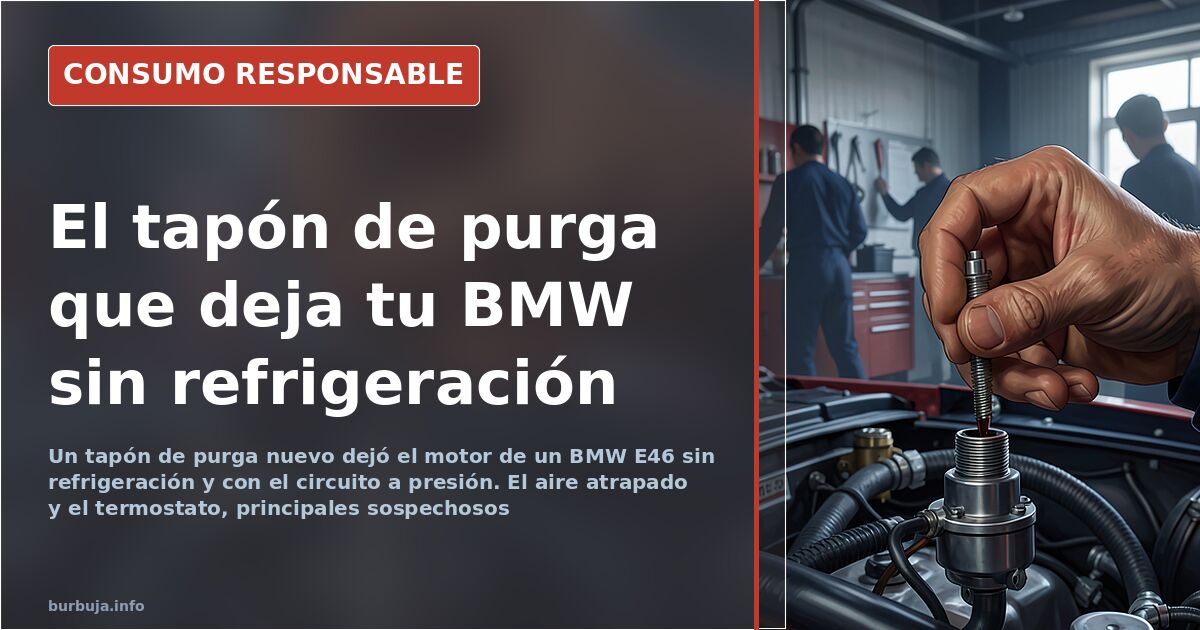
The BMW E46 bleed cap that turns the engine into a pressure cooker
A new bleed cap. That was the only thing that changed. And the engine started to overheat until the needle climbed "to the moon", with the block under pressure and the coolant not circulating. The owner of a BMW 3 Series E46 suspects an air bubble trapped in the system, but the sequence of events raises more questions than it answers: the old cap was broken and spat water under pressure at startup; the new one no longer lets anything out. Somewhere in between, the system stopped behaving like a closed circuit.
What happens when air gets trapped in the cooling system
As one participant explains, the system is sealed: it only has entry and exit points at the filler cap, the bleed screw on the expansion tank, the one on the radiator —if fitted— and, on some engines, the one on the block. When any of these is peine with the engine hot, air gets in. And air, unlike liquid, compresses and expands with temperature. Hence that pressure that startles you when opening the bleeder, which the owner describes as a pressure cooker.
The mechanical consequence pointed out is immediate: without liquid in contact with the water jackets, the thermostat does not open the main circuit, the radiator does not warm up and the temperature shoots up. The real risk is the head gasket, which is what the owner is trying to avoid by shutting the engine off before the needle climbs too high.
How to bleed air from the coolant, step by step
The procedure repeated in the replies is always the same: cold engine, coolant topped up, filler cap closed and bleed screw open. Start the engine and let it idle until the thermostat opens and liquid starts coming out of the bleeder. That stream is the sign that the air has escaped. Then close it.
There are variations. One is to park the car nose-up on a slope so that the heater bleeder sits at the highest point. Another, more drastic one, is to blow into the filler cap while opening the bleeders until water comes out. And a third, the most frequently mentioned: run the heater on full blast throughout the process to force circulation through the heater core. The level will drop as the air escapes; you need to top up and repeat until it stabilizes.
The new cap could also be to blame
Not everyone buys the air diagnosis. Some point directly at the freshly installed cap: even new ones can be defective, and a cap that does not seal properly prevents the system from building the pressure it needs to raise the coolant's boiling point. The thermostat is also mentioned as a usual suspect when the radiator does not warm up.
The suggested check is simple: with the engine running, touch the hoses running from the engine to the radiator. If one is cold and the other scalding hot, the thermostat is not opening. If both are cold and the needle climbs, the problem lies elsewhere.
The underlying question remains: if the system is not leaking anywhere and the level holds, where does the air that reappears after every bleeding attempt come from? The answer is not in the parts. And without it, any bleed is just a patch.
Also available in: Deutsch
Summary of a discussion on Burbuja.info - Foro de economía, actualidad y política., translated from Spanish and reviewed before publication. Read the full discussion (16 replies).
More summaries
-
eMule, torrent, IPTV: the menu to watch series without paying fees
BitTorrent, eMule, Kodi, IPTV or shared accounts: the alternatives to streaming platforms that are spreading among those who refuse to pay fees.
-
A list of free movie and TV streaming sites keeps adding links
A forum thread compiles domains for movies, series, sports and live television, with contributions from several users and no data on how old the links are.
-
Thermal emitter costs the same to run as an oil radiator
A thermal emitter uses exactly as much electricity as an oil radiator: one kilowatt hour equals one kilowatt of heat. Only a heat pump multiplies performance by three.
-
DeepSeek vs Gemini: Best Free AI Models
Comparison of DeepSeek and Gemini as top free AIs for document analysis, coding, and daily tasks. Which one wins without paying?
-
Budget DIY concrete pool: €9,000 versus €15,000 from a contractor
Building a 9x4.5-metre pool yourself costs €9,000 compared with the €15,000 a professional charges. A full breakdown of materials and the irrigation pond trick.
-
FM/AM/SW radio: how to improve reception without being a technician
A hobbyist asks how to improve BBC reception in Ibiza; forum users suggest a copper wire on the antenna and keeping the radio away from the ADSL line.