
The 21 Million Bitcoin Cap: Digital Scarcity or Market Manipulation?
The 21 million bitcoin limit sparks debate: investors see digital scarcity, while skeptics view it as a price-manipulation narrative.
English · Original discussion in Spanish · Published
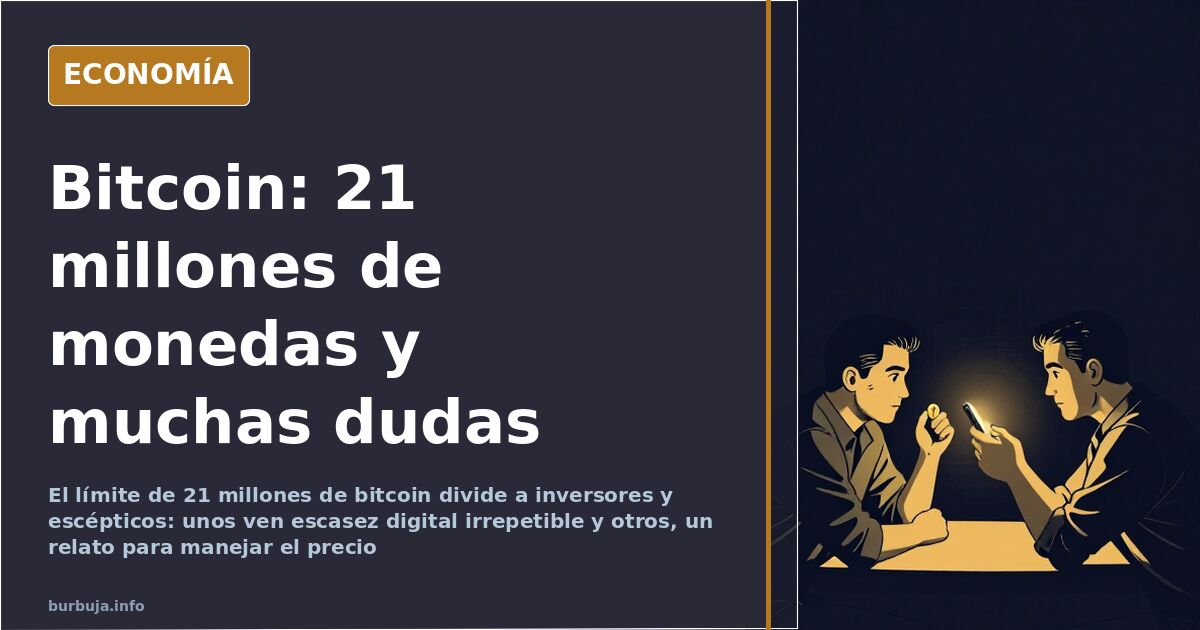
Bitcoin: 21 million digital scarcity or a trap for the gullible
"I was an early adopter of everything since the eighties, except this." This is the confession of someone who trinc bitcoin from day one, let it pass because they were "too busy with other matters," and now recounts it with the resignation of someone looking at an old photo. Around this statement, a controversy has arisen starting with an uncomfortable question about the personal damage left by the crash when those holding the setup pack up. The core issue is more prosaic: are the 21 million bitcoins a mathematical scarcity or a number chosen to sell the narrative?
It is necessary to separate outrage from the data. Bitcoin has been trading for over a decade, bought and sold, and its price has passed—from one participant's calculation—from cents to over 90,000 euros, while the euro's purchasing power declines. What is debated is not whether it exists, but whether its limit is real and if anyone can touch it.
Why the 21 million limit does not convince everyone
The initial argument is that the figure is a whim: it could be 50 million or 5, and whoever controls the game would adjust it to hook buyers. The technical answer is that there is no room for maneuver. The cap comes from halving the mining reward every four years, a pogre that tends to 21 million without exceeding it, and from the 64th halving onwards the reward is zero: not even a billionth of a bit more can be extracted.
Adding decimals does not increase the total, just as adding digits to pi does not make pi a larger number. It is the most cited refutation and also the one that convinces skeptics the least: some see mathematics and others see a faith that requires believing in the code. The middle ground, if it exists, is that technical scarcity does not guarantee that the price will hold.
Can you buy bread with bitcoin?
Here the disagreement is less abstract. One school of thought holds that an asset that cannot pay for food, clothes, a car, or a house cannot have scarcity or inflation in the sense that money does; it would be, at best, a refuge for speculators. The counterargument comes with Visa and Mastercard cards that settle in the currency without the merchant touching it and with a reminder: there are those who hold almost half a unit since 2017 and do not plan to move it.
The discussion shifted to the practical. Paying in bitcoins, withdrawing money to a current account, complying with the Tax Agency, or evading banks that block operations. Here the conversation becomes less philosophical and more domestic: the promise of a currency without intermediaries clashes with the real management of withdrawing it from the system.
Gold, tulips, and the watch bubble
It is argued that in turbulence gold rises and the stock market falls, while bitcoin crashes, and therefore it does not fulfill the refuge function attributed to it. Others return the comparison: the tulip story has been told for ten years and the asset remains standing, inviting a review of the analogy.
The freshest parallel is with luxury watches, whose market peaked in April 2022. People who had never looked at a watch buying by hearsay, week after week, until the pawn shops could not place the stock and the matter crashed. Who paid 14,000 euros for a Submariner retains at least something to show on the wrist; a token does not go on the wrist.
MicroStrategy, US gold, and the institutional path
The numbers moving the narrative are corporate. According to what was spread in the thread, MicroStrategy acquired 55,500 BTC for about 5.4 billion dollars, at 97,862 dollars per unit, and accumulates 386,700 BTC acquired for about 21.9 billion at an average of 56,761 per bitcoin. In parallel, a senator has proposed selling part of the country's gold reserves to buy one million bitcoin.
This is the scenario that the most optimistic consider decisive: if a large state adopts bitcoin as a reserve, the 21 million will seem few. On the other side of the scale weighs that Bill Gates prefers farmland, and that some warn that bitcoin functions as a buffer where excess liquidity goes: when money stops being in surplus, the asset crashes. Nobody disputes that, what nobody knows is when.
Who wins, who sold too early, and who missed out
The emotional residue is the same in all corners. Those who bought at 50 and sold at 100, those who entered at 1,000 and left at 1,500, the few who held on without needing the money. The anger would not come from the asset, but from having exited too early and, according to one participant, from finding blocked accounts where one could previously withdraw without problems.
And there remains the one who stepped aside: the one who trinc it from minute one, had the jewel in front of them, and let it pass day after day. They did not go bankrupt. They just stood watching.
The disconcerting data is small and devastating: someone put in 24 euros when this came out and received 2.45 bitcoins. With the figures discussed in the conversation, that afternoon gesture is now worth more than the salary of several years. The uncomfortable question at the beginning remains unanswered, but the other one—how many regret it—has a clear answer: many.
"I was an early adopter of everything since the eighties, except this." This is the confession of someone who trinc bitcoin from day one, let it pass because they were "too busy with other matters," and now recounts it with the resignation of someone looking at an old photo. Around this statement, a controversy has arisen starting with an uncomfortable question about the personal damage left by the crash when those holding the setup pack up. The core issue is more prosaic: are the 21 million bitcoins a mathematical scarcity or a number chosen to sell the narrative?
It is necessary to separate outrage from the data. Bitcoin has been trading for over a decade, bought and sold, and its price has passed—from one participant's calculation—from cents to over 90,000 euros, while the euro's purchasing power declines. What is debated is not whether it exists, but whether its limit is real and if anyone can touch it.
Why the 21 million limit does not convince everyone
The initial argument is that the figure is a whim: it could be 50 million or 5, and whoever controls the game would adjust it to hook buyers. The technical answer is that there is no room for maneuver. The cap comes from halving the mining reward every four years, a pogre that tends to 21 million without exceeding it, and from the 64th halving onwards the reward is zero: not even a billionth of a bit more can be extracted.
Adding decimals does not increase the total, just as adding digits to pi does not make pi a larger number. It is the most cited refutation and also the one that convinces skeptics the least: some see mathematics and others see a faith that requires believing in the code. The middle ground, if it exists, is that technical scarcity does not guarantee that the price will hold.
Can you buy bread with bitcoin?
Here the disagreement is less abstract. One school of thought holds that an asset that cannot pay for food, clothes, a car, or a house cannot have scarcity or inflation in the sense that money does; it would be, at best, a refuge for speculators. The counterargument comes with Visa and Mastercard cards that settle in the currency without the merchant touching it and with a reminder: there are those who hold almost half a unit since 2017 and do not plan to move it.
The discussion shifted to the practical. Paying in bitcoins, withdrawing money to a current account, complying with the Tax Agency, or evading banks that block operations. Here the conversation becomes less philosophical and more domestic: the promise of a currency without intermediaries clashes with the real management of withdrawing it from the system.
Gold, tulips, and the watch bubble
It is argued that in turbulence gold rises and the stock market falls, while bitcoin crashes, and therefore it does not fulfill the refuge function attributed to it. Others return the comparison: the tulip story has been told for ten years and the asset remains standing, inviting a review of the analogy.
The freshest parallel is with luxury watches, whose market peaked in April 2022. People who had never looked at a watch buying by hearsay, week after week, until the pawn shops could not place the stock and the matter crashed. Who paid 14,000 euros for a Submariner retains at least something to show on the wrist; a token does not go on the wrist.
MicroStrategy, US gold, and the institutional path
The numbers moving the narrative are corporate. According to what was spread in the thread, MicroStrategy acquired 55,500 BTC for about 5.4 billion dollars, at 97,862 dollars per unit, and accumulates 386,700 BTC acquired for about 21.9 billion at an average of 56,761 per bitcoin. In parallel, a senator has proposed selling part of the country's gold reserves to buy one million bitcoin.
This is the scenario that the most optimistic consider decisive: if a large state adopts bitcoin as a reserve, the 21 million will seem few. On the other side of the scale weighs that Bill Gates prefers farmland, and that some warn that bitcoin functions as a buffer where excess liquidity goes: when money stops being in surplus, the asset crashes. Nobody disputes that, what nobody knows is when.
Who wins, who sold too early, and who missed out
The emotional residue is the same in all corners. Those who bought at 50 and sold at 100, those who entered at 1,000 and left at 1,500, the few who held on without needing the money. The anger would not come from the asset, but from having exited too early and, according to one participant, from finding blocked accounts where one could previously withdraw without problems.
And there remains the one who stepped aside: the one who trinc it from minute one, had the jewel in front of them, and let it pass day after day. They did not go bankrupt. They just stood watching.
The disconcerting data is small and devastating: someone put in 24 euros when this came out and received 2.45 bitcoins. With the figures discussed in the conversation, that afternoon gesture is now worth more than the salary of several years. The uncomfortable question at the beginning remains unanswered, but the other one—how many regret it—has a clear answer: many.
Summary of a discussion on Burbuja.info - Foro de economía, actualidad y política., translated from Spanish and reviewed before publication. Read the full discussion (394 replies).
More summaries
-
A 5-Euro Bitcoin Gift Ends Up Worth 2.67
A man distributed 5 euros in Bitcoin to 20 newcomers, but fees reduced the gift to 3.60 euros, peaking at 2.67.
-
Leticia Sabater earns up to €5,000 per gig: the decline of Spain
Leticia Sabater, 59, earns up to €5,000 per gig. Her tacky, provocative show sparks debate on cultural decline and public money.
-
Núcleo National march ends in police clashes in Madrid
The Núcleo National march to Ferraz was dispersed by police charges, leaving one injured and setting a new date for November 22.
-
Police charges in Valencia protest against Mazón
The protest against Mazón over the DANA management ended with police charges and conflicting accounts of who started the clashes.
-
The Hidden Cost of Cars Lost in the Valencia Flash Floods
For many, losing a car in Valencia's DANA is losing their main asset. The debate over insurance and compensation from the Consorcio de Compensación de Seguros.
-
Spain's Porn Campaign Sparks Internet Control and Tax Evasion Debate
Spain launches a porn campaign focusing on internet control and tax evasion, sparking debate over digital ID and sector regulation.